admin
admin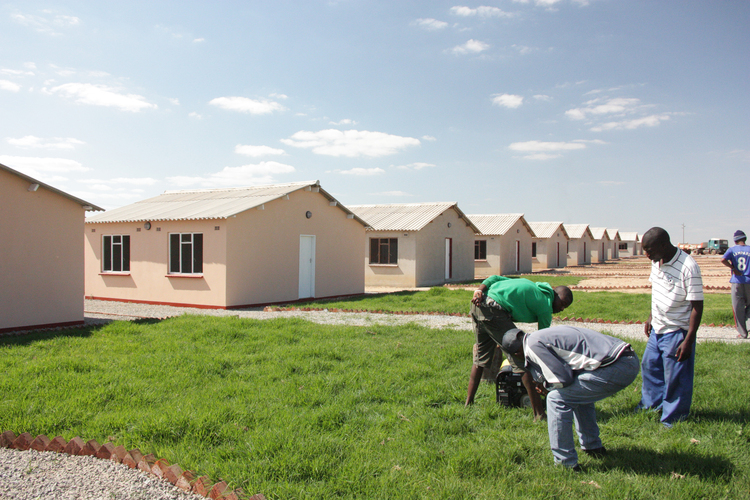

MORTGAGE lenders are beginning to tweak their products in order to force through their facilities to consumers, the majority of whom have been unable to afford them.
Most financial institutions re-introduced mortgage facilities in 2009 to unlock value in the lucrative property sector, but generally low savings and illiquid market conditions have been a major stumbling block.
The country has more than 1,3 million home seekers who are on the national housing waiting list.
However, six years after the facilities came in, low-income earners are still finding the conditions set by financial institutions to qualify for mortgages too steep.
In most cases, initial deposits and interest rates ranging between 15 percent and 18 percent have been considered as both punitive and prohibitive.
Faced with low subscriptions, banks such as ZB Building Society, FBC Building Society, CABS and CBZ have had to downwardly review initial deposits and to restructure their facilities.
Angling for the
informal market
ZB Building Society, which has houses along Twentydales in Hatfield, Harare and housing stands in Beitbridge, is particularly angling for the burgeoning informal market.
Mrs Melenie Gumbo, ZB’s head – group marketing and communications, told The Sunday Mail Business last week that there is need to come up with creative products.
“As a sector, there is need for us to come up with creative products that meet the needs of the informal (sector) and these include mortgages.
Traditional banking tools cannot be applied to this market and hence as ZB we have a strategy that is aimed solely at meeting the needs of the informal sector.
“While we are not yet able to offer informal sector mortgages, we are looking into this area quite closely as we have noted the increased demand for affordable housing,” said Mrs Gumbo.
ZB currently offers 10-year mortgage facilities at interest rates of between 15 percent and 18 percent.
However, to qualify for such facilities an initial 25 percent deposit, as stipulated by the Building Society Act, is required.
While it used to be the norm that mortgage facilities were strictly confined to bank account holders, some building societies are beginning to break from the trend.
And it has proved helpful to CBZ.
The group’s executive-marketing and corporate affairs, Mrs Laura Gwatiringa, said the bank had decided to open up its Nehosho project in Gweru, a development that has improved sales for both houses and stands.
The Nehosho housing projects consists of 1 095 undeveloped low-cost residential stands that have since been serviced.
It is mainly being funded from a combination of external lines of credit from Shelter Afrique and internal sources.
Prices for the housing units range from US$15 000 to US$23 000 and a minimum deposit of 25 percent is also required, which essentially means a prospective home seeker has to cough up between US$3 750 and US$6 250 as initial deposit.
Monthly repayments on the mortgage range from US$200 to US$300.
Gweru City Council has 35 000 people on its housing waiting list.
CBZ’s mortgage interest rates range from 8 percent to 18 percent per annum and rates are primarily dependent on the sources of funding.
In order to maximise the uptake of its products, CBZ has developed three products: Employer-assisted schemes, bank projects and the Cash Plus Housing Savings Account.
Through the employer-assisted scheme, the employer invests money with the bank in return for mortgages facilities for the employees.
Usually the rates are lower and the tenure of the facility can be negotiated.
Also, the Cash Plus Housing Savings Account, which allows account holders to build up their savings in order to qualify for mortgages, seem to be tailored for the informal sector.
According to Mrs Gwatiringa, although the appetite for mortgage finance is “very high”, the market is being affected by “low incomes and limited availability of affordable long-term housing finance”.
“This is further worsened by low levels of income for individuals to qualify for short-term finance.
“Ordinarily mortgages should run for 25 years which currently is not possible,” she said.
But FBC seems to have particularly targeted the middle-income earners.
The bank’s Glaudina project along Harare-Bulawayo Road, where housing units carried a US$130 000 price tag, required a 25 percent initial deposit, which translates to a hefty $32 500.
Unsurprisingly, the uptake of the houses has been “very good”.
FBC Holdings’ head — group marketing, Ms Priscilla Sadomba, told The Sunday Mail Business last week that all the 36 units under the Masotsha Ndlovu phase one and two (Waterfalls) have been sold.
About 36 units – also in Waterfalls – are now being sold under phases three and four.
In addition, FBC has 157 units in Kwekwe’s Mbizo 9 Extension.
The need to promote savings
Ms Sadomba said the mortgage lending requires long-term funding, which, unfortunately, is presently not available.
Of the US$5 billion in local bank deposits, more than 90 percent is transitory.
In the past, there were long-term investment vehicles such as Paid Up Permanent Shares (PUPS) under which building societies would harness long-term funding for onward mortgage lending.
“These instruments need to be resuscitated and there is need to inoculate a culture of savings within our populace no matter how small the income might be.
“The credit lines that are being accessed by local financial institutions are (also) expensive as they are generally landing in double digits (so), there is need for local financial institutions to engage the financiers to lower the cost of funding.
“There is also need to lower the conveyance fees to make it affordable for the ordinary person to register mortgage bonds and transfer title,” said Ms Sadomba.
CABS, which formed a tie-up with the Harare City Council to offer houses for first-time home owners, is one of the companies that was affected by disaffected consumers.
And the building society seems to have balked.
While housing units were pegged between US$21 000 and US$27 000 for the project, which attracted initial deposits between US$5 800 and US$7 258, this has since been markedly reviewed.
Initial deposits now range from US$2 200 and US$2 700 for two-roomed and four-roomed housing units, respectively.
The project is now not confined to first-time home owners.
About 3 500 housing units are expected to be constructed by CABS and City of Harare.
On the overall, it seems that most of the facilities are limited to a 10-year tenure.
A 25-year year period is usually considered as ideal. In the 2015 National Budget, Finance and Economic Development Minister Mr Patrick Chinamasa indicated that some investors had shown interest in providing mortgage funds that will be secured through securitisation of existing mortgage bonds.
In order to incentivise provision of new additional mortgage financing, Government waived stamp duty on cession of mortgage bonds with effect from January 2015.
The measure was expected to enhance availability of resources towards financing the national housing programme.
It is generally believed that the market will determine when mortgage charges will be reduced.
Some building societies have even resorted to reviewing their interest rates every quarter.



 Online Reporter