

 Online Reporter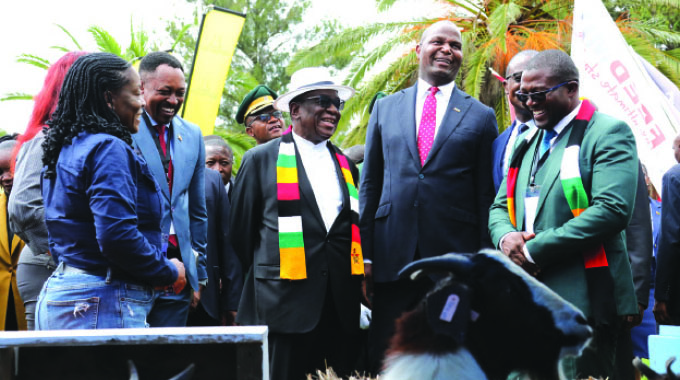
Vusumuzi Dube
“MOZAMBIQUE is Zimbabwe and Zimbabwe is Mozambique. We are one!”
A statement echoed multiple times by Mozambican President Daniel Francisco Chapo in his keynote address at the official opening of the 65th edition of the Zimbabwe International Trade Fair (ZITF) in Bulawayo yesterday.
The visiting Mozambican leader was the Guest of Honour at the country’s oversubscribed premier trade and investment expo.
He emphasised that the two neighbouring states not only share a border, but also possess deep-rooted political, economic and cultural ties dating back to the pre-independence era.
Speaking in Portuguese with the aid of an interpreter, President Chapo spoke at length about the relationship between the two countries, and urged further improvement to achieve mutually beneficial trade and foreign direct investment flows.
“It’s a fact that co-operation with the Republic of Zimbabwe has great significance for Mozambique, not only because of the sharing of common borders, but also because of the deep historical ties of political, economic and cultural coexistence, which date back to the times of the national liberation struggle which, over the decades, have translated into active and mutual support in the defence and consolidation of our sovereignties and have crystallised in close co-operation at bilateral, regional and continental levels,” said President Chapo.
“Our presence at this important Fair represents our determination to boost and facilitate trade between Mozambique and Zimbabwe in particular, and with the world in general, as well as to attract foreign direct investment from Zimbabwe and the countries represented here in the agriculture, industry, transport and logistics sectors, among other sectors.”
He said the cordial bilateral relations between the two countries should stimulate higher commercial gains through economic complementarity and the creation of economies of scale leveraging available natural resources, existing infrastructure and logistical means, with emphasis on the Beira Corridor.
President Chapo noted that ZITF 2025 was being hosted just a few days after the celebration of the 45th anniversary of Zimbabwe’s Independence Day, similar to Mozambique’s scheduled hosting of the 60th edition of the Maputo International Trade Fair, which takes place from August 25 to 31 this year.
The neighbouring country will be celebrating 50 years of its independence, marking a point of intersection between the two countries.
President Chapo said despite the geographical proximity, the immense natural and strategic resources yet to be explored, and the historical political ties of friendship between Zimbabwe and Mozambique, trade relations and investments are still incipient and consist of low value-added products, mostly commodities, and with no record of any notable change in their structure or composition over the last few years.
“This can be seen in the data we present below, in terms of the trade balance and foreign direct investment flows. Our participation in this event has the central objective of gathering the experiences of the main stakeholders and interested parties in the industrial, agricultural, transport and logistics sectors, with emphasis on farmers, agribusiness operators, policy makers and international organisations, with a view to promoting economic recovery, innovation and the sustainability and resilience of the agricultural, industrial, transport and logistics sector for the benefit of our private sector, communities and the country in general,” he said.
President Chapo revealed that Zimbabwe has been part of the traditional foreign investors in Mozambique for the last three decades, having reduced its participation in recent years, motivated by the well-known challenges that afflict not only Zimbabwe but most countries in the SADC region and the African continent in general.
“Between 2015 and 2024, 37 projects were approved, which could create 1 649 jobs, involving private investors from Zimbabwe, for a total value of around US$120 million, of which the equivalent of around US$35 million was direct investment,” he said.
Zimbabwe’s investment, President Chapo said, was directed at 31,70 percent in the aquaculture and fisheries sector, in second place, the tourism and hotel sector with 23,49 percent of the approved investment and, in third place, the industry sector with 21,10 percent.
“Therefore, in terms of private investment, between our two countries, we noted with satisfaction the presence of foreign direct investment from Zimbabwean companies in Mozambique, which, although modest, expresses the willingness of businesspeople from our countries to explore intra-African investment opportunities,” said the Mozambican leader.
He further noted that the two nations had vast natural resources, which they could each exploit to boost their individual economies.
“Zimbabwe has enormous reserves of natural resources, with emphasis on arable land, forests and wildlife reserves, known worldwide, such as Victoria Falls, strategic mineral resources such as gold, lithium, copper, among others that contribute to the positioning of its economy as an economic power and source of foreign direct investment in the region, without leaving aside the role of breadbasket of the region and the continent that it played in the past,” said President Chapo.
Mozambique, like Zimbabwe, he said, has immense reserves of soil and subsoil resources, including 35 million hectares of arable land, availability of water, natural gas, various types of minerals, a long coastline and logistical infrastructure that facilitates access to the sea for hinterland countries in the SADC region.
“All investors from Zimbabwe and other countries who decide to invest in Mozambique in the various sectors, particularly agribusiness, industry, energy, tourism and hotels, infrastructure, transport and logistics, benefit from the availability of untapped resources.”
Turning to the ZITF experience, President Chapo said the platform was critical in promoting opportunities for cooperation and exchange in key economic areas of agriculture and agribusiness, industry, transport and logistics.
“We live in a globalised world, characterised by growing multilateralism in political and economic relations in the international arena, where economic diplomacy plays a fundamental role,” he said.
“Our presence at this prestigious business event is part of this constant search to strengthen our economic diplomacy from a bilateral and multilateral point of view.
“Our participation in this event also provides us with a platform for promoting and facilitating business partnerships and investments for companies and investors from both countries, interaction between members of both Governments for the promotion and facilitation of cross-border trade and investment, as well as the creation of a platform for exchanging information on business between Mozambique and Zimbabwe,” said President Chapo.


