Chronicle Editor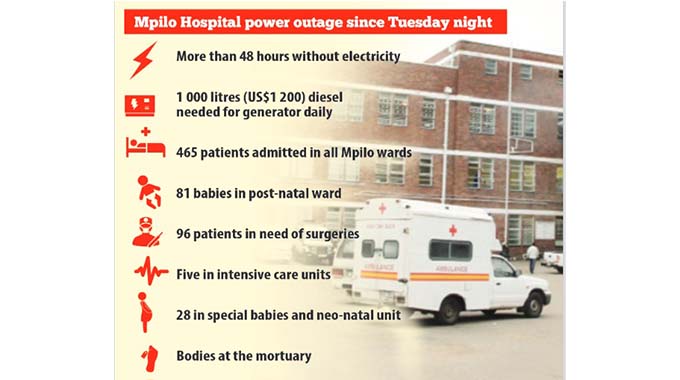
Thandeka Moyo-Ndlovu, Health Reporter
THE country’s second largest referral health institution, Mpilo Central Hospital in Bulawayo, has been without electricity since Tuesday.
The erratic power supplies have often damaged valuable life-saving equipment at the institution thereby putting the lives of patients at risk.
The 900-bed hospital caters mainly for the southern region which covers Bulawayo, Matabeleland North and South as well as Masvingo and Midlands provinces.
Patients were left in darkness on Tuesday evening, forcing authorities to divert their meagre resources to buying fuel for the generator.
Mpilo also relies on electricity for water supply and has been struggling to provide fresh water to 465 patients.
This development comes amid reports that the ward for patients under Covid-19 investigations is filling up as more cases are being detected in Bulawayo.
Mpilo Central Hospital patients, staff and visitors are at a risk of contracting Covid-19 due to lack of water to regularly clean hands.
Lack of power has also affected the hospital mortuary and there are fears the bodies may start rotting if the situation is not addressed soon.
Affected patients include 96 who are admitted to surgical wards awaiting operations which cannot be done without continuous power supply.
A total of 18 pregnant women are in the labour ward awaiting delivery and some might require Caesarean section.
In the past power cuts have led to the break down of radiotherapy machines thereby putting the lives of cancer patients at risk.
Radiotherapy treatment involves using high doses of radiation to kill cancer cells and shrink tumours and it also damages the DNA within cancer cells.
Health experts say radiotherapy is the only effective way to treat cervical cancer which accounts for more than a third of cancers from the southern region.
Cervical cancer is fast overtaking HIV as a killer disease and more than three quarters of women seeking cancer treatment at Mpilo have stage three cancers.
At this stage, the cancer would have advanced so much that it is virtually incurable.
Stage three and four cancers require palliative treatment which is only meant to treat symptoms or ease pain until the patient dies. If diagnosed early, at stage one or two, there are chances of complete recovery.
Cancer patients should access treatment regularly to stop the cells from multiplying which often leads to difficulties in treatment or deaths.
In an interview yesterday, acting Mpilo chief executive officer Dr Xolani Ndlovu said the issues of electricity outage has always compromised the lives of patients.
He said since Tuesday, Mpilo is spending US$1 200 on fuel daily for its five generators.
Dr Ndlovu said there were 28 babies in the special neo-natal unit who cannot afford to be out of the incubators.
“In the past we were connected to two sub-stations such that if there was a problem on one line we would be supplied with electricity from the other line. Of late, particularly this year, we have had rolling power cuts and this compromises our service provision in a big way,” said Dr Ndlovu.
He said the hospital water reservoirs are underground and therefore the pressure from the Bulawayo City Council water is not enough to supply all areas of the hospital.
“We need electricity to pump the water to the other areas of the hospital so if there is no power we cannot supply water to all areas,” he said.
He said Mpilo was owed millions by residents which meant the hospital cannot afford to pay for an alternative source of power.
“At Mpilo we do not turn away patients because historically this hospital was created for residents from the western side of this city who may not always have the means to pay for health care services. Yes, we do have patients who must pay upfront for elective procedures but we have under-fives, over 65 and maternal services which are free of charge,” said Dr Ndlovu.
Contacted for comment, Zesa’s acting western region general manager Engineer Lloyd Jaji said his team was working flat out to restore power at Mpilo.
He said the extended outage was due to the falling of poles which were submerged in water given the hospital has lots of water underground.
“We are in the process of restoring power at the hospital. We delayed to restore power at the hospital because the place has too much water and it affected our maintenance. We are aiming to restore power by tonight and the other significant affected places are out of town and due to the slippery roads, there might be delays in reaching affected areas,” he said.
Eng Jaji said the greatest challenge was the theft of copper cables and appealed to members of the public to desist from vandalising Zesa infrastructure as this was adversely affecting service delivery. — @thamamoe


 Online Reporter