Online Reporter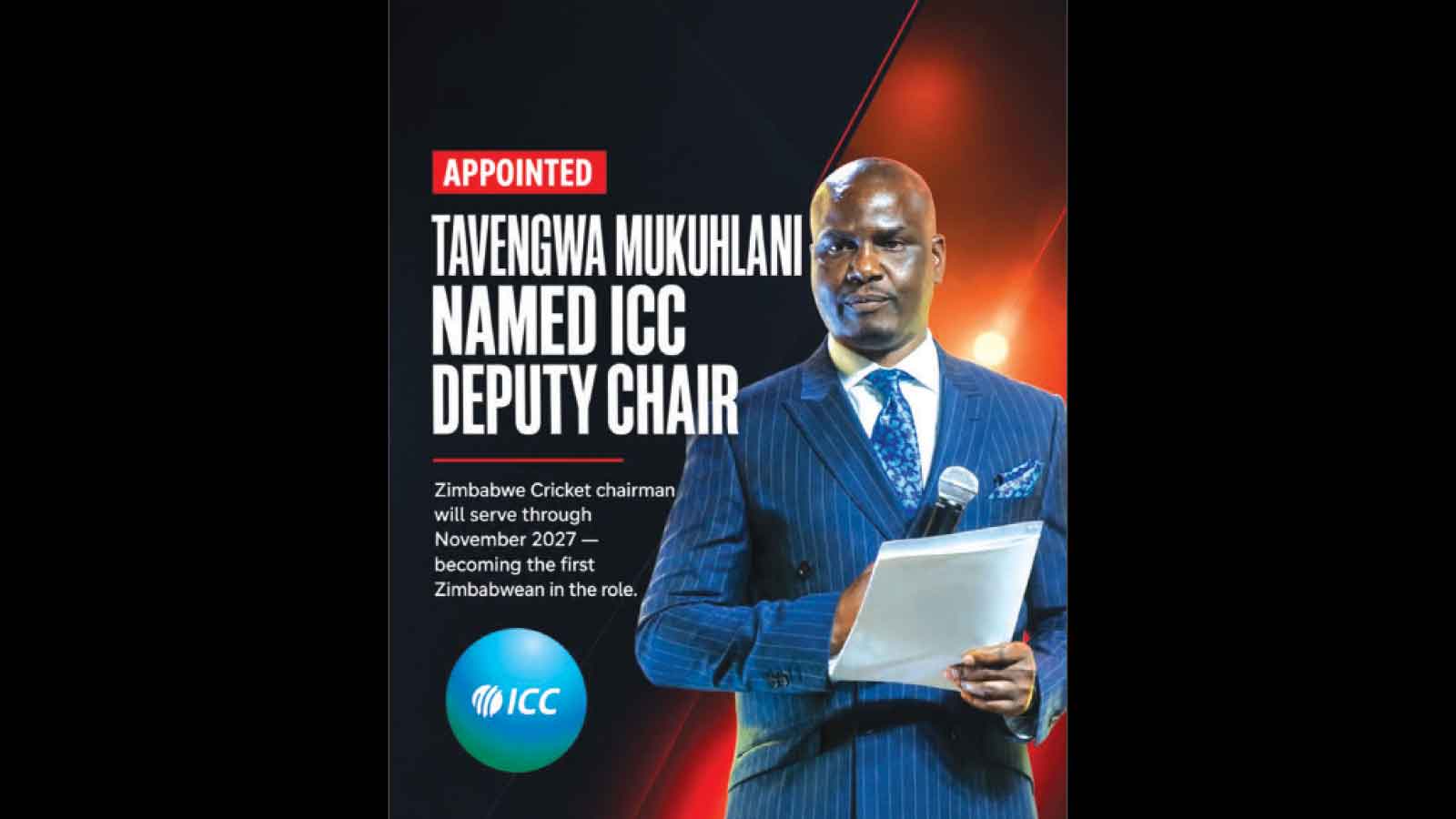
Don Makanyanga-Zimpapers Sports Hub
FOR Tavengwa Mukuhlani, the moment he learned he had been appointed International Cricket Council (ICC) deputy chairperson was not met with celebration alone.
It was a moment of reflection.
The Zimbabwe Cricket (ZC) chairperson had expected the nomination process.
He understood that his name was in the frame.
But even with that knowledge, the reality of becoming the first Zimbabwean to occupy one of the highest offices in world cricket carried an emotional weight he had not fully anticipated.
“I never imagined that I would be the deputy chairperson of the ICC,” he said in an exclusive interview with Zimpapers Sports Hub.
“But I was somehow a bit mentally prepared because there’s a nomination process.
“I had a very humbling feeling, very humbling feeling. It was emotional.”
On September 17, the ICC confirmed Mukuhlani as its deputy chairperson until November 2027, making him the first Zimbabwean to occupy the position.
He succeeds Imran Khwaja and takes the role at a particularly significant moment, with Zimbabwe preparing to co-host the 2027 Men’s Cricket World Cup alongside South Africa and Namibia.
For Mukuhlani, the appointment is not the beginning of the journey. It is the latest chapter in a story that began long before the ICC boardroom.
And remarkably, he insists it was never a journey he mapped out.
“If you had asked me when the year began in 2026 that do you see yourself as vice chairperson of the ICC — no. I never imagined that would happen,” said the ZC chairperson.
That admission captures something central to Mukuhlani’s rise.
His career has been shaped less by a carefully constructed route to the top than by a succession of opportunities, difficult assignments, relationships and moments when he happened to be in the right room.
“I found myself at the right place at the right time. And certain things falling into place,” he added.
Long before he was ZC chairperson or an ICC board member, Mukuhlani was introduced to international cricket administration by one of the country’s most influential administrators, Peter Chingoka.
Chingoka did not simply introduce him to the structures of ZC; he exposed him to the international game.
“Peter Chingoka, when he was chairperson, he would take me to ICC meetings even before I was his deputy.
“So, he introduced me to the national cricket administration at an early age,” recalled Mukuhlani.
Those early visits gave Mukuhlani a first-hand view of international cricket governance while he was still finding his feet in administration.
The next stage came through provincial cricket.
“I was also thrust into local administration, provincial administration, quite early,” he said.
One of the defining moments was his appointment as the first black chairperson of Mashonaland. It was another opportunity he had not necessarily been expected to receive.
Other candidates were initially in line for the position, but when they did not take it up, Mukuhlani found himself in the room when the issue was being discussed.
“. . . I happened to be in the meeting where the conversation was taking place,” he said.
Then came an unexpected suggestion.
“So, obviously, it will not make sense to a lot of people because we have different sets of values but in administration, I believe you need God, because you can’t make yourself,” said Mukuhlani.
“I will tell you why I’m saying that. When I became the first black chairperson for Mashonaland, I was not the person that was supposed to be the chairperson.
“It only happened that the three people that were supposed to take the post were not there before Ozias Bvute and Macsood Ibrahim then turned to the three guys and said, ‘Why don’t you take him?’”
That decision became another step towards the national stage.
By the time Mukuhlani became chairperson of ZC, the organisation was facing some of the most difficult years in its history.
Financial problems, institutional tensions, World Cup qualification disappointment and periods of suspension involving Zimbabwe’s sports authorities and the ICC tested the administration.
Mukuhlani looks back on those years as an education.
“I think I would say the last 10 years have made me battle-hardened.
“I have seen the worst for Zimbabwe cricket coming out of a US$27 million debt, failing to qualify for the World Cup, getting suspended by the Sports and Recreation Commission and getting suspended by ICC.
“Seeing changes even at ICC. This has been a great internship,” he said.
Mukuhlani joined the ICC board in 2015 after becoming ZC chairperson, but his arrival at the global table came at a time when Zimbabwe’s standing in international cricket was under pressure.
His recollection of his first experience at the ICC illustrates how different Zimbabwe’s position was then.
“I recall that in my first time there, I was not even given a permit to sit on it. It goes to show how we were viewed as a member,” said Mukuhlani.
A decade later, the contrast is striking.
“I think it speaks a lot in terms of where the country has moved from and what we have done as a country to the game of cricket.”
His time on the ICC board subsequently exposed him to a wide range of areas within the organisation, including finance, human resources, development, nominations and the Olympics Working Group. He serves on the ICC Finance and Commercial Affairs Committee and Nominations Committee and chairs the HR (human resources) and Remuneration Committee.
The experience, he says, has been invaluable.
“I have had the privilege of sitting on the finance committee, chairing the HR committee, sitting in the first Olympics Working Group, development committee, and now I’m in the Nominations Committee. I’m also in the Olympics Working Group.
“And I think every appointment to the committee must be aligned with the strategic view of the chairman. At a personal level, you get to understand the ins and outs of ICC. Being in various committees in the last 10 years that I’ve been on the board, it has been a great asset,” he said.
Mukuhlani does not claim those assignments were deliberately designed to prepare him for the ICC deputy chairperson position.
“Whether the chairperson was preparing me for this, I wouldn’t know,” he said.
His rise also brought relationships with influential figures in global cricket.
“I had a good relationship with Shashank Manohar, I had a good relationship with Jay Shah and my peers around the board,” he added.
But Mukuhlani is reluctant to reduce his journey to connections or timing. His philosophy is rooted in patience.
“First, number one, you need God. Number two, you have to be very patient. There are times when it looks like it’s your turn, but it’s actually not your turn, and you need to be very patient and to speak less and listen a lot and give yourself time to learn,” he said.
As chairperson of the Africa Cricket Association, he has increasingly focused on how the continent can expand its cricket footprint and create meaningful pathways for countries outside the traditional cricket centres.
“I hope I will be able to use my position as deputy chair to try and influence that direction. But I am alive to the fact that there are other priorities as well in the organisation,” he said.
“It’s a process. I appreciate resources are far stretched. But I think continental bodies have a role to play. Asia Cricket Council, the European Community and Africa, they have a role to play in the development of upcoming countries.”
“And as I mentioned, Asia Cricket Council, if you look at countries like Nepal, it’s now a force to reckon with,” he said.
That thinking has informed his push for more meaningful cricket between African nations.
Zimbabwe, South Africa and Namibia recently played a landmark T20I tri-series, a competition Mukuhlani sees as part of a wider effort to create regular high-level cricket on the continent.