Chronicle Editor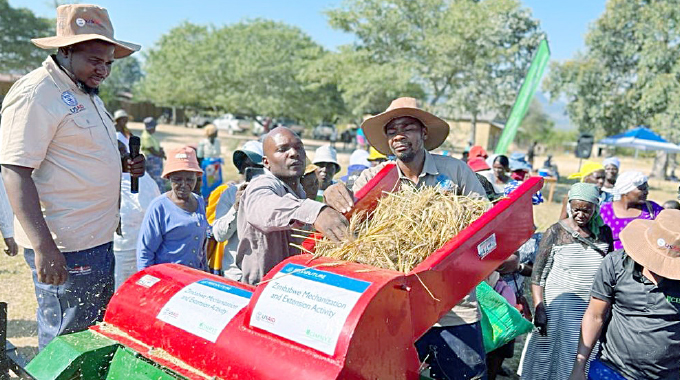
Judith Phiri, Features Reporter
IMAGINE craving for a traditional meal and the first thing on your mind is isitshwala samabele and relish. You go to a place where traditional food is sold, but you can barely eat the sorghum meal because of its texture; it’s too grainy and has a gritty taste. Not only are you turned off and lose your appetite but you also feel you have wasted the little money you had. Worst yet the hunger still persists.
In most instances, this happens because of the way small grains are processed through an arduous task of manual threshing using sticks. The threshing is a sophisticated process that uses a variety of low-tech implements and tools, each with a very specific function suited to the various stages. The branches of specific trees that grow in a particular area are sourced beforehand.
“During the threshing, we use brooms to sweep back scattered grains. We also playfully turn the small grains with our feet to bring the heads that are lying at the bottom to the top to make it easy for the threshers to beat them,” explains Ms Sizalokuhle Moyo from Maphisa in the sprawling Matobo District of Matabeleland South Province.

A significant number of rural women farmers bear the brunt of taking care of their families. Besides the house chores and travelling long distances to fetch water, when it’s farming season, women play a leading role during planting and harvest times.
Ms Moyo said during the threshing process, there is grain spillage, incomplete separation of the grain from chaff and grain breakage due to excessive striking.
Women have often been at the forefront of processing small grains by the laborious task of manual threshing using sticks.
They repeatedly beat the heads of small grains on hard surfaces, such as granite or hard clay, to separate the grains. Despite efforts to minimise contamination by threshing them in sacks or on plastic sheets, the gritty taste is hard to eliminate.
Even through winnowing, roasting and milling, this would do little to eliminate tiny soil and stone particles from the final product as physical separation is challenging.
However, a solution has been found as the locally made, affordable multi-crop thresher comes in to offer a convenient post-harvest processing option for smallholder farmers, especially women.
The development has taken the agriculture sector to a whole new level, lessening the burden on women so that they spend less time processing small grains after harvests and more time on house chores and taking care of the family.

The multi-crop thresher is a scale-appropriate machine, which offers a smarter and less strenuous way to produce high-quality small-grain meals, including in drought-prone regions, without being contaminated with sand or stone particles.
The innovation was introduced by the Feed the Future Mechanisation and Extension Activity, implemented by International Maize and Wheat Improvement Centre (CIMMYT) and funded by the United States Agency for International Development (USaid), to address the challenges of traditional small grain processing and offer new market opportunities to farmers.
In an interview, agronomist consultant, Mr Leo Maphosa who is the founder of CropTech Systems, said small grains production and consumption in Zimbabwe has traditionally been key to the agriculture sector.
“Traditional grains play a crucial role in Zimbabwe’s agricultural sector, contributing to food security, nutrition and sustainable livelihoods. In terms of the agro-ecological regions in the country, farmers in ecological regions one and two grow crops such as maize, sunflower, sorghum, pearl millet, groundnuts, African peas and sugar beans.
“In natural region three, farmers grow crops like maize, sorghum or sunflower, sorghum, pearl millet, groundnuts, African peas and sugar beans. Farmers in regions four and five grow sorghum, millet and sunflower. They also have the option to choose from maize, African peas and ground nuts,” he said.
Mr Maphosa said the coming in of the new technology would ensure that the sand content and gritty texture, often associated with sorghum or millet meals, will be reduced as this would often lead to reduced interest in mealie-meal from small grains.
He said this was because of the traditional method of manual threshing on the soil, which was also a strenuous and time-consuming process that incorporates sand and gravel particles into the threshed grains (and then into flours and mealie-meal), resulting in an unpleasant eating experience.
According to CIMMYT, the multi-crop thresher is powered by an eight HP diesel engine.
Mechanisation specialist and technical lead of the Mechanisation and Extension Activity, Abdul Matin, said the multi-crop thresher is the perfect machine to process sorghum, millets, maize (husked or un-husked), wheat, cowpeas, sugar beans and soybean.
“It is made in Zimbabwe and designed to promote mechanisation as a business as it can easily be transported. It has high threshing efficiency, fuel-efficient, easy to operate and women-friendly.”
Mr Matin said the operator simply feeds the crop into the in-let hopper and as it passes through the threshing drum, the machine efficiently separates the grain from the chaff, releasing clean grain through the outlet chute.
He said the thresher would help reduce the decline of small grain production in the country and complement Government efforts to expand its cultivation in natural regions four and five.
“When operating the machine efficiently, one can thresh up to 0.5 tonnes per hour for small grains. The multi-crop thresher has been viewed as a vital component of climate-resilient agriculture, CIMMYT organised awareness meetings, including the 2023 Seed and Mechanisation Fairs, for farmers to witness the speed and quality performance of the multi-crop thresher. They could also assess the quality of pearl millet processed using the thresher and others threshing wheat in an irrigation scheme showcasing the efficiency of the process and improved grain quality,” said Mr Matin.
Speaking at the recent one-day Zimpapers Traditional Grains Conference organised by Sunday News in Bulawayo, Agricultural Engineering, Mechanisation, Farm Infrastructure Development and Soil Conservation chief director, Engineer Edwin Zimunga said mechanisation is critical in every part of agricultural processes.
“When planting small grains, there is a common denominator of mechanisation, the same goes for weeding, harvesting and the processing.
Mechanisation and equipment are important. Do we need to continue using sticks or now we need to have more modern machinery?
“Ultimately, when you then look at that agricultural factor on productivity, we have also been trying to say as Government, what do we need to do especially because we have adopted what we call agro-ecological tailoring in terms of agriculture,” he said.
Eng Zimunga said there is a need to get the common denominator right, which is mechanisation and equipment to positively contribute to the growth of the sector.
He said when he joined the Ministry of Lands, Agriculture, Fisheries, Water and Rural Development, the mechanisation development index was around 13 percent.
“Deliberately, we have had to bring in what we call strategic investments in that common denominator to make sure that we try and push production and the productivity levels. It’s indeed beginning to show the benefits from 13 percent mechanisation development index, as a country, we now stand at about 42 percent overall,” he said.
Eng Zimunga, however, said it was worrying that the same index for traditional grains was still hovering around 16 percent.
“There is a need to take another look, from a strategic investment level and see what can be done to push for small grains mechanisation and equipment investments.”
The southern regions of Zimbabwe — particularly Matabeleland North and South, Midlands and Masvingo — are ideally suited for cultivating traditional grains such as sorghum and pearl millet, in line with their climatic and ecological profiles.



 Online Reporter