Online Reporter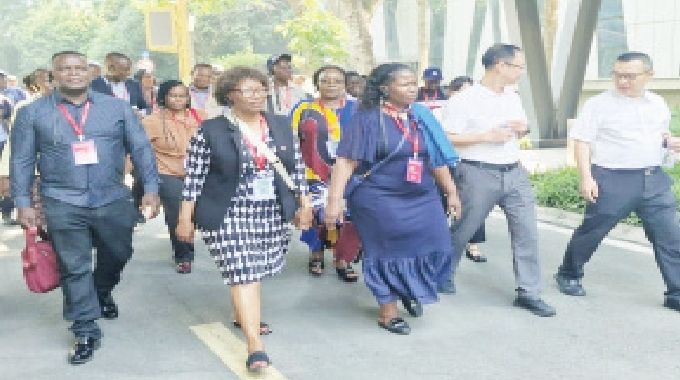
Vusumuzi Dube in CHENGDU, China
ZIMBABWE is deepening economic and development co-operation with China, with infrastructure development, railway modernisation, energy, skills transfer and mineral beneficiation emerging as key areas of potential partnership between the two countries.
The opportunities were highlighted during a series of industrial visits by senior Zimbabwean Government officials attending the Ministerial Seminar for Senior Public Management Officials of Zimbabwe in China, organised by the Academy for International Business Officials (AIBO), an institution under China’s Ministry of Commerce.
Leading a delegation on a tour of the China Railway Rail Transit High-Tech Industrial Park and China Railway Number 2 Engineering Group Company in Chengdu, Public Service, Labour and Social Welfare Deputy Minister Mercy Dinha said Zimbabwe was keen to translate its longstanding relations with China into practical development partnerships.
“This visit is a significant milestone in our ongoing efforts to deepen the comprehensive strategic partnership between Zimbabwe and China, a bond built through a deepened and shared history and mutual support,” she said.
Deputy Minister Dinha said Zimbabwe saw significant opportunities for cooperation with Chinese companies in the rehabilitation and modernisation of transport and energy infrastructure, as well as technology and skills development.
The railway sector emerged as one of the key areas for collaboration as Zimbabwe seeks to restore a network that has been operating significantly below its historical capacity.
“Our current rail network carries less than 50 percent of its peak volume, severely constraining our economic transformation agenda. Reviving the railway network is therefore central to Government’s efforts to expand trade, improve transportation efficiency and strengthen Zimbabwe’s position as a true regional economic hub,” she said.
She said Zimbabwe was looking beyond simply rehabilitating existing railway lines and was seeking partner-ships capable of supporting the modernisation of the entire rail system.
“We seek partnership to modernise our rail lines, upgrade signalling systems, supply new locomotives and wagons, and construct new strategic connections,” said Deputy Minister Dinha.
The delegation was exposed to the engineering and construction capabilities of China Railway Number 2 Engineering Group Company, with Dinha describing Chinese railway engineering firms as potential strategic partners in Zimbabwe’s infrastructure development programme.
“We value your expertise and see you as a key partner in building modern, efficient rail systems that save our people and our industries,” she said.
She added that improved railway infrastructure would strengthen the movement of people and goods, support industrialisation and enhance Zimbabwe’s participation in regional trade.
“Leadership at China Railway Number 2 Engineering Group Company, I say Zimbabwe is ready. We look for-ward to a productive exchange today and to deepening our cooperation in the years ahead,” she said.
Beyond transport infrastructure, the officials also explored opportunities arising from Zimbabwe’s rapidly expanding lithium industry during a tour of Chengxin Lithium Group in Chengdu.
Public Service Commission Commissioner Rosemary Rubvumo Mukogo, who is also a board member of the Minerals Marketing Corporation of Zimbabwe (MMCZ), said the country’s lithium sector was becoming increasingly important to economic development.
She said the value of lithium in Zimbabwe had increased by 413 percent in 2026, demonstrating the growing contribution of the mineral to the national economy.
“Six years ago I didn’t know that we have lithium that will be contributing so much to our Gross Domestic Product,” she said.
Chengxin Lithium Group has invested in Zimbabwe through the Sabi Star Lithium Mine in Buhera, contributing to employment and economic activity in the area.
Commissioner Mukogo said Zimbabwe welcomed the investment, particularly the company’s focus on beneficiation and value addition rather than the export of raw minerals.
“We are proud to host your investment through Sabi Star Lithium mine in Buhera and are grateful to the jobs and economic activity you bring to our communities. We are especially proud in the areas of beneficiation where instead of exporting raw you are looking at beneficiation and adding value,” she said.
She said this approach was aligned with Zimbabwe’s National Development Strategy 2 and Vision 2030, which seek to increase value addition, strengthen local processing capacity, create employment and develop indus-tries around the country’s natural resources.
The industrial visits therefore provided the Zimbabwean delegation with practical insights into China’s infra-structure, engineering and mineral-processing capabilities, while creating opportunities to identify areas where Chinese expertise and investment could support Zimbabwe’s development agenda.
Deputy Minister Dinha said the lessons from China were particularly relevant as Zimbabwe implements its National Development Strategy towards Vision 2030, with infrastructure development and capacity building remaining critical priorities.
“We are deeply impressed by the group’s expertise in engineering and construction, sectors that are critical in Zimbabwe’s structural and economic transformation,” she said.
She also emphasised the importance of ensuring that cooperation goes beyond the construction of infrastructure and investment in resources to include technology transfer and the development of local technical capabilities.
“China’s commitment to sharing knowledge and expertise aligns perfectly with our aims of developing a high-skilled workforce,” said the Deputy Minister.
The engagements also build on the outcomes of the Forum on China-Africa Cooperation (Focac), particularly the 10 partnership actions aimed at supporting Africa’s development priorities.
She said Zimbabwe was committed to creating an environment conducive to investment and partnerships between Zimbabwean and Chinese companies and institutions.
“We reaffirm the Government of Zimbabwe’s commitment to fostering a conducive environment for investment and partnerships,” she said.