daniel chigunwe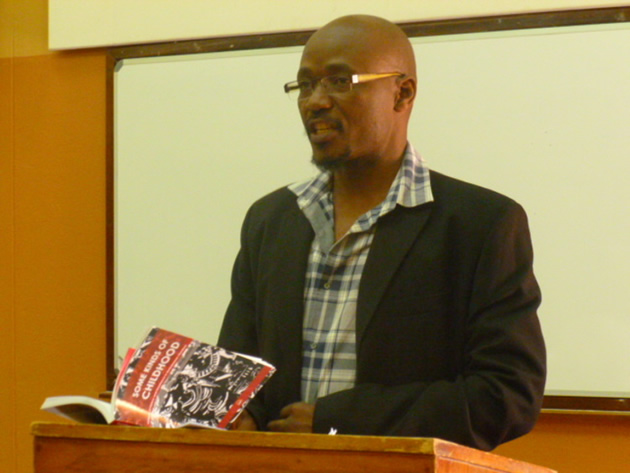
Robert Muponde’s “The Scandalous Times of a Book Louse: A memoir of a Childhood” (2021), published by Penguin Random House South Africa, ticks all the right boxes on the essence of biography or autobiography, and what constitutes an inspirational story.
For biography inspires, teaches, admonishes, questions, instils discipline and encourages honesty.
Muponde has mastered the autobiographical mode in such a reflective way that reading any other book after his memoir, less inspirational and rushed, would be burdensome.
He has set the bar too high.
Humanity can ride on the crest of the successes of subjects of biographies, like Muponde, through understanding of how they rise above the torrential tide against them, by masking their doubts, persevering, inspiring self- confidence and fighting back.
The memoir attracts multiple readings.
It can be read as a bildungsroman, a pastoral novel, or a historical novel. Both the lay reader and the academic can draw a lot from the raconteurs in the memoir.
The book also unlocks the enigmatic Ronald Guramatunhu, a particular character that pervades the author’s fictional experiences.
Another intriguing character in the memoir is Akizha.
Gosh; the beautiful Akizha is Muponde’s cousin, who inspires him to write when she says to him, “Sekuru, when you write books thighs will open before you like a newspaper in the wind.”
Raped and impregnated at 11, Akizha endures hell in the form of her tormentor-husband, 21-year-old Julius, for two years, until she decides to end her ordeal.
The femme fatale of the village and township, she is described as “attractive like a well-kept cemetery.” She “can tell who is to be killed in a fight for her,” relishing talking to the victim, and letting him “enjoy the privilege to proof-read his own obituary”, like one “unveiling someone’s tombstone before they have died.”
Having survived wild fires and storms, she is endowed with a body “that made big men cry like just weaned babies.”
Such is Akizha’s intangible and mysterious power. She gives back to men whatever they implanted in her through their phallic eccentricities: softly, sensually, passionately, coldly and brutally.
Such also, is Muponde’s forte — metaphor, imagery and symbolism, which he morphs into the ordinate and inordinate alike.
That way he creates characters whom the reader feels like hugging, caressing, haggling with, kissing or strangling.
Simply masterful, the author’s use of the conventional setting hoists the reader onto a therapeutic pedestal, or infectious nostalgia, depending on the mood.
Like Shimmer Chinodya, Muponde effortlessly takes the reader into his space through reflection on shared experiences. He has a way of telling his own story in a manner that makes it become our story; yours and mine.
The intellectual-artist draws you into his storms, with such astounding ease that leaves you aghast. He nostalgically takes you back and forth along his time travails.
Muponde has a way of drawing the reader in, making him locate himself in the many physical, emotional and psychological sites that the fictional experiences depicted bring forth.
He runs riot with your experiences as if they were his own; or well, he tells his story as if he were telling yours. He has a way of drawing the reader in.
A great storyteller, Muponde carries hilarity beyond the story. Having mastered the art of audience involvement in storytelling, he becomes the story, the mirth and the connection. He has a way of making an old story refreshingly new by turning a phrase or two. Words are — they bring human endeavour, toil and experience to life.
Indeed, even though a story of life endures, it should not be left until life’s end for it to be told.
I have had the honour to be imparted on by such great storytellers; my late brother Andrew, my late grandmother Violet (known as VaVhariyeta by her legion of admirers) and my mother, the Queen.
They had unique signatures.
Having had my eye for a good story sharpened by three storytellers of repute, and knowing how a story behaves in the hands of such narrators, I knew I was a participant in Muponde’s memoir; his story.
“KwaTsimba has made me think about how the story of leaky and bookless legacies is a powerful refrain in the fate of most of my kith and kin.
“So when I started writing this story of stories, and remembering with these stories, it was not in order to retell but remain alive in things long vanished,” reveals Muponde in his latest offering, “The Scandalous Times of a Book Louse: A memoir of a Childhood”.
Because of an entrenched bookless legacy, my brother and grandmother’s stories lie buried with them. With the advent of technological advancement, and its social media platforms that have replaced the grandmother of yore, my mother’s stories are at risk of loss.
True, a people’s story exists in the many individual stories redolent in a community’s aspirations. If that story unfolds through the eyes of a child, as it does in Muponde’s memoir, then the better it is for societal censure, for innocence allows those still to sin to tell a phoney from a mile away.
As society gawks at its own exposed entrails, it wonders whose child it could be that may perhaps so vividly bring collective memory to such a cirque.
It soon dawns on the community that the egregious eccentricities, voyeurism, brutality, contemptible individualism and avarice that the child magically exposes blow by blow through his own unfettered story, is after all a summation of societal travail.
But when hilarity is poetically laced with heartrending honesty as to combine expectation with abject suffering, where the story becomes a means to starve off hunger, and the child equally mirrors that which he/she is contemptuous of in adults, then society becomes a scandalous heap of singeing dreams.
There are so many stories seething in all of us, burning us inside, and exhausting us as they seek the vent out through silent anger or torrents of tears.
But words fail us, for words do not come cheap. Central to the theatre of war that humanity grapples with on a daily basis are words. Words are as destructive as they are constructive. The family has a way of destroying or moulding an individual; and words, through their lack or eminence are pivotal in that annihilation or creation.
Trust Muponde to give you such words to describe your feelings for that beautiful teacher whom you wished to marry, or write a note to and leave it in your exercise book when you were in primary school or secondary school.
He will offer you the right words to use to describe your loathing for that teacher, who turned your school days into nightmares, and was the reason why you would feign sickness for days in the week just to avoid him/her.
He has all the apt words to evoke your memories of the women and girls you peeped at, either when they were bathing by the river, or improperly seated, despite the fear of “shohwera”.
Muponde can even poetically relive your first encounter with the target of your wet dreams; take you along the path you set grass traps for unsuspecting users; and hold your hand as he takes you to that favourite pooping spot in the bush or up the rock dome beyond your mother’s garden patch.
He will remind you of games such as fongo and chisveru and your first dojo in the bush.
He can even tell you how it feels to lose everything in a moment of madness; when all frenzy is lost on the receding horizon, and hope wears so many shades that the only discernible hue remains a mirage.
Full article on: www.herald.co.zw
Words are Muponde’s forte, as the artist reveals in the introduction to the memoir scandalously titled “A Book Opens Thighs like a Newspaper in the Wind”:
“My name is Ronald Guramatunhu. I descend from my father Jega, who was derived from Chatambudza, who in turn was founded in the loins of a man whom he said had my looks.
“This ancient Ronald lookalike was an iron smith, making spears, axes and hoes and women’s bangles. He came from my grandfather’s stories. I am a wordsmith, like my mother Soko and my father Jega. I come from books.”
The Salisbury Declaration that “changed everything” for him, as he “had to bury” himself “to survive it” was accompanied by his father’s letter, which he dictated to Ronald (Muponde) read:
“I know the boy Ronnie is a pillow of thorns. As you know, what gives you a wound is asking for flies to bite you. My sister, he who has a child, must put his mouth in his armpit when he wants to laugh at the faults of other people’s children.
“This is your child too. Your blood also runs in his veins. If he should cause you much trouble, do not return him to Rusape. Kill him for me. When you have done so, bury him there. I have finished.”
It is this declaration that changed young Muponde’s course and shaped him for the career path he later took, and landed him at the University of the Witwatersrand in Johannesburg, South Africa where he has been for the past two decades, as probably the first black professor of English in the School of Literature, Language and Media, and the Wits director of postgraduate affairs.
Indeed, a man is not born a professional, politician, tradesman or businessperson, but he is born a human being with foibles and frailties, which he has to conquer to achieve greatness.
Therefore, one who “reads biography will not become mentally bankrupt. To read and learn from what he reads is a mark of intelligence” (Royal Bank of Canada Monthly Letter, August 1973).
As Emerson avers, “In every man there is something wherein I may learn of him, and in that I am his pupil.”
A man who accepts that he has more to learn from others’ experiences, and remains a pupil all his life leaves an enduring legacy of success.
Birth and death, love and passion, ambition and avarice, triumph and defeat, temptation and sin, deceit and jealousy have always weighed down on human endeavour.
The competent biographer, therefore, should be alive to the complexity of honesty. Knowing that the truthfulness of a thing, event or incident does not make it right or honourable to recount.
“The hallmark of a good biographer is not passion but good sense. He has to weed out the irrelevant and seek what is strong, novel and interesting. He needs a profound knowledge of human nature, wide sympathies, and an impersonal standpoint” (Royal Bank of Canada Monthly Letter, August 1973).
There are some little events, which others may consider trivial, in one’s life which may have a stronger bearing on major happenings that sharp or map a person’s destiny.
As highlighters of character traits, such events should be chronicled as long as the risk of trivialising the vital is mitigated or avoided.
There is so much to learn from autobiographies and biographies.
As Benvenuto Cellini points out, upright and capable men across stations, who have done exceptionally well to deserve praise, have a duty to record the events of their lives.
And Robert Muponde appropriately answers the call in “The Scandalous Times of a Book Louse: A memoir of a Childhood” (2021).



 Online Reporter