admin
admin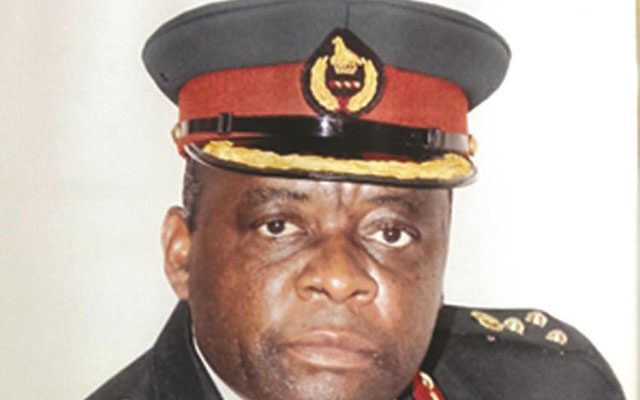
BRIGADIER-General James Jotham Murozvi, whose Chimurenga name was James Tichatonga, is no more. The Almighty God, in his infinite wisdom and unchallengeable judgment, snatched him from our midst, so tragically and suddenly, at West End Hospital in Harare at 9pm on April 6, 2017.
His wife and daughter had rushed him there after he had collapsed 40 minutes earlier at the carport, outside his house in the Grange, Harare, as he alighted from his vehicle. He was pronounced dead on arrival at the hospital.
He appeared to have succumbed to diabetes and high blood pressure, twin killer ailments which he had battled for many years, but had appeared to be well under control during the weeks and days leading up to his untimely death.
The late General Officer, was born on June 2, 1956 in Bikita, Masvingo being the second born in a family of five. He attended his primary education from Standard 1 to 3 at Marozva Primary School and later his Standard 4 to 6 at Pamushana Primary School in Bikita.
He later pursued his secondary education up to Form 4 at Nyatsime College in Harare. After completing his Form 4, he enrolled for a teacher training programme in secondary education at a training college in Gweru.
While the late Brigadier-General was on the teacher training programme, the Rhodesian authorities attempted to press-gang him, along with his peers, to undergo the compulsory National Service Programme. The young James objected to this forced enlistment into military service, which would have seen him fight against and kill fellow black people.
This, coupled with the brutality and injustices he witnessed daily being inflicted upon the black majority by the white colonial oppressors of the then Rhodesia, forced him to abandon the teacher training programme mid-course.
Like other young boys and girls of his age at the time, he was seized with the spirit of nationalism and the urge to fight and dismantle the colonial apparatus that had continued to subjugate the black majority in the country. Spurred by the nationalist consciousness of liberating his country and its people from relentless white oppression, which engulfed his generation at the time, the young James joined other young men and women to sneak into Mozambique through the Mount Selinda area of Rhodesia’s eastern border in September 1975 to join the Zimbabwe African National Liberation Army (Zanla).
This was a very risky decision, which resulted in death, injury or capture and incarceration, for many who were caught in the dragnet of the heavily armed and well-equipped border monitoring patrols of the then Rhodesian Security Forces.
Incidentally, one of his sisters, Shingirai Murozvi, also proceeded to the liberation struggle and returned home in 1980. She, however, was kidnapped along with seven other comrades by suspected Muzorewa Auxiliary Forces (Madzakutsaku) in Highlands soon after independence, never to be seen again.
Upon arrival in Mozambique, the late General Officer briefly stayed at Espungabeira and later at Machazi, before proceeding to Chibawawa. At Chibawawa, he met with Major-General Englebert Rugeje who happens to be his homemate from Bikita, along with many other comrades with whom he was to share his well-beaten path in the liberation struggle and after.
While there, he played an instrumental role in the Education Department, applying the rudimentary skills he had acquired in the aborted teacher training programme to educate the young children of school going age who were crossing the border in their thousands daily.
During the same year, 1976, he was selected to undergo military training at Takawira 2 in Chimoio, Mozambique, where he exhibited great potential, determination, courage and aptitude in military matters. This saw him being selected in early December 1976 to go for further training in Tanzania at Nachingueya Training Camp, as part of the 5 000-strong Songa Mbeli (Advance) Group. His group sailed to Tanzania from Mozambique on the famous navy ship called Mapinduzi.
It was on board the ship where he first met with now Brigadier-General (retired) Charles Wekwete, who was coming from Doeroe Camp, and with whom he shared several crucial steps of his life story thereafter.
Upon arrival in Tanzania, the late Brigadier-General underwent regular recruit training alongside Brigadier-General Wekwete, who had become his close friend, as part of the Songa Mbeli Group, from early to around September 1977. The two of them were chosen as part of a Group of 100 outstanding performers, who then underwent a further Senior Tactics Course under Tanzanian People’s Defence Force (TPDF) and Chinese instructors.
This course was intended to enhance their instructional capabilities in command, tactics and the operation of support weapons at company and battalion group level. After completion, they were then assigned as instructors for the next wave of recruits, called the Fanya Haraka (Move Fast) Group, which included the likes of now Major General Douglas Nyikayaramba.
During the whole of 1978 into early 1979, the late James Murozvi, underwent a full year-long Regular Officer Cadet Course which was specially designed for Zimbabwe and also run jointly by Chinese and TPDF instructors.
With him on this pioneering cadet course were the current Director-General in the President’s Office Major-General Happyton Bonyongwe, Brigadier General (retired) Charles Wekwete, former Director-General in the President’s Office Brigadier-General (retired) Elisha Muzonzini, Major General (retired) Gibson Mashingaidze, the late national hero Brigadier-General Gideon Lifa, the late Major Joseph Kanengoni, current Commander 3 Brigade Brigadier-General Gutu, Comrade Aaron Nhakaniso, the late Colonel Trust Masocha and Brigadier-General Mutisi, all members of the 100-strong special group alluded to above.
On completion, a few members of this group remained in Tanzania as instructors for the third and last 5 000-strong wave of recruits to be trained there at the height of the war, which was called Sasa Tunamaliza (Now We Are Finishing).
James Murozvi, Wekwete and the others returned to Mozambique from where they were immediately deployed to the battle front. They constituted a prudently and deliberately groomed nucleus of commanders of small fighting units of platoon to company size, which were composed of newly trained Songa Mbele, Fanya Haraka and Sasa Tunamaliza guerrillas, who were joined by thousands of others coming from Ethiopia, Libya, Yugoslavia, Romania and other countries.
Without doubt, these massive reinforcements provided the critical mass which, in no time, turned the tide against the settler regime, forcing it to capitulate at the Lancaster House Talks by the end of November 1979.
During this epochal stage of the liberation struggle, the late General distinguished himself as a leader of men and women in the field of combat, first in Manica Province, under then Provincial Commander Comrade Tonderai Nyika, now Major General (retired) Paradzayi Zimondi, the current Commissioner-General of Prisons and Correctional Services.
He fell under direct command of Major-General (retired) Gibson Mashingaidze, who was the Provincial Political Commissar. Owing to his dedication to duty and exceptional performance, the late General Officer was elevated to the post of Detachment Political Commissar.
In July 1979, he was reassigned to Gaza Province, where he operated as a Detachment Security Officer until the attainment of Independence in 1980. His Provincial Commander in Gaza was Comrade Rex Tichafa. His immediate Head of Department was Comrade Dewetewe, now Colonel (retired) Shumba, who was the Provincial Security Officer.
When the ceasefire was announced, the late General Officer was ordered to join a ZANLA Reserve Force that did not go into the Assembly Points, but remained in the operational areas clandestinely, armed and on high alert, which was expected to spearhead the resumption of the war in case the ceasefire broke down.
This group also took part in mobilising the people to go out en-masse to vote overwhelmingly for the Patriotic Front, resulting in the first landslide electoral victory of our revolutionary Party in 1980.
They also were instrumental in preparing and educating the people on the conduct of the election. From there, he proceeded to Mutandahwe Assembly Point from which he was then transferred to Goromonzi Transit Camp. The late General Officer was attested into the Zimbabwe National Army on June 2, 1980 as a Lieutenant.
He was posted to Army Headquarters and appointed General Staff Officer Grade Three. During that same year, he was posted to then Grey Scouts (now Mounted Regiment) as the Unit Adjutant. He was also among the first blacks from the Liberation Struggle to join this white dominated Regiment together with the likes of the late Colonel Trust Masocha, retired Colonel Jealous Murape and Lt Col Mabhena.
In July of the same year, the General was chosen to be part of a 36-member Group, comprised of 12 members each from ZANLA, ZIPRA and the former Rhodesian Forces. Here, he was once again joined by Wekwete, who he had last seen in Mozambique in early 1979 when they were deployed to the battle front.
This group first went to Inkomo Barracks, where it underwent a short two-month long course, before going to Staff College Camberley in Surrey, in the United Kingdom. There the General and his colleagues attended another two-month Pre-Integration Course which was specially designed for Zimbabwe by British instructors.
This group, which included the late General Officer, upon returning to Zimbabwe formed the core of pioneer officers who spearheaded the integration of the Zimbabwe National Army.
In 1981, he was posted to Headquarters 1 Brigade as the Administrative Staff Officer Grade 3 where he worked under General Chiwenga, the current Commander Zimbabwe Defence Forces, who was the Brigade Commander then. While at Headquarters 1 Brigade, he was appointed Military Intelligence Officer.
As the Military Intelligence Officer, besides his routine tasks at the Brigade Headquarters, he played a crucial role of facilitating the security of South African ANC’s Umkhonto Wesizwe Fighters inside Zimbabwe, and assisting them to cross the border into South Africa, organising their logistics and reconnoitring routes for them. He did this in co-ordination with the likes of the late Chris Hani and other surviving high level leaders of the ANC who were in exile at the time. These operations constituted a crucial part of Zimbabwe’s support and contribution to the fight against apartheid.
As a result of the hard work the late General Officer was doing, he was promoted to the rank of Captain and was subsequently posted back to Army Headquarters as the Personal Staff Officer to then Chief of Staff General Staff, then Major-General Vitalis Musungwa Gava Zvinavashe in 1984.
He was again posted to Headquarters 2 Infantry Brigade as the Brigade Major where he actively participated in various capacities in Operation BUTTERFLY (Beira Corridor) and Operation COBWEB (Nyamapanda-Zobwe Corridor) in the Mozambican Campaign.
In 1985, he was posted to the then Directorate of Army Training as a General Staff Officer Grade 1 responsible for Training and was later promoted to the rank of Major on March 1, 1986.
In 1990, he was posted to the Military Intelligence Directorate and was appointed Staff Officer Grade 1 Evaluation. After serving with the Military Intelligence Directorate for two years, he was again posted back to Army Headquarters and appointed Personal Staff Officer to Commander of the Army, the late national hero General Zvinavashe, where he served during the period 1992 to 1993.
In 1994, he was posted to Zimbabwe Defence Forces Headquarters as Personal Staff Officer to Commander Defence Forces, when General Zvinavashe was elevated to Commander Zimbabwe Defence Forces. On June 30, 1994, he was promoted to the rank of Lieutenant Colonel. Owing to his dedication to duty and exemplary performance, the late General Officer was again promoted to the rank of Colonel on 9 October, 1996.
Taking into account his vast experience, unquestionable loyalty, patriotism and dedication to duty, he was appointed Defence Attaché to the United Kingdom in 1999, where he represented the country to the best of his ability considering that it was during this same period that the British were vigorously pushing for regime change in Zimbabwe.
On completion of his tour of duty in the United Kingdom, he was posted to Zimbabwe Defence Forces Headquarters once again, this time as the Director Operational Requirements, from January 1, 2006 to January 1, 2007. He was then posted to Headquarters 5 Infantry Brigade as Deputy Commander, from 2007 to 2010.
From Headquarters 5 Infantry Brigade, the late General Officer was posted to the then National Defence College, where he served as a Staff Officer from May 1, 2010 to February 1 2011. He was then posted back to Zimbabwe Defence Forces Headquarters and appointed Director-General Defence Strategic Planning from February 2 2011.
On May 18, 2015, the late General Officer was seconded to the Ministry of Welfare Services for War Veterans, War Collaborators, ex-Political Detainees and Restrictees and appointed Principal Director; the position he held until his untimely death. He was the anchor and face of the ministry’s core function of delivering statutory welfare benefits to Veterans of the Liberation Struggle.
These, according to the Constitution of Zimbabwe Amendment (No.20) Act 2013, comprise those who fought, those who assisted the fighters and those who were detained, imprisoned or restricted for political reasons during the War of Liberation. His functions also included looking after the welfare needs of Widows of National Heroes under the National Heroes Act and War Victims under the War Victims Compensation Act.
The General was spearheading the ministry’s current efforts to align its governing laws to the new Constitution. This process, which is at an advanced stage, seeks to amalgamate the War Veterans Act and the Ex-Detainees Act into one Act to be called the Veterans of the Liberation Struggle (Rights and Benefits) Act, which will incorporate groups that were hitherto excluded from the law, such as nationalists, former non-combatant cadres and War Collaborators. Once enacted, this will drastically increase the number of beneficiaries.
General Murozvi was busy designing and operationalising the systems and structures in the Welfare Department, which would absorb this anticipated surge. He was imminently due for automatic promotion to the rank of Major-General upon formalisation of his retirement from the Zimbabwe Defence Forces on his substantive enlistment in the Civil Service.
The late General and freedom fighter successfully attended and completed various military career courses to enhance his command and administrative skills, which included the following:
Senior Staff Course (United Kingdom) in 1980.
Standardisation Course (Zimbabwe Military Academy) in 1980.
Intermediate Intelligence Course (School of Military Intelligence) in 1983.
Intermediate Staff Course (Zimbabwe Staff College) in 1984.
Command and Staff Course (INDIA) in 1990 to 1991.
National Defence Course (National Defence College) in 2013.
The late General Officer was also a holder of the following Academic and Professional Qualifications:
Diploma in War and Strategic Studies (UZ).
Bachelor of Science Honours Degree in Politics and Administration (UZ).
Master of Arts International Studies and Diplomacy (UK).
Master of Science Strategic Management (CUT).
Master of Science Defence Studies (Madras University India).
The late Brigadier General was awarded the following medals for his continued dedication, selfless and exemplary service to the nation:
Liberation Decoration — for his gallantry and selfless dedication to the liberation of Zimbabwe.
Independence Medal — for his contribution towards the Independence of Zimbabwe.
10 Year Service Medal — for his immense contribution to the integration, formation and development of the Zimbabwe National Army during the first ten years of its existence.
Fifteen Year Long and Exemplary Service Medal — for his exemplary service for continuous fifteen years.
Mozambique Campaign Medal — for his contribution towards the restoration of peace and stability in Mozambique.
Democratic Republic of Congo Campaign Medal — For his contribution towards peace and the regard for humanity in the Democratic Republic of Congo during OPERATION SOVEREIGN LEGITIMACY.
The Grand Officer of the Zimbabwe Order of Merit Award — for his eminent achievement and distinguished service to Zimbabwe or to humanity at large.
An unassuming, introvert and inimitably humble comrade, the late General was also a great team player. Quiet and a man of very few words, and never one to brag about his achievements, he was that kind of person who could easily blend into any situation, settle down completely unnoticed and perhaps be taken for a fool, yet being extremely intelligent, incisively perceptive, highly analytical and at the same time capable of seeing way deeper and beyond all those with whom he shared any situation. He can be described as the typical textbook Intelligence Operative.
Clearly, the late Brigadier-General Murozvi was no ordinary cadre, but a true revolutionary and comrade. He committed his whole life, from his teens until his untimely death, to serving the people of Zimbabwe and he fought to defend its territorial integrity, sovereignty, independence and national interests.
He made valuable contributions to regional peace and security. Above all, he remained focused and steadfast in the protracted fight against neo-colonial regime change machinations by Britain and her allies.
As we pay our last respects to Brigadier-General Murozvi, we must not forget the sacrifices he and other heroes and heroines made for the freedom of our motherland, Zimbabwe. We must defend what they stood and fought for. We must uphold the principles and values that the late Brigadier-General has bequeathed us.
The late General Murozvi is survived by his wife, Group Captain (retired) Joice Murozvi (nee Magonde), herself also an ex-combatant whose Chimurenga name was Progress Magamba, four children (two boys and two girls) and two grandchildren, a boy and a new born girl who was, as God’s grand design would have it, born to his last born daughter, Gamu on the same night he passed on. Gamu actually helped her mother to rush him to hospital, and the two of them held the General’s hand as he breathed his last, little knowing that by sunrise there would be this new addition to the family.
We share the profound grief of Mrs Murozvi, the children, the grandchildren and all his relatives. His untimely death is very saddening and painful, not only to them, but to all peace loving Zimbabweans.
The Ministry of Welfare Services for Veterans of the Liberation Struggle, the Zimbabwe Defence Forces, the entire fraternity of Veterans of the Liberation Struggle and, indeed, the entire Security Forces of Zimbabwe, both serving and retired, the ruling ZANU PF Party and the people of Zimbabwe at large have lost a trusted and hardworking cadre who will be difficult to replace. Our thoughts are with the bereaved family during this tragic episode.
To our dear beloved General, we say, go ye well gallant fighter and brave son of the soil. Your blood has, indeed, watered the Zimbabwe Flag as we used to sing during the War of Liberation. You have fought your fight.
Ours is to continue it, pursuing with vigour, our role as Veterans of the Liberation Struggle of being the ideological school of the nation, custodians of the Revolution and the bedrock upon which our Party, ZANU PF, shall continue to build itself for as long as we survive. Rest in peace gallant fighter, our dear brother in the Armed Struggle for the emancipation of the People of Zimbabwe.
May his soul rest in eternal peace.
Zorora Murugare, Lala Ngokuthula.
Source: Ministry of Welfare Services for War Veterans, War Collaborators, ex-Political Detainees and Restrictees.


 Online Reporter