Online Reporter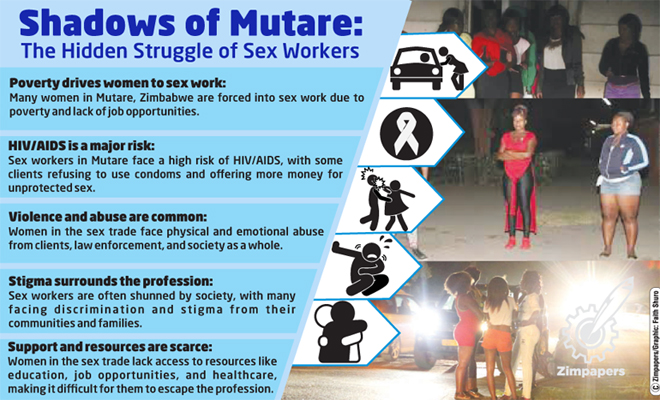
Liberty Dube
Weekender Correspondent
WHEN the sun sinks behind the green hills of Mutare, the city changes its clothes.
Sprawling high density suburbs — Sakubva, Chikanga, Dangamvura, Hobhouse, Zimta, and Gimboki — along with the Central Business District, stir with a different kind of energy.
Vendors pack away their wares, commuter omnibuses thin out after 9pm, and the night economy steps forward, quietly but cautiously.
For the ladies of the night, this is morning.
For Mary (not her real name), preparations begin long before the first client: a cold bath when taps run dry, makeup applied in a cracked mirror, and a phone charged at a neighbour’s house because electricity is unreliable.
By the time clubs in the city centre pulse with music and bars in the suburbs fill up, the women are already at work — calculating risk, price, and survival.
In Chikanga and Dangamvura, bar walls and pre cast fences become stages. Under half light and half shadow, women in trademark short, tight skirts — or sheer crop tops that leave little to the imagination — line the streets.
A “short time” can cost as little as US$3. Quick, rushed, and often dangerous. Cheap does not mean easy; sometimes it means desperation on both sides. It can mean a drunk client. Or a rowdy sex worker whose frustration from a bad night erupts into fights that draw police attention and scatter everyone into darkness.
Health hovers over every negotiation.
Condoms are the rule, but money bends rules. Unprotected sex is offered at a higher price — a cruel arithmetic that turns bodies into bargaining tables.
Here, HIV and AIDS are not abstract statistics. They have names, faces, and graves.
Yet some clients believe they carry laboratories in their eyes. They scan a woman’s face, her skin, her weight, and decide — right there in the dark — that she is “clean.” A healthy glow becomes a test result.
In Mutare’s night economy, ignorance wears confidence. Some clients trust their eyesight more than condoms, mistaking good looks for good health.
“I wake up at 4pm in the afternoon, not because I am lazy, but because my work starts when other people rest. My day is counting money before I even make it.
“Rent is US$50. School fees for my son is another problem. If I do not work, nobody eats.
“By 7pm, I am dressed. Not too flashy because flashy brings trouble. I start in Chikanga beer halls (at Chikanga TM where there are more than 20 bars and several night clubs) where short time can be US$3 or US$5.
“People think that money is easy, but it is the hardest money you can earn. For US$3, a man wants everything. Just imagine, some demand unprotected sex. When I refuse, a client can become so rough.
“But dry days are there when we accept about US$20 for short time with no protection. HIV is always in my mind. I lost my best friend in 2019.
“She took one client without protection because her child was sick. One night changed everything. I test regularly, I carry my own condoms, but clients sometimes tear them on purpose. You only notice later,” said Mary in an unsolicited interview recently.
She added:
“The worst nights are when alcohol mixes with anger. Some girls fight each other over clients. Police come. We run and scatter.
“Sometimes you lose money, sometimes shoes, and dignity. But there are good nights too. A regular who pays fairly.
“A client who talks like a human being. Those nights remind me that I am still a person, not just a service.”
As the night deepens, the scene shifts to clubs near the city centre. Music thumps. Beer bottles clink. Here, prices rise and so do expectations. Security guards hover, offering a thin layer of protection.
“People judge us like we woke up one day and chose this life,” said Tariro (her second name) (26), of Dangamvura, who prefers city clubs, especially that one situated at the heart of the city.
“I came to Mutare looking for work after my parents died. Jobs were promises, not realities. This line of work was available. In clubs, the money is better, let us talk of US$10, US$20 and even more, but the risks are different.
“Men think because if they pay you more, they own you.
“They want to remove condoms, they want rough things, and they want silence. When you refuse, they threaten to call the police or accuse you of stealing. Unprotected sex is offered like a bonus. You will hear one client saying I will add US$10, let us do it raw, as if HIV listens to prices.
“Sometimes I say no. Sometimes hunger says yes. That is the truth people don’t like.
“NGOs come with pamphlets, but pamphlets don’t pay rent. Still, I try to protect myself. I test. I know my status. Fear lives in my stomach, but I do not let it drive,” she said before adding:
“The worst loss is when a client disappears without paying. The best win is going home early with money and peace. I dream of leaving this life, but dreams need capital. Until then, the night is my office.”
By 3am fatigue sets in. Heels hurt. Voices go hoarse. Those still standing lean on each other, sharing cigarettes, warnings and laughs that sound louder than they feel.
“What keeps us alive is each other,” says Mai Chipo (41), popularly known as Rasta.
She is a veteran of the streets. She is nomadic. You can wake up in Masvingo and see her plying her trade at Mucheke Rank, and the following day you can see her at Chigovanyika in Chitungwiza.
The other weekend you can see her in Chiredzi at Chigarapasi Beerhall. On a finer day, you can see her at Tandarai Bar in Dombotombo in Marondera.
“I have seen girls come and go. Some get married. Some get sick. Some disappear.
“When a young one comes, I teach her rules, such as, never get in a car alone, never leave your drink unattended, never trust a man who refuses a condom.
“Short time for US$3 is dangerous because it attracts desperation. That is when fights erupt, when a rowdy girl or drunk client turns violent. HIV is real here. I live positively.
“I take my medication. I work carefully. Life did not end when I got my status, it just changed. What hurts is stigma.
“Clients want us at night, but hate us in the day.
“My win is surviving. Paying school fees for my daughter. Sending groceries to my rural home in Masvingo. My loss is my youth, which I spent negotiating safety instead of dreaming freely. But every morning I wake up alive, and that is not a small thing,” she said in an emotional interview.
As the sunrises, the ladies of the night drift back to their respective high-density suburbs and some to low-density suburbs, blending into the morning crowds and the night’s stories stay behind.
The interviews held were not easy.
The girls were initially reluctant to open up, but this is the reality of what happens in the world’s oldest profession. Survival of the fittest.
Some ladies of the night are now frequenting the heart of the city, particularly at one of Mutare’s oldest brothels, looking for clients, and there has been an upsurge, especially after 2021 when a commercial sex worker popularly known as Joyie, received US$15 000 from a client who had hired her for the night.
The lady of the night, could not believe her eyes after her client — believed to be an illegal gold panner — decided to splash the greenbacks on her for the one-night stand.
And now they believe the place has got luck.