

 Online Reporter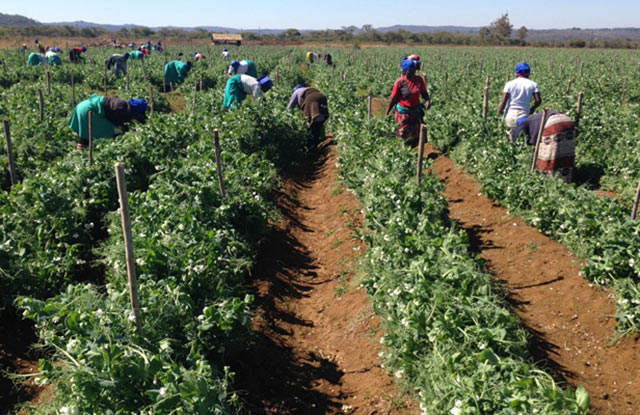
Specialist Writer – Agribusiness
SMALLHOLDER farmers in Mutoko are planting mangetout and sugar snap peas for the European Union(EU) and United Kingdom (UK) markets for the first time under a Hub and Spoke arrangement with Kuminda.
Six groups of smallholder farmers in Mutoko under Nyahunure Community Organisation have planted half a hectare each of peas for export with technical and market support from the national trade development and promotion organisation ZimTrade and Kuminda.
Funding and institutional support is from Christian Aid Zimbabwe (CAID) and the Embassy of the Netherlands in Zimbabwe.
Programme coordinator for Nyahunure Community Organisation, Mr Francis Pawandiwa, said these organisations are training farmers and linking them with the export market.
“For our peas to meet international standards, they must be Global GAP certified and Kuminda has deployed agronomists to ensure our products meet these standards.
“We are contracted by Kuminda, who determines the dates of planting for our produce to reach the market when required,” he said.
Kuminda is a multi-national company founded in Zimbabwe and jointly owned by Messrs Mwale and Fred Matenga, who have been linking it with international markets.
Kuminda chief executive, Mr Clarence Mwale, said they started contracting farmers under the “Hub and Spoke” model earlier in the year, with planting commencing in week six and continuing until the end of June.
The export of the early cultivated crop started in week 14 (early April).
ZimTrade has created thematic clusters countrywide to specialise in areas of comparative advantage and aggregate produce for export, as part of its market intelligence, export development, export promotion and advocacy.
The trade organisation recently visited Mutoko Horticulture Cluster and the Women’s Economic Strengthening for Resilience Project (WESRP) Peas Pilot, being run by Nyahunure Community Organisation.
“ZimTrade, along with the Netherlands Embassy, CAID and Kuminda, is spearheading export-ready pea production, supplying inputs, developing clusters and allowing smallholder farmers to create sustainable livelihoods through exports.
“Just three weeks after planting, all groups exhibited a healthy, uniform crop stand, excellent field management practices, and well-maintained production sites,” read a post from ZimTrade on its official X handle.
ZimTrade said farmers proudly shared how they were working collectively to make the pilot project a success, with women taking a leading role in production while being actively supported by men, demonstrating the power of inclusive and community-driven agricultural development.
Zimbabwe’s export future depends on combining its traditional strengths with innovation, quality standards and strategic global partnerships.
Zimbabwe is seeking to exploit trends in global markets such as e-grocery, QR codes, branded packs, ocean freight, cold chain reliability, alternative routes and risk management under logistics and resilience for export growth.
CAID said the WERSP complements and aligns with the National Development Strategy 2 (NDS 2), Agriculture Food Systems and Rural Transformation Strategy 2 (AFSRTS 2) and Rural Development 8.0 on food security, household income, women’s economic empowerment and livestock production.
It takes about eight weeks for the peas to mature and four to five weeks of picking. Zimbabwe exports peas by both air and sea freight, depending on the period.
The UK in Zimbabwe disclosed that the United Kingdom has, under the Zimbabwe Economic Partnership Arrangement (EPA), empowered 5 000 small-scale farmers with skills and resources to grow mange tout and sugar snap peas, as well as employing women as graders and packers, while Zimbabwe supplies 60 percent of the UK’s sugar snaps.
Zimbabwe enjoys duty-free market access under the EPA.
EPAs are permanent partnerships that encourage a progressive shift from aid to trade and investment as engines of growth, jobs and poverty reduction.



