admin
admin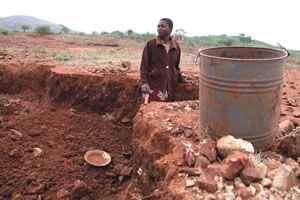
resource has found its way to as far as Germany and Italy, underlining its importance whose glorious lustre has graced many a structure home and abroad.
Not that the same lustre has been seen where the stone is extracted, unfortunately, as communities have bled and been scarred and thus remain poor.
An even less glorious side of Mutoko is that of market gardening whereby the area is noted for producing vegetables that farmers sell cheaply at Mbare Musika in Harare where they arrive, mainly, perched precariously atop laden trucks.
The poor farmers return home the following morning without much lucre, all to the cycle of toil and little returns.
But Mutoko has its golden side, too.
The area, especially Makaha in Mudzi, is home to deposits of gold that have provided hope that the area could uplift the livelihoods of its populace.
However, this Godsend may not be able to uplift the standard of the people of Mutoko, and might even turn out to be a curse just like black granite has shown to be on the torn visages of the areas it is extracted.
“We have not been able to enjoy the resources fully because our people do not have the machinery to undertake proper mining,” laments Chief Nechombo, Ngoni Nyamukondiwa.
His area, which borders Manicaland on the east, comprises of 60 villages.
“Our children here do not have mining claims and it is the outsiders that come from afar with papers of the Ministry of Mines and invade our fields.
“They will leave us empty handed eventually,” he told The Herald.
The miners do not develop roads or other amenities that are essential to the community.
“Nothing,” says Chief Nechombo.
The traditional leadership is slighted by the fact that not only do they see their resources being shipped away and land degraded.
“We are not even consulted when these strangers come and they do not even have regard for the local people.
“This has led to clashes many times,” he said.
He appealed to Government to assist in the speedy processing of claim applications by locals as well as provide machinery so that the poor locals could extract value from their resource.
He reckons that although gold cannot as be as abundant as black granite in the area, it could uplift the lives of his people.
Such hope is what characterises the life of 24-year-old Patience Nyakatangara of Benias village under Chief Chimoyo.
The mother of one is seen digging with a hoe in an open field for the rock that bears the precious mineral.
As the woman, who says she has been doing this since 2005, hits at the earth with her rudimentary instrument, stopping to pick with her bare hand some small black rocks which she pile beside the pit, an air of desperation pervades.
It becomes even more poignant when it is time to suckle the baby as the poor mother has to give what the baby wants when her labours are showing little yields and she has not had replenishment.
Today, the sky has been overcast, a fillip to work harder for the days of energy-sapping sun will eventually come down heavily, characteristically.
The overcast sky also points to the breaking of the heavens to cool the earth.
Yet after the break she sits the baby down and resumes her work.
“After collecting enough stones for the day I will go and crush and wash them and get something for the day,” she says.
The crushing is done by means of a wooden mortar and pestle, an arduous exercise that will reward the fortune seeker with one or two points of gold, on average.
A point – 0,1 grammes – is sold for US$2,50.
Nyakatangara believes it is only when she and many others in the area get machinery and other support will their lives be transformed.
Nancy Ngonera (24), a mother of two, whose industry is characterised by picking out rubble from a nearby mine with an eye on rocks that may yield the precious mineral, is of the same opinion.
She will have to take the rocks back home to the tiresome process of crushing and washing – and hoping.
Her situation at the mouth of a mine hole where she also sweeps dust which she hopes to wash and yield gold, shows a disconcertingly contrasting picture.
Norest Karifandika and about 20 others who work on a claim owned by a businessman from Shamva, allow Ngongera and others to collect the stones and dust.
Partly it is because the stones and dust are like the proverbial crumbs from the high table.
On the other hand, it is because the men seem to understand the plight of the women and their wretched condition.
The men are slightly better off, but identify with their folk.
The mine has a compressor and a generator, which make the job easier.
But the machines do not belong to the men and for all their physical toils they have to share with the claim owner.
There are a lot of other challenges.
“There is only one mill in this area and it is very expensive that the owner has to take the ore to Shamva where milling is even cheaper,” Karifandika says.
A colleague chips in: “Claim forms are not prepared on time and we have problems with authorities if one has to mine without them.”
He adds that because of lack of capital, one other aspect that suffers is that of safety.
“We have to make do with what is there,” he says referring to the casual clothes that they have to work in in operations that need special clothing.
The miners do not have such articles as respirators which situation presents a danger as they go down up to 30 metres and have to endure smells of explosives.
All this threatens to derail the gains of Independence, which brought hope.
Headman Benias Sabao recalls that the areas where white colonialists laid claims used to be no-go areas for blacks but the coming of Independence in 1980 reconciled blacks with their God-given resources.
However, if the situation does not improve, the people here can only be barely better than in colonial times.



 Online Reporter