Chronicle Editor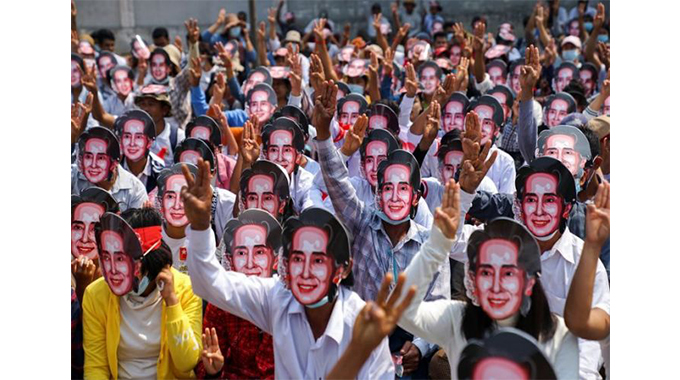
Myanmar’s ousted leader Aung San Suu Kyi appeared at a court hearing via video conferencing yesterday as supporters marched in several towns and cities in defiance of a crackdown after the bloodiest day since the February 1 military coup.
Police fired tear gas and stun grenades to disperse hundreds of protesters in the main city of Yangon yesterday, witnesses said. They later combed through side streets firing rubber bullets and at least one person was hurt, media reported.
Suu Kyi, aged 75, looked in good health during her appearance before a court in the capital Naypyidaw, one of her lawyers said. Two more charges were added to those filed against her after the coup, she said.
“I saw Amay on the video, she looks healthy,” lawyer Min Min Soe told Reuters, using an affectionate term meaning “mother” to refer to Suu Kyi.
“She asked to meet her lawyer.”
The Nobel Peace laureate, who leads the National League for Democracy (NLD), has not been seen in public since her government was ousted and she was detained along with other party leaders.
She was initially charged with illegally importing six walkie-talkie radios. Later, a charge of violating a natural disaster law by breaching coronavirus protocols was added.
Yesterday, two more charges were added, one under a section of a colonial-era penal code prohibiting publication of information that may “cause fear or alarm”, and the other under a telecommunications law stipulating licences for equipment, the lawyer said.
The next hearing will be on March 15. Critics of the coup say the charges were trumped up.
Meanwhile, Human Rights Watch and Rohingya refugees in India are urging the government to provide refuge to 81 Rohingya whose boat has been drifting in the Andaman Sea for over two weeks.
Since last month, India has been providing food, medical and technical aid to Rohingya crammed on a fishing boat that was found drifting in international waters after it left southern Bangladesh.
The Rohingya had hoped to reach Malaysia but the boat’s engine had technical issues.
Eight people on board the boat have died and many of the 81 survivors are sick and suffering from extreme
dehydration, having run out of food and water four days into their journey, which began on February 11.
India’s coastguard repaired the vessel but was not permitting it to enter Indian waters, wanting it to return to Bangladesh.
“We are begging Indian authorities to bring our people to land. How can all countries refuse to accept 81 lives stranded in international waters?” said Sabber Kyaw Min, director of Rohingya Human Rights Initiative (RHRI) in India, on Monday.
“Eight are already dead, we have a right to receive their bodies,” Min said, adding that he and about 16 000 Rohingya refugees living in India were urging the government to accept the distressed refugees.
Meenakshi Ganguly, the South Asia director of Human Rights Watch, said India should uphold its obligations under international law and protect the refugees.
“The Rohingya have been so persecuted, and for so long, they are desperate to find a place where they can be safe and made to feel welcome. And yet, no country in the world, even those that sympathise with them, are willing,” Ganguly said.
India’s foreign ministry did not respond to questions on whether the 81 Rohingya will be allowed to enter India, nor did it provide an update on talks with Bangladesh on the issue.
New Delhi has not signed the 1951 Refugee Convention, which spells out refugee rights and state responsibilities to protect them. It also does not have a domestic law protecting refugees.
But Bangladesh foreign minister AK Abdul Momen last week told Reuters news agency that his government expects India, the closest country, or Myanmar, the Rohingya’s country of origin, to accept the 81 survivors.
More than one million Rohingya refugees from Buddhist-majority Myanmar are living in teeming camps in predominantly Muslim Bangladesh. Many of them fled their country after Myanmar’s military conducted a deadly crackdown on them in 2017.
Myanmar doesn’t recognise the Rohingya, who have been there for generations, as an ethnic group and insists they are Bangladeshi migrants living “illegally” in the country.
Last week, India said approximately 47 of the occupants of the boat are in possession of ID cards issued to them by the United Nations refugee agency, UNHCR, office in Bangladesh, stating that they are displaced Myanmar nationals.-Al Jazeera.


 Online Reporter