

 admin
admin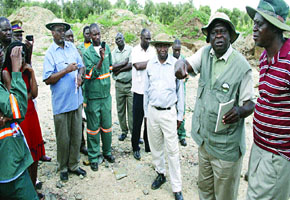
“On 25 June last year, we ordered the company to stop operations because it had heavy earth moving equipment that it was using to divert the course of the river and dig deep pits along its bed,” said an EMA official from Matabeleland South.
He said one of the major challenges facing the police and local authorities was that miners came armed with permits from the Ministry of Mines and Mining Development.
“According to the law, mining takes precedence over all activities and people use the permits to abuse the environment. We need a system that will ensure permits are only issued to people who have a rehabilitation plan for the environment and have ways of ensuring the community benefits from mining activities,” said the official.
He said soon afterwards, a Mr Saratiel Chimanikire came with a mining certificate issued by the Ministry of Mines and Mining Development, authorising him to mine on the Chinese claim.
“He brought about 500 panners that caused further damage and deprived communities downstream of clean water,” added the official.
He said the Chinese company managed to wrest the claim from Mr Chimanikire following a court battle.
“Now, they have been awarded five more mining claims along the river. As EMA, we are saying they should not be allowed to move to those claims without rehabilitating the environment here,” said the official.
The Chief Executive Officer of Umzingwane Rural District Council (RDC), Mr Ndumiso Mpofu, said the council did not have resources to combat environmentally destructive mining practices in the district.
“We only have three rangers and they cannot cope with the ‘armed warlords’ in charge of panning camps. The locals are now fighting with us because we stopped them from panning in the river but now the Chinese who are causing worse damage have been allowed to pan,” lamented Mr Mpofu.
He said there should be a law compelling anyone interested in mining in the district, to sign a Memorandum of Understanding (MoU) with the RDC detailing how the environment would be protected and how the community would benefit.
Mr Felix Moyo, an EMA board member, who is also the director of information and public relations at the National University of Science and Technology, said there was need for stern action, as the place had become a “graveyard of the environment.”
The village head at Portbury Village, where the activities are taking place, Mr David Ndlovu, said the Portbury Irrigation Scheme shut down in 2011, after the course of the river was diverted.
He said Silalabuhwa Irrigation Scheme has also been affected.
“Mining activities have disrupted the natural flow of the river. This river used to have water throughout the year but now it is dry most of the time. Villagers are now extremely poor because of that. Our livestock keeps falling into the deep pits and sometimes we watch the animals rot, as we cannot retrieve them due to the depth,” said Mr Ndlovu.
Professor Sheunesu Mpepereki, the chairperson of the EMA board, said he was shocked by the extent of environmental degradation at the river.
“Even the reports fail to capture the scope of damage that is being inflicted on the environment. We should all say no to this and conscientise locals to refuse to let anyone, who has not been approved by the community to carry out mining. The community is directly affected by this and they should be empowered with knowledge to fight it,” said Prof Mpepereki.
He said the two-year sentence meted out to panners was not deterrent as they continued multiplying. Prof Mpepereki said the damage was not only affecting the environment but the region’s food security.
He said the late VP Landa John Nkomo once told him that investors given mining certificates by Government were not immune from environmental laws and needed to be regulated.
“VP Nkomo told me this after a Russian company in Penhalonga produced a mining certificate,” he said.
Dangerous chemicals that include mercury, cyanide and other metals are discharged into the river and have long term effects like causing cancer and some mental disorders to people who use the water.
The EMA board is on a four-day tour of the southern region to assess environmental damage on the ground with a view of coming up with counter strategies.
Today, the team will be touring Bulawayo.
The tour ends tomorrow.



 derick.khumalo
 Online Reporter