admin
admin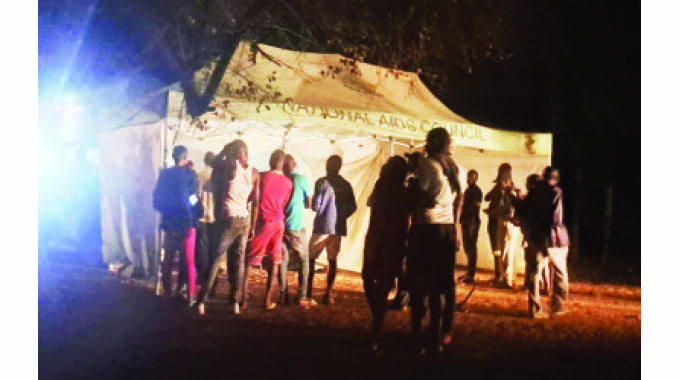
Fungai Lupande
Mashonaland Central Bureau
HIV testing, cancer screening and other health services are being offered by the National AIDS Council (NAC) by moonlight as the council seeks to get sex workers and their clients, who tend to dislike the light of day, to take testing seriously.
In Muzarabani, the allure of the moon has become a focal point for sex workers and their clients.
During a night-time visit to Muzarabani, the testing team was accompanied by a group of over 20 journalists, who descended the Mavuradonha mountain range around 9pm, and the moonlight created a nostalgic and transient ambience.
Meanwhile, the Muzarabani growth point was bustling with activities, with a multitude gathered for a live band performance by a local artist, Mr Bigboy Motsi popularly known as Mr Muzarabani.
Nearby, NAC was providing HIV testing, STI screening, and counselling services. Both young and old individuals, male and female, queued for these services.
One sex worker, identified as Mary, who travelled from Centenary to work in Muzarabani, mentioned that she was screened for STIs and is awaiting treatment.
She highlighted the prevalence of sexually transmitted diseases in Muzarabani and the challenges some sex workers face in accessing treatment, leading to the spread of diseases.
While NAC could not provide cervical cancer screening at that time, they assured the sex workers that the service would be made available to them.
Those who could not receive immediate treatment were given referral letters for free treatment at health facilities.
Mary expressed appreciation for the night testing programme, emphasising that sex workers are often uncomfortable with seeking services during the day.
“NAC said they could not do cervical cancer screening, but they promised to provide the service to us. After the screening, those who cannot be treated today are given referral letters for free treatment at health facilities,” she said.
“This night testing programme is commendable because sex workers are not comfortable seeking services during broad daylight.”
Another sex worker, Blessing, who tested negative for HIV, emphasised the importance of protecting herself through condom use.
As a single mother of three, Blessing said she prioritises her health.
She also mentioned the difficulty sex workers face in seeking HIV services during the day, especially due to the reluctance of their married clients to be tested in public spaces.
The overall sentiment was positive towards the night testing programme, with hopes that NAC would continue offering these services regularly.
It was noted that sexually transmitted diseases are prevalent in Muzarabani, with girls as young as 13 involved in sex work. These young individuals often avoid seeking HIV services due to their age, posing risks to their clients.
One individual, John, who preferred to remain anonymous, came for HIV testing after hearing about the moonlight testing initiative.
He expressed the need for self-testing kits, particularly because clinics are far from where he stays.
He also highlighted the rise of sexual activities among young teenagers due to the lack of entertainment, appealing to local leaders to organise activities for the youth.
“The place is crowded, many people have turned up for the services, and I am in the queue. Where I stay, clinics are far, and we are appealing to NAC to provide self-testing kits,” he said.
“Children as young as 13 and 14 are resorting to sexual activities due to lack of entertainment. We are appealing to local leaders to organise sporting activities for our children.”
The district AIDS coordinator for Muzarabani, Mr Richard Chasema, described the inaugural moonlight HIV testing as a success. He said 107 men and 67 women turned out for HIV testing and the positivity rate was 4,2 percent.
He said the moonlight testing was targeting sex workers and their clients as a key population.
“We noticed that when we plan for awareness campaigns during the day in the community, sex workers don’t attend because they will be resting. We also notice that most of sex worker’s clients are family men who are not comfortable getting tested in broad daylight.”
Apart from HIV testing, counselling, and screening for STIs, NAC was also testing for non-communicable diseases like high blood pressure and diabetes.
Mr Chasima said Muzarabani’s growth point, Centenary, and St Albert business centre are hotspots for STIs.
Other places like Hoya and Chiwenga, which border Mozambique, will be prioritised due to the high number of cases being recorded in these areas.
Cases of STIs are increasing each year in these three urban centres which NAC now targets with the moonlight testing services.
“We have clinics and health posts offering primary health care services to alleviate the challenge of long distances to clinics,” he said.
The HIV prevalence rate in Muzarabani stands at 4,7 percent. The prevalence rate for the most sexually active group of 15 to 49 years stands at 0,74 percent.
New HIV infections in Muzarabani were at 0,07 per cent and 0,03 percent for younger people of 15 to 24 years.
“We have started recording cases of young children who are getting into sex work. We have engaged the Department of Social Services for the rehabilitation of these children.


 Online Reporter