Vusumuzi Dube
Mthabisi Tshuma, [email protected]
THE National Arts Council of Zimbabwe (Nacz) in Matabeleland South province has urged communities to prioritise language preservation through consistent use of local languages.
Native language use is expected to promote multilingual education across the province and beyond, with a strong emphasis on safeguarding culture.
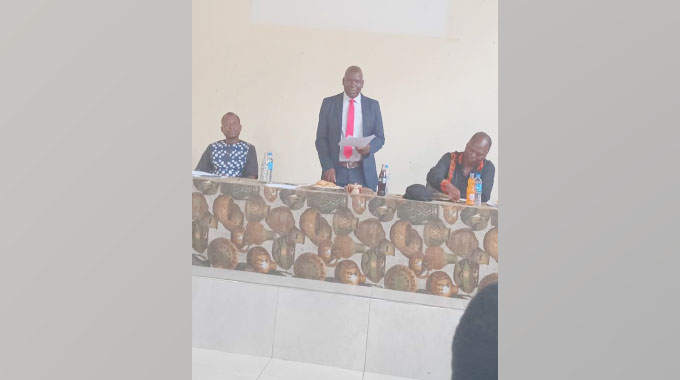
Speaking during the belated International Mother Language Day commemorations held at Minda High School in Matobo District recently, Nacz Matabeleland South Provincial Arts Manager, Percy Vela, said languages are dynamic and play a key role in cultural promotion.
International Mother Language Day is observed annually on 21 February to promote linguistic and cultural diversity and multilingualism. Proclaimed by UNESCO in 1999 and celebrated since 2000, the day emphasises the importance of mother-tongue based education for learning, literacy and the preservation of heritage.
This year’s theme, “Youth voices on multilingual education”, highlights the crucial role of young people in defending, revitalising and using their languages to enhance linguistic diversity and inclusion.
Matabeleland South, a culturally diverse province comprising seven districts — Beitbridge, Gwanda, Insiza, Bulilima, Mangwe, Umzingwane and Matobo — has seven indigenous languages spoken, with six of them taught and examined in schools.
Vela urged policymakers, educators, teachers, parents and families to strengthen their commitment to reinforcing and encouraging the use of mother languages in formal and informal sectors, while promoting multilingual education and inclusion.
“A language signifies a sense of identity; race, ethnic or geographical location or origin. This makes language a very sensitive issue, as it is the mirror of cultural and traditional beliefs in which a sense of belonging to a certain community is built.
“Languages are dynamic as they grow or develop due to the creation of new words as the world is developing as well. A language might as well die or disappear due to ‘language/linguistic hegemony’, and this is why we should celebrate this day to promote and preserve as well as protect our languages,” said Vela.
He noted that the internet poses a risk of linguistic “uniformisation”.
“Then that makes it a wake-up call, that technological progress will serve ‘plurilingualism’. The mother tongue can also be referred to as the native language. A native language is the first language that infants acquire from their area of domicile before speaking or articulating any word (lexicon).
“A language is a central point of communication that two people or more react to in accordance with an instruction or message decoded based on understanding and ability to interpret a certain language. This helps a child to interact or act in a meaningful manner with his or her family and peers around his or her social circumference and generally the community as a whole,” said Vela.
He said Jahunda native speakers are no longer found in Gwanda, where they once lived, due to linguistic hegemony.
“Resident community members are proud to be referred to as ‘AmaJahunda Amahle’, yet the Jahunda native speakers are now nowhere to be found and there are no orthographic pieces of Jahunda language due to linguistic hegemony.
“This goes back to the mother tongue based on multilingual education with growing understanding and tolerance to its importance, particularly in the education system. Local languages should be recognised and taught in schools, regardless of location and the speech community,” said Vela.
Follow on X: @mthabisi_mthire



 Online Reporter