

 dyton mupawaenda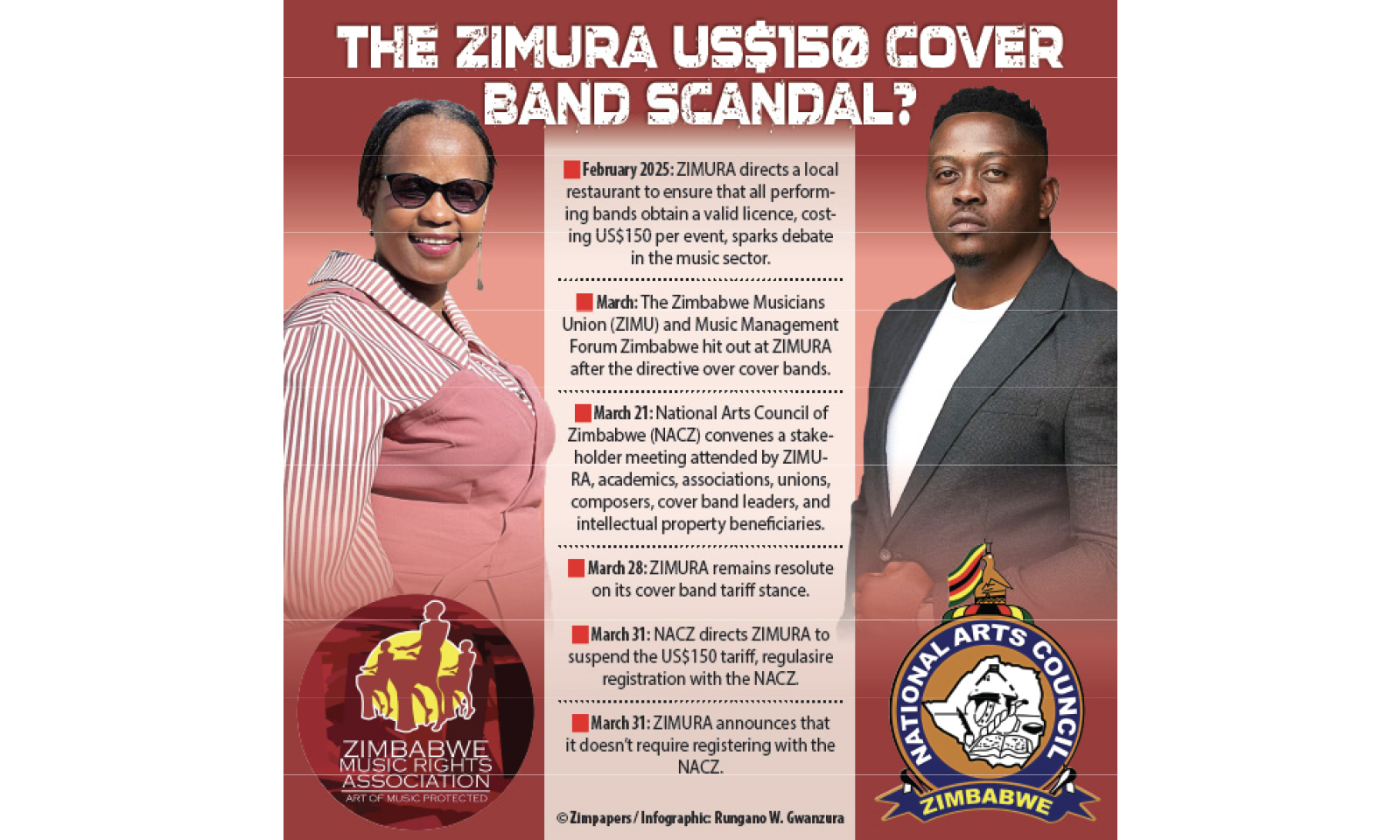
Mbulelo Mpofu-Zimpapers Arts and Entertainment Hub
JUST when it seemed that the heated debate surrounding the US$150 cover band tariff imposed by the Zimbabwe Music Rights Association (Zimura) had settled following a recent dialogue, new developments have reignited tensions.
The National Arts Council of Zimbabwe (NACZ) yesterday intervened, calling for the suspension of the contentious fee, but Zimura remains resolute in its stance.
This dispute stems from Zimura’s decision to proceed with imposing a US$150 licensing fee per show for cover bands, a sharp increase from the previous annual fee of US$50.
This move comes despite a meeting two weeks ago that brought together key stakeholders, including representatives from NACZ, Zimura, academics, associations, unions, composers, cover band leaders, and intellectual property beneficiaries.
Discussions focused on establishing a fair and sustainable tariff structure for cover bands operating in Zimbabwe.
According to NACZ, following lobbying from various music institutions addressing concerns over Zimura’s proposed tariff, NACZ facilitated what seemed like a productive dialogue with Zimura and other music industry stakeholders.
Following the meeting, NACZ expressed satisfaction with the progress and stated that Zimura had shown a willingness to reconsider the fee structure if proper lobbying processes were followed, including direct engagement with composers whose music is performed by cover bands.
Last week, on March 27, NACZ followed this up with a meeting with representatives of copyright holders who strongly expressed their views on the matter and challenged both NACZ and Zimura to arrive at a solution that holistically protects their rights, ensures copyright infringement is taken seriously, and guarantees fair compensation.
“The conclusion was that, at the wider consultation, users of copyrights would be adequately educated on the sanctity of copyrights, and their views would be respected. They believe the $150 tariff should be the entry level, and Zimura should charge more for bigger concerts.”
NACZ said they had shared with Zimura, their intention to invite rights users for this engagement before convening a broader dialogue forum.
However, in an unexpected turn of events, Zimura issued a public notice on Friday, reaffirming its stance.
“Effective immediately, all performers and organisers must obtain the necessary licences before staging any event featuring protected musical works,” Zimura communicated on their social media platforms.
In response, through a statement issued on Monday, March 31, NACZ executive director Napoleon Nyanhi criticised the tariff, labelling it “punitive”.
He raised concerns over its implementation process, the change in licence periods, and its deviation from international best practices.
Following this, NACZ suspended all directives regarding the US$150 tariff, pending further discussions and negotiations.
“. . . All directives for payment of the $150 tariff are suspended immediately, pending the conclusion of the registration, dialogue, and negotiation processes,” Nyanhi said in the statement.
He also directed Zimura to regularise its registration with NACZ as an arts association.
“We direct that Zimbabwe Music Rights Association regularises its registration with the NACZ as an arts association, in line with the National Arts Council of Zimbabwe Act Chapter 25:07, read in conjunction with section 4 of Statutory Instrument 87 of 2006.”
“The National Arts Council of Zimbabwe takes seriously its mandate to foster, develop, and improve the knowledge, understanding, and practice of the arts in Zimbabwe,” said Nyanhi in the statement.
In response, Zimbabwe Musicians Union (Zimu) founding president, Edith WeUtonga Katiji, welcomed NACZ’s intervention.
“We are grateful for this stance by NACZ. It reinforces our concerns about Zimura’s mismanagement. In the coming weeks, the real issues surrounding Zimura must be exposed in the best interests of the Zimbabwean music sector. They have acted in bad faith, and this must stop,” she said.
However, Zimura’s executive director, Polisile Ncube-Chimhini, dismissed NACZ’s position, asserting that Zimura is not legally obligated to register with NACZ.
“The NACZ’s press statement has no bearing on us. We are not an arts organisation; we are a royalty-collecting body registered under the Companies and Intellectual Property Office of Zimbabwe (CIPZ), a department within the Ministry of Justice, Legal and Parliamentary Affairs.
“We do not report to the Ministry of Sport, Recreation Arts, and Culture.”
In apparent response to Nyanhi’s claim that Zimura had been engaged regarding the meeting with rightsholders, Ncube-Chimhini said: “We were not engaged in any discussions – NACZ simply posted their statement on social media.
“This holds no legal weight for us. We see this as more of a rant than a directive,” she said.
Zimura’s Board echoed this stance, stating that NACZ had misrepresented the legal requirements governing the organisation.
“Zimura has operated for 43 years without NACZ registration because it has never been a statutory requirement. We are not obligated to register under two separate Acts of Parliament,” the board said in a statement. – Follow on X: @MbuleloMpofu.



 Online Reporter