Online Reporter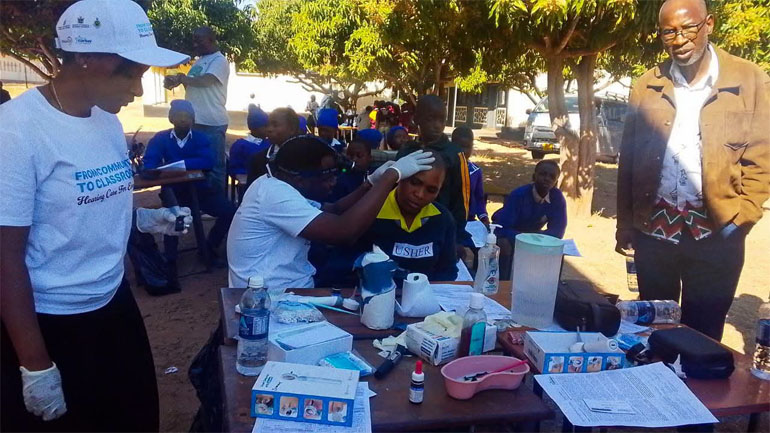
Tendai Gukutikwa
Health Reporter
THE Government is scaling up hearing care interventions to ensure that every child can learn through expanded screening programmes and the provision of hearing assistive devices.
This was revealed by the Deputy Director for Primary, Secondary and Learner Welfare in the Ministry of Primary and Secondary Education, Mrs Lucia Ncube, during the belated World Hearing Day commemorations held at Munyoro Secondary School last week.
The event was held under the theme: ‘From Communities to Classrooms: Hearing Care for Every Child’.
Working with the Ministry of Health and Child Care and development partners, the Government is rolling out new-born and school hearing screening programmes across all provinces to identify problems before they affect education.
“We are making significant progress in strengthening hearing care across Zimbabwe because we recognise that a child who cannot hear properly cannot fully participate in learning. Early identification allows us to intervene before hearing loss becomes a barrier to education,” said Mrs Ncube, adding that hearing screening is now a key pillar of school health programmes, enabling health workers and teachers to identify learners requiring specialist attention.
“Our vision is for hearing checks to become as routine as measuring a child’s height and weight. Detecting hearing loss early gives children a far greater chance of succeeding academically and socially,” she said.
To improve classroom support, the Government has established resource units for learners with hearing impairments in almost every district. Resource units are ensuring that learners with hearing loss receive the specialised support they need closer to their communities.
“Our goal is to build an education system where every learner has an equal opportunity to thrive,” she said, adding that teacher training colleges are also equipping future educators with sign language skills.
The Government has further intensified community-based rehabilitation, with workers conducting door-to-door visits to identify children with hearing challenges and refer them for audiology services before their education is disrupted.
“Our Community-Based Rehabilitation workers are helping us find children who might otherwise remain hidden in communities.
‘‘Early identification and timely referrals are changing lives because intervention comes before learning is seriously disrupted,” she said. While demand remains high, the Government and its partners are also increasing access to hearing aids and other assistive devices.
“Hearing aids remain limited, but the Government and its partners continue to distribute them to deserving learners. Every assistive device placed in the hands of a child is an investment in that child’s education and future,” said Mrs Ncube, adding that communities are the first line of defence against preventable hearing loss.
“It is often mothers who first notice that a baby is not responding to sound. It is Early Childhood Development teachers who realise a learner constantly asks for instructions to be repeated.
‘‘These observations must never be ignored because they can determine a child’s future. We must reject the belief that children with hearing impairments cannot learn.
‘‘They can excel when they receive early diagnosis, appropriate support and an inclusive learning environment,” she said, urging communities to discard misconceptions surrounding hearing impairment.
She called for stronger collaboration between parents, teachers, health workers and communities.
In an interview on the sidelines, ENT specialist and Wizear director, Dr Erasmus Muganda, said early intervention remains the most effective way of preventing avoidable hearing loss among children.
He said the World Health Organisation estimates that about 90 million children aged between five and 19 years worldwide have hearing problems, with nearly 60 percent of those cases being preventable.
“Most childhood hearing problems are caused by simple conditions such as wax build-up or untreated ear infections. These are conditions that can be addressed through early screening and treatment before they interfere with learning,” he said.
He urged parents and teachers to watch for warning signs. A simple ear examination today can change a child’s future. Parents and teachers must learn to recognise the warning signs because early intervention changes lives,” said Dr Muganda.
Community members and learners from surrounding schools received free ear examinations, hearing assessments and other ear care services during the commemorations.