admin
admin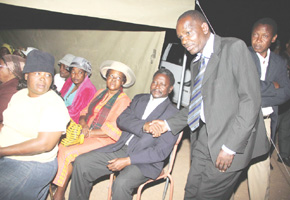
“We acted quickly on receiving information from Bulawayo and had a round robin and consulted all members of the Politburo. All members of the Presidium said yes. Forty one Politburo members also said yes while two members were out of the country and 14 were not reachable. Thus 46 members of the Politburo said yes out of 62 members,” Cde Mutasa said.
“He will be buried at the National Heroes Acre on Friday morning. We hope everything will be done as quickly as possible,” he said.
Cde Mutasa described Cde Ncube as an outstanding member of Zapu who became involved in the fight for the country’s liberation from British colonial rule as early as 1959.
“He was an outstanding person in Bulawayo particularly in Zapu where he held a number of positions. He also got involved in the integration of Zapu and Zanu-PF,” Cde Mutasa said.
On his working relations with Cde Ncube, Cde Mutasa said: “I worked very well indeed with Cde Ncube. He was not a difficult person. He was helpful and quite understanding.”
Cde Mutasa said a committee of ministers chaired by Home Affairs co-Minister Kembo Mohadi was handling burial arrangements.
Cde Ncube’s body will today be taken to his Mpopoma home at 9am before proceeding for a church service at Seventh Day Adventist Church in Pelandaba at 11.30am.
Acting Zanu-PF Bulawayo provincial chairman Cde Killian Sibanda called on the city’s residents to come and bid farewell to a gallant son of the soil.
He thanked the Zanu-PF Politburo for honouring Cde Ncube with the national hero status.
“As a province, we feel humbled and honoured that the Politburo gave him such high respect,” said Cde Sibanda.
He said there would be buses that would take mourners to Harare for the burial. The buses would leave the city this evening.
Since the announcement of his death on Sunday, condolence messages have been pouring in, with a majority of cadres describing him as a revolutionary par excellence.
In his condolence message on Monday, President Mugabe said Cde Ncube belonged to that exceptional breed of pioneer politicians who rallied Africans to fight against the British colonial settler regime.
The President said Cde Ncube’s death created a deep chasm which will be difficult to fill in both Zanu-PF and the country as a whole.
Cde Ncube, who was a widower, was born in 1938 in Tsholotsho District and attended Matshudula School for his Standard 1 to 3 before going to Luveve School in Bulawayo for his Standard 4 up to 6.
He did Ordinary Level through private studies and also learnt at Hope Fountain Mission from 1956 to 1958. Cde Ncube worked as a schoolmaster from 1959 to 1969 before working at Boka Group as a sales representative.
He joined the ANC in 1959 and later the NDP, Zapu and the PCC and was also the chairman of the Progressive and Development Association, a wing of Zapu from 1962 to 1966.
In 1965, Cde Ncube was arrested for resisting the Unilateral Declaration of Independence and sentenced to 18 months in prison. In 1969, he was arrested again for rising against the referendum for a republic by the Rhodesian Front and was detained at Khami Prison for three years.
Cde Ncube was also detained at Marandellas Prison (Marondera) from 1977 to 1979 for recruiting and dealing with freedom fighters, the likes of Andrew Ndiweni and John Maluzo Ndlovu. In 1981, Cde Ncube was elected the Zapu Matabeleland provincial chairman and was also co-chairman of the Matabeleland North Integration Task Force of PF-Zapu and Zanu-PF.
In 1989, he was elected Zanu-PF Central Committee Member and was later appointed the deputy national secretary for the commissariat and culture, a position he held up to 1998.
He was elected Member of Parliament for Mpopoma constituency in 1990 until 1995. In 2001, he served in the interim committee of Bulawayo Province until the elections in 2004 when he was elected Central Committee member of Zanu-PF for Bulawayo. Cde Ncube is survived by five children and three grandchildren.
Mourners are gathered at 88/7670 Mpopoma.


 Online Reporter