Online Reporter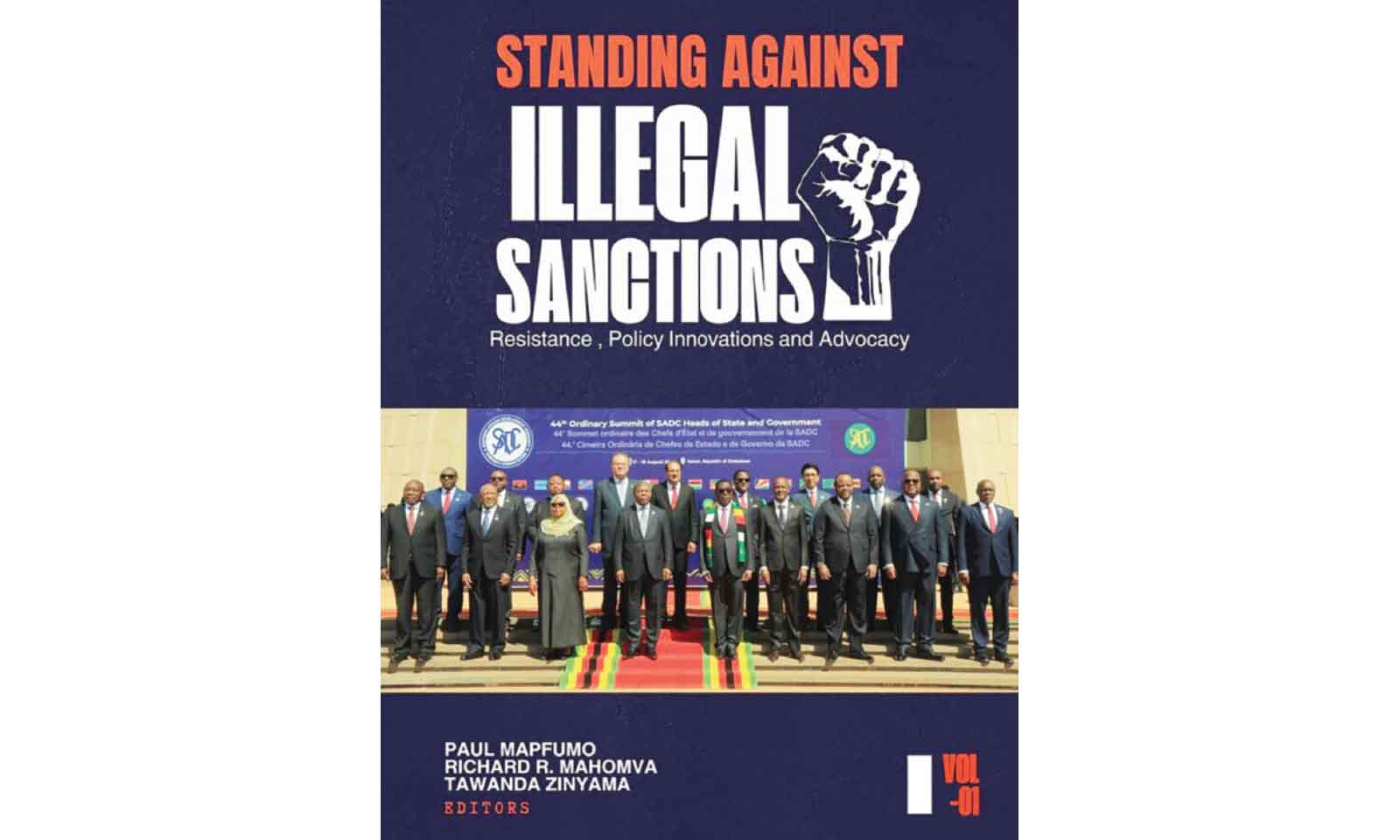
Hazel Usavi
Correspondent
The recent twin launch of the national Budget and the National Development Strategy 2 validate the key assertions of the book; “Standing Against Illegal Sanctions: Resistance, Policy Innovations and Advocacy.”
Chapter 13 of this volume projects the pragmatic, inclusive and citizen-centric policy architecture of the Second-Republic as disarming forces of the effects of the illegal sanctions.
Written by Terence Mashingaize and Richard Mahomva, chapter 13 of the book traces the birth of the Second Republic as an important and long-lasting governance renewal moment for Zimbabwe since her attainment of independence. This is crucial to sustain the realisation of the November 2017 “legacy restoration” project which gave rise to the new dispensation.
This marked a pivotal reorientation in the country’s politics and foreign-policy posture (Mahomva & Mashingaidze 2025).
Further to this, Ndlovu-Gatsheni (2015) argue that the new dispensation’s rhetoric of “pragmatism,” “openness,” and “engagement” aligns with broader decolonial aspirations to reassert African agency in global politics, while Mamdani’s (1996) work on post-colonial authority helps explain the State’s attempts to reframe sovereignty, land and citizenship in developmental rather than in colonial residual terms.
As such, the chapter underscores that the Transitional Stabilisation Programme (TSP) and National Development Strategy 1 (NDS1) gestured a genuine shift towards economic recovery, international re-engagement and citizen-centred policy reform.
Through the chapter, the book highlights that the Second-Republic has been driven by the ideology of pragmatic inclusive governance for national transformation. This ideology has key scaffolding pillars which are: pragmatism, inclusivity and citizen centric approaches to governance and African Humanism.
Explaining the Second Republic Statecraft Reform Pillars Pragmatism
This refers to a manner of dealing with problems using practical approaches and resolution that are applicable in real life as opposed to idealism. The mending of the economy even through currency stability and fiscal discipline among other measures reflects pragmatic economics.
Inclusivity
This principle is said to be the provision of equal access to opportunities and resources for marginalised groups. To this end, the Organisation for Economic Co-operation and Development states that Government becomes more citizen-centric, thus mitigating the impact of the sanctions in the lives of ordinary Zimbabweans.
The book persuasively argues that the Second Republic has anchored its governance reforms on the constitutional mandate of devolution as articulated in Chapter 14 of the 2013 Constitution.
By operationalising this through the Devolution and Decentralisation Policy (2020), the Government seeks to reverse the long-standing tradition of centralised authority by promoting accountable, participatory, and inclusive governance at provincial and local tiers (Madhekeni 2021).
“Standing Against Illegal Sanctions: Resistance, Policy Innovations and Advocacy” highlights that the constitutionally-required allocation of at least 5 percent of national revenue to local authorities has enabled infrastructure improvements which have strengthened decentralisation (Mukokomani 2022).
In the process, this has driven Zimbabwe towards a progressive pathway to growth even under the illegal sanctions.
African Humanism
This concept was developed by the founding President of Zambia, the late Kenneth Kaunda. It refers to an Afrocentric moral code of being which puts justice fairness mutual respect and human relatability at the core of all social political and economic planning and engagement. It is a philosophy which emphasises the humanisation of power for political actions to service public interests for all (Mahomva & Mashingaidze ,2025).
The Government’s citizen-centric reforms, aligned with OECD standards, further illustrate this shift through devolved local structures (VIDCOs/WADCOs), participatory budgeting forums, and expanded e-governance systems designed to lower access barriers for marginalised communities.
Such practices mirror global indicators of accessible, responsive public administration. This means that the intended systematic disconnection of the people from their Government becomes weakened.
Adjacent to African humanism, according to Mahomva and Mashingaidze (2025) is the concept of Zimbabwean Socialism (ZimSoc) -an amalgam of Marxist egalitarianism.
The combination of ZimSoc and African Humanism promote class empathy and unity. Contemporary economic reforms similarly reflect this blend of normative aspiration and pragmatic adaptation.
These pillars underscore, Zimbabwe’s renewed positive image in terms of domestic and foreign policy. Zimbabwe’s foreign-policy reorientation is captured in the slogans “Zimbabwe is Open for Business” and “Friend to All, Enemy to None”. Sabao, Mahomva and Mhandara (2021) view this diplomatic shift as a deliberate break from the isolationism of the late Mugabe era, situating it within global trends of multi-polar engagement and economic pragmatism.
This addresses preceding position to this matter by Moyo (1995; 2017) who notes that Zimbabwe’s pursuit of investment, regional integration, and institutional reform must reflect the long-standing developmental imperatives rooted in the liberation struggle’s ethos of sovereign self-determination.
Global Anti-sanctions legitimacy
The book presents the Second Republic as strongly aligned with continental and global development frameworks, particularly the UN 2030 Agenda, AU Agenda 2063 and the SDGs. Infrastructure rehabilitation most notably through road constructions, dam construction and bridge rebuilding are evaluated positively by analysts who emphasise its role in improving connectivity, strengthening agricultural supply chains and reducing spatial inequalities (Chirisa & Nyamadzawo 2022).
Zimbabwe’s reported compliance with NEPAD goals especially poverty reduction, food security and women’s empowerment are reinforced by evidence from revitalised irrigation schemes and has enhanced climate-resilient smallholder productivity (Rukuni ,2019).
These milestones indicate the extent to which Zimbabwe is winning the fight against the illegal sanctions. Such findings enrich the sanctions debate particularly in revealing the Southern-African nation’s anti-sanction resilience mechanisms.
The book also commends the now minimised State interventions on markets. Praise is also accorded to the strengthened regulatory frameworks and enhanced consumer protection mechanisms. These interventions advance Zimbabwe’s anti-sanctions “pragmatic developmentalism” aimed at stimulating private investment and sectoral productivity. Evidence of increased activity in mining, agriculture and manufacturing discussed in this book align with AfDB (2023) findings.
The book’s recognition of employment creation and poverty reduction efforts particularly through vocational programmes and Heritage-Based Education 5.0 is consistent with other scholarly pivots to how Education 5.0 enhances human capital formation and innovation-driven development (Mapfumo & Makaye 2022).
The Second Republic’s foreign policy has undergone a notable reorientation, marked by the “engagement and re-engagement” strategy that seeks to reintegrate Zimbabwe into the global community following years of diplomatic strain.
This policy has been framed as a corrective measure to the international isolation experienced during the late First Republic. Mlambo & Raftopoulos (2021) argue that Zimbabwe’s current foreign policy reflects a pragmatic recalibration of Zimbabwe’s global posture toward cooperation, economic recovery, and institutional credibility.
The Government’s outreach to Western and European partners has emphasised re-establishing trust through political reforms, debt repayment strategies, and multilateral dialogue.
Efforts such as the Arrears Clearance and Debt Restructuring Process championed with support from former AfDB president Dr Akinwumi Adesina have been highlighted as evidence of diplomatic progress.
Although Western sanctions remain a point of contention, studies show that EU Zimbabwe relations have warmed through increased cooperation in humanitarian assistance, governance support, and infrastructural investment, signalling slow but meaningful diplomatic thawing.
A defining feature of the Second Republic’s diplomatic strategy is its pursuit of a multi-polar engagement model, reflected in the strengthening of ties with China and Russia. Consistent with the contemporary shift towards global multipolarity, this eastward engagement is driven by economic imperatives, including access to investment, technology, and strategic partnerships.
China remains Zimbabwe’s most prominent development partner, contributing significantly to mining, energy and infrastructural development, while Russia has expanded its footprint in sectors such as platinum mining and agriculture.
The book reveals how the Second Republic’s diplomatic realignment embodies an ambitious attempt to stimulate domestic economic growth through a diversified foreign policy, balancing Western re-engagement with strengthened eastern alliances. This approach positions Zimbabwe as an increasingly active participant in a shifting global order, though its long-term success remains contingent upon internal reforms and the equitable governance of external partnerships.
Education and Homegrown Solutions to National Challenges
This book also provides a comprehensive analysis of how the Second Republic repositions higher education as a strategic driver of national development through the adoption of Education 5.0. The shift from the traditional Education 3.0 model — focused on teaching, research, and community service to one that incorporates innovation and industrialisation marks a significant transformation in Zimbabwe’s development philosophy.
The text shows convincingly that Education 5.0 is designed to produce home-grown solutions by equipping graduates with practical, entrepreneurial, and technological skills aligned with Vision 2030.
Mapfumo & Makaye (2022) reaffirm this position, arguing that the model transforms universities into innovation centres, fostering manufacturing, product development and start-up creation through innovation hubs and industrial parks.
This production-oriented education dovetails with national priorities in sectors such as agriculture, energy, and health, situating universities as engines of industrial growth and anchors of a modernised, competitive economy.
The chapter also explores the philosophical dimension of higher education through the integration of Unhu/Ubuntu, showing how ethical values, communal responsibility, and social cohesion complement technical skills formation. Mangena (2020) emphasise that Ubuntu-based education fosters graduates who are not only innovative but morally grounded and community-oriented.
In conclusion, the book sheds light on how the Second Republic has a sovereign framework which is designed to guide Zimbabwe to prosperity in the face of sanctions.
The book rejects the Western dialogical blueprint highlighting its distinctiveness through emphasising the importance of inclusive and people-centric policy making processes.
The Transitional Stabilisation Programme (TSP) and National Development Strategy 1 (NDS1) represent attempts to stabilise the economy and transition towards a private-sector-led, upper-middle-income framework.
In agriculture, schemes like Command Agriculture and Pfumvudza/Intwasa revitalised production and advanced food security, while Education 5.0 transformed universities into engines of innovation through industrial parks and innovation hubs.