Online Reporter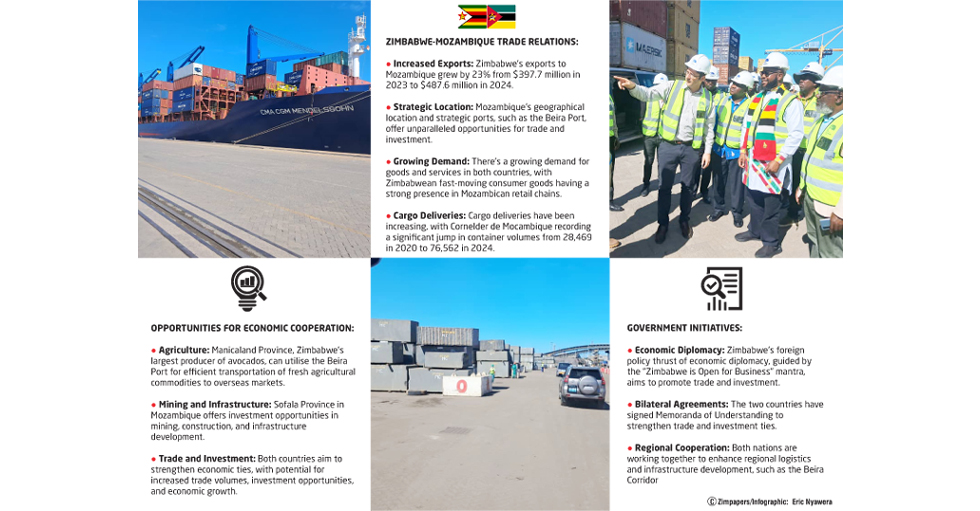
Cletus Mushanawani in BEIRA, Mozambique
ZIMBABWE’S trade landscape is witnessing a significant shift, with its neighbour, Mozambique, emerging as a key economic partner.
Bilateral trade between the two countries has been on an upward trajectory, with Mozambique now ranking as Zimbabwe’s fourth-largest trading partner.
Exports from Zimbabwe to Mozambique increased from $397,7 million in 2023 to $487,6m in 2024, showing a 23 percent growth.
This burgeoning relationship is driven by a combination of strategic geographical location, favourable trade policies, and a growing demand for goods and services.
As the two nations continue to strengthen their economic ties, the prospects for increased trade volumes, investment opportunities, and economic growth look promising.
This emerged during the ZimTrade Outward Trade Mission to Beira, Mozambique which ended yesterday (Thursday).
There is a strong presence of Zimbabwean fast moving consumer goods in Mozambican retail chains, with almost every shop, ranging from backyard tuckshops to retail giants stocking the products.
Cargo deliveries have also been growing every year, with cargo handlers, Corndelder de Mocambique recording increased volumes.
In 2020, the company processed 28 469 containers, but the figure skyrocketed to 76 562 in 2024.
The opening of the Forbes Border Post to operate 24 hours has increased cargo flow to and from Mozambique.
With Manicaland Province being the largest producers of avocadoes and a key region for fresh agricultural commodities, the Sea Port of Beira presents a strategic opportunity to safely and efficiently transport this produce to overseas markets.
Speaker after speaker during the Outward Trade Mission highlighted the importance of translating the political goodwill between Zimbabwe and Mozambique into tangible economic partnerships that deliver benefits to the people of the two nations.
Zimbabwe’s Consular General in Beira, Mr Malvern Bere said the Trade Mission aligns well with Zimbabwe’s foreign policy thrust of economic diplomacy, guided by the national mantra, Zimbabwe is Open for Business, launched by Government under His Excellency President Emmerson Mnangagwa in 2017, as a policy and promotional campaign aimed at signalling a new era of economic reform, investment friendliness, and global re-engagement.
“This Trade Mission represents a pivotal moment in the strengthening of economic ties between Zimbabwe and Mozambique—two nations bound by history, geography, and a shared vision for prosperity. Our presence in Beira underscores a mutual commitment to harnessing the immense potential of our bilateral relationship to drive sustainable economic growth.
“Zimbabwe and Mozambique have long enjoyed strong relations, dating back to the days of liberation struggles. As neighbours, we are uniquely positioned to leverage our complementary strengths. Zimbabwe brings to the table a diverse range of high-quality products and services from agricultural produce, processed foods to manufactured goods and services. Mozambique, with its strategic ports, thriving markets, and dynamic economy, offers unparalleled opportunities for trade and investment,” said Mr Bere.
He added: “The purpose of this mission is clear: to create meaningful linkages between Zimbabwean businesses and Mozambican buyers, to explore new markets, and to forge partnerships that will drive mutual prosperity. Events like this are not just about transactions, they are about building trust, fostering collaboration, and creating lasting relationships that transcend borders.
“As the Zimbabwean Consul General to Mozambique, I am proud to witness the energy and innovation that Zimbabwean companies bring to this platform. Our private sector is resilient, dynamic, and ready to compete on the global stage. To our Mozambican partners, I encourage you to explore the quality, reliability, and value that Zimbabwean businesses offer. Whether it is in agriculture, manufacturing, or services, there are opportunities to create synergies that benefit both our economies.
“I urge the Zimbabwean delegation to seize this opportunity to showcase the best of what Zimbabwe has to offer. They should engage with their Mozambican counterparts, understand their needs, and explore how we can co-create value. To our Mozambican friends, I invite them to engage with our businesses and see firsthand the opportunities awaiting them.”
Minister Mugadza said as people of the two countries honour the strong political relations, there is need to turn focus towards the growing imperative of economic diplomacy.
“Mozambique and Zimbabwe possess vast complementary resources – from agriculture and energy to mining and logistics – that, if synergised, could unlock greater trade and industrial development for both our nations. Let me emphasise that increasing bilateral trade and investment is no longer an option; it is a necessity.
“We must work together to remove bottlenecks, harmonise trade policies, and promote greater private sector engagement. Initiatives such as the Beira Corridor development and enhanced border infrastructure should be prioritised to facilitate smoother movement of goods and services. Manicaland Province has vast investment opportunities which Sofala Province can be interested in.
“From mining, agriculture, tourism, hospitality, transport and logistics to name but a few, Sofala Province stands to benefit from an investor friendly environment that we offer. The business delegation that has accompanied us has a lot to learn from this end, and we hope they will find a market for their products and also consider setting up shop here. Our joint borders process a lot of goods on a daily basis, most of which destined for the international market through the Beira Ports. We are hopeful that more and more goods should be destined for our local markets in Manicaland and Sofala Provinces,” said Advocate Mugadza.
Secretary of State for Sofala Province, Her Excellency Cecilia Sandra Jeronimo Francisco Chamutota said Zimbabwean companies’ presence in Beira, was not just a diplomatic gesture, but a firm commitment to strengthening trade and investment relations, cooperation and building sustainable partnerships between our countries.
“We had the opportunity to share ideas, identify opportunities and lay the foundations for future investments in strategic sectors for mutual development. The speeches were marked by clarity, vision and a spirit of collaboration, contributing significantly to the success of this conference.
“The ideas generated here should not just stay in the conference room. The real impact will come from our ability to turn these proposals into concrete actions, to keep the dialogue open and to strengthen the partnerships established. We would like to acknowledge the effort and dedication of everyone involved in this mission, from government representatives to businesspeople, civil society, national and international organisations, entrepreneurs, academics and others, whose professionalism and openness to dialogue have remarkably enriched our debates,” said Her Excellency Chamutota.
Cornelder de Mocambique executive managing director, Mr Jan de Vries said imports from Zimbabwe tripled over the past few years with more people opting to use Beira to export or import their goods.
“We are handling a lot of imports from Zimbabwe on a daily basis, ranging from tobacco, chrome, ferrochrome, vermiculite to tea. Of late, we are now handling high volumes of lithium exports from Zimbabwe. Many people now opt to use Beira as their export route from Zimbabwe because of the distance. When we started in 1998, we were handling 0,46 metric tonnes of cargo, but this has since jumped to 4, 05 metric tonnes. Our terminal is the most efficient in Southern Africa.
“We have the capacity to store around 10 000 containers here in the yard. As we continue growing, we will continue investing, and we are anxiously waiting for the arrival of new and bigger cranes from the USA that will handle bigger vessels. We are also expanding our yard to store more containers. We are also modernising and digitalizing our systems so that we can do things more efficiently, and continue serving the Zimbabwe market which is very important for us,” said Mr Jan de Vries.
ZimTrade Eastern Region manager, Mr Admire Jongwe said their presence in Beira was to seek more markets for the Zimbabwean products as well as business opportunities for businesses.
“Our exports are increasing and we want to see more being done in that sector. Mozambique is now ranked fourth on the exports recipients from Zimbabwe, and we want to see more Zimbabwean products in this neighbouring country. Most of the exports from Zimbabwe to Mozambique include processed foods, building and construction materials, iron and steel, social services, agro-processing, agriculture inputs and implements, horticulture and minerals.
“From this Trade Mission we expect the signing of trade deals between Zimbabwean companies and their Mozambican counterparts. This is also an opportunity to create business leads and synergies for our local businesses. We are also out to help Zimbabwean companies to improve their understanding of the Mozambican market, and enhance bilateral trade cooperation taking advantage of the Bilateral Trade Agreement and trading blocs such as SADC and COMESA. We also want local businesses to also source products from Beira,” said Mr Jongwe.
Sofala Business Council president, Mr Ricardo Cunhaque said there are a lot of investment opportunities in the construction, infrastructure, education, tourism, mining, hydro-power generation and agriculture sectors.
“There are a lot of investment opportunities in various sectors in Mozambique especially agriculture, mining and construction. We have a young population and there are massive opportunities in the construction sector as we need to build more houses and schools for our children. There is rapid urban growth in cities like Maputo, Matola, Beira, Nampula and Chimoio, so we need more houses, schools, roads, bridges and hospitals. This means high demand for construction materials and services.
“We also need to invest in our education so that we produce graduates with high technical skills. We also need investment in agro-processing so that we can utilise the vast tracks of land in Mozambique to feed our growing population. We are open to engage with businesses who want a win-win situation. We believe that with a clear vision and commitment we can make a difference and make our two countries big trade partners,” said Mr Cunhaque.
“Cornelder de Moçambique (CdM) is a private consortium, formed through a partnership between the Mozambican public company Porto e Caminhos de Ferro de Moçambique (CFM – Ports and Railways of Mozambique) and Cornelder Group. CdM has been operating the Container and General Cargo Terminals in the port of Beira since October 1998 and is one of the most important providers of the port services in Mozambique. It is currently cited as one of the key bases for transport logistics in the country.”