


 Online Reporter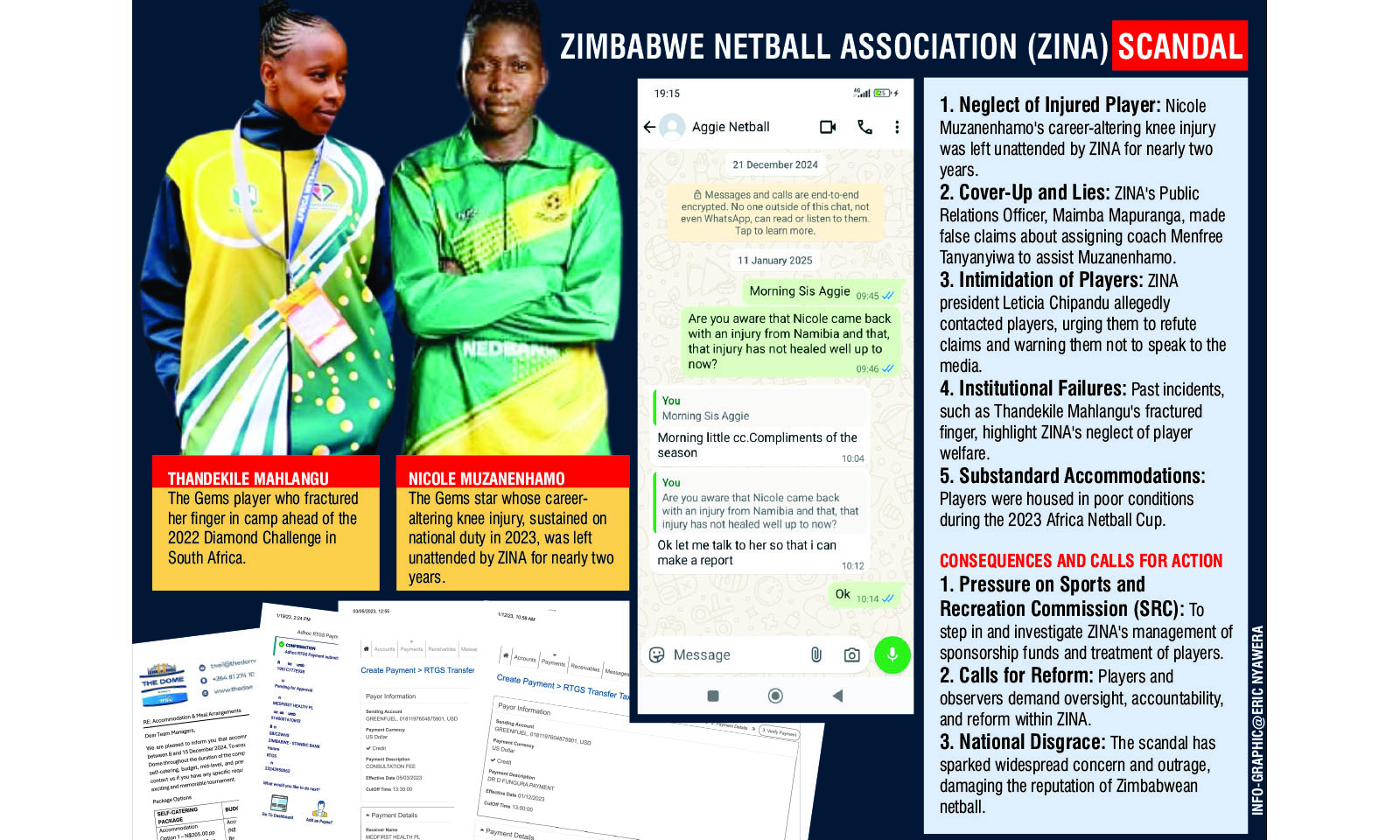
Veronica Gwaze
Zimpapers Sports Hub
LAST Sunday, this publication laid bare the rot at the heart of Zimbabwe Netball Association (ZINA) — a trail of broken promises, neglected athletes and questions over how resources are managed — despite a major sponsorship deal with a top financial institution.
If last week raised alarm bells, what has been laid bare in the days that followed has blown the lid off a culture of deceit, intimidation and systemic failure.
Instead of addressing the glaring concerns, the netball mother body appears to have doubled down, reaching into their bag of old tricks: cover-ups, coercion and outright lies.
As Zimpapers Sports Hub has discovered, the more ZINA try to clear their name, the deeper they sink into scandal.
At the centre of the unfolding drama is Nicole Muzanenhamo, the Gems star whose career-altering knee injury, sustained on national duty in 2023, was left unattended by ZINA for nearly two years.
After last week’s exposé, the association’s public relations officer, Maimba Mapuranga, reached out in a belated attempt to clean up the mess.
He admitted Muzanenhamo was injured while representing Zimbabwe at the Africa Netball Cup in Botswana, but claimed the association had assigned coach Menfree Tanyanyiwa to assist her, citing convenience, since both are based in Bulawayo.
Yet, in a recorded conversation, Tanyanyiwa flatly denied ever being approached or mandated by ZINA to perform the task.
“What he is saying is not true. I am not a ZINA member, so why would they assign me that role?” Tanyanyiwa questioned Mapuranga’s claim.
“And if they truly wanted to help, why didn’t they approach her actual coach, Sibonginkosi Dube, who’s also in Bulawayo?”
This contradiction alone casts fresh doubts on the association’s version of events.
But the plot was far from over.
On Thursday, sources confirmed that Mapuranga travelled to Bulawayo and sought a meeting with Muzanenhamo at a local hotel.
He allegedly offered to finally take her to a specialist — an offer the player declined, referring him to her handlers.
“It felt like a smokescreen,” said a close source. “They are only rushing now because they were exposed.”
That same day, another troubling development emerged.
ZINA president Leticia Chipandu allegedly began contacting national team players individually, urging them to publicly deny claims that they had been made to pay US$70 for warm gear ahead of last year’s Scotland Invitational Tournament, despite the presence of a title sponsor.
One player, speaking on condition of anonymity, revealed she recorded the conversation.
“She said she was under probe and feared we would be questioned. She warned us not to speak to the media and threatened to exclude anyone who did from future national teams,” the player said.
The message was unmistakable: Protect the institution at all costs, even if it means silencing those it is supposed to protect.
Yet that message has been heard before.
ZINA’s recent actions are not isolated blunders; they appear to be part of a disturbing trend that has persisted behind closed doors for years.
Take, for instance, Thandekile Mahlangu, another Gems player, who fractured her finger in camp ahead of the 2022 Diamond Challenge in South Africa.
Despite expressing pain and requesting to rest, she was forced to travel and play.
Only after visible discomfort during the second match was she benched.
And when the team returned to Zimbabwe, ZINA did nothing about her injury and never followed up on her condition.
It was her club that eventually stepped in, footing a US$4 000 bill for corrective surgery, a cost the association never acknowledged.
These are not just administrative oversights. They are institutional failures — those that threaten players’ careers, livelihoods and physical well-being.
The Gems’ trip to Namibia for the 2023 Africa Netball Cup is yet another chapter in ZINA’s growing book of negligence.
According to documents reviewed by this publication, the tournament’s organisers had secured the Dome Hotel in Swakopmund for all teams.
ZINA’s sponsor had selected a mid-level package for the Gems at N$1 085 per person per day.
Due to late communication, the funds were wired directly to ZINA’s account and the association then made their own arrangements.
The players were housed at the Swakopmund Municipal Rest Camp, crammed into frame-type chalets at an average of N$900 per unit — four players per room.
“We raised concerns about the conditions,” said one player. “But we were told to keep quiet or risk being blacklisted from national team selections.”
The silence, it seems, is not consensual. It is for survival.
For many of these athletes, netball is not just a sport, it is their livelihood. And being dropped from the national setup could mean losing access to sponsorships, stipends and exposure.
In that context, many choose silence over speaking the truth.
ZINA’s troubles are no longer whispers in the corridors; they are loud cries for oversight, accountability and reform.
What is most damning is not the initial injury, or the shabby accommodation or the bizarre demand that players fund their own kit.
It is the response, a web of denials, threats and contradictions that reveal an organisation more committed to self-preservation than athlete welfare.
And even as the net tightens around ZINA, players are the ones who remain trapped, torn between representing their nation and protecting themselves from the very body meant to support them.
In the wake of these revelations, pressure is now mounting on the Sports and Recreation Commission to step in.
Questions loom over how sponsorship funds are being managed, why injuries are neglected, and why players feel coerced into silence. If the national netball team, one of Zimbabwe’s most admired women’s sports brands, can be left this vulnerable, what message does that send to the next generation?
Who will want to play for a team where pain is ignored, truth attracts punishment and lies are policy?



