Online Reporter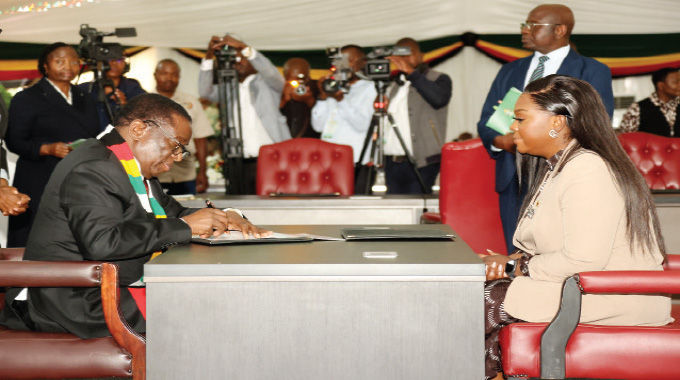
Oliver Kazunga, [email protected]
AS Artificial Intelligence (AI) reshapes economies and societies across the globe, Zimbabwe is making a bold and deliberate move to secure its place in this rapidly evolving technological era. Last Friday, the nation unveiled its National Artificial Intelligence Strategy (2026–2030), signalling a determined push to harness cutting-edge technologies for economic transformation, innovation and long-term national development.
The launch arrives at a pivotal moment. According to a United Nations Trade and Development (UNCTAD) report, the global AI market is projected to surge from US$189 billion in 2023 to an extraordinary US$4,8 trillion by 2033 — a 25-fold leap within a decade. UNCTAD further anticipates that AI will dramatically expand its dominance in the frontier technology landscape, rising from seven percent to 29 percent of the sector.
Against this backdrop of explosive global growth, Zimbabwe is positioning itself not as a bystander but as an active and deliberate participant seeking to shape AI for national and regional progress.
President Mnangagwa launched the strategy at the New Parliament Building, an event that brought together Government officials, academics, industry leaders and development partners. Standing proudly in the continent’s emerging administrative capital of Mount Hampden, the Parliament complex has become a visual symbol of Zimbabwe’s modernisation drive — an apt venue for the unveiling of a policy designed to place the country at the forefront of Africa’s AI discourse.
Yet the ambition behind the strategy stretches far beyond symbolism. Rather than viewing AI as a passing technological trend, the national framework presents it as a cornerstone of development — linking economic transformation, innovation, technological sovereignty and cultural identity.
Central to the strategy is a framework built on six pillars: talent development, digital infrastructure, sector adoption, governance and ethics, research and innovation and international co-operation. These pillars together aim to position Zimbabwe as a regional centre for inclusive and sustainable “AI for Development” within Southern Africa.
A defining feature of the strategy is its grounding in African philosophical values. The policy places heavy emphasis on Ubuntu, indigenous knowledge systems, and the development of AI that supports local languages and cultural contexts — a distinctive approach that blends modern technology with African identity.
Delivering the keynote address, President Mnangagwa stressed AI’s importance to Zimbabwe’s ongoing modernisation.
“Artificial intelligence will reshape economies, societies and the nature of work. Zimbabwe must not be a passive consumer of these technologies. We must be creators, innovators and leaders in applying AI to solve our own development challenges,” he said.
He added that the strategy aligns closely with the Government’s Vision 2030 agenda, which aims to transform Zimbabwe into an upper-middle-income economy. AI, he said, has the potential to vastly improve productivity and efficiency across key sectors including agriculture, mining, healthcare, education, energy and public service delivery.
“Our approach is guided by Ubuntu. Technology must enhance human dignity, strengthen communities and advance shared prosperity.”
Information Communication Technology, Postal and Courier Services Minister Tatenda Mavetera presented the strategy’s technical framework, outlining mechanisms to guide implementation over the next five years. These include the establishment of a National Artificial Intelligence Council for oversight, and an AI Strategy Implementation Office to co-ordinate delivery across Government institutions.
The strategy also proposes AI centres of excellence within universities and regulatory sandboxes to enable controlled experimentation with emerging technologies. Minister Mavetera said a strengthened digital backbone — through upgraded high-performance computing and sovereign data platforms — would be crucial to supporting local innovation.
“Artificial intelligence must serve Zimbabwe’s development priorities. Our strategy places strong emphasis on building local talent, empowering start-ups and ensuring that our data and computational resources benefit the people of Zimbabwe,” she said.
For 24-year-old software developer Tariro Rinomhota, the new policy brings renewed optimism. Running a Harare start-up that uses AI to translate textbooks into Shona and Ndebele, she described the strategy as transformative.
“Before this, it was almost impossible to access educational content in local languages. This strategy gives young innovators like me the framework and support to scale our ideas for real impact,” she said.
Her experience underscores the strategy’s practical intention — AI is not abstract, but something that can directly touch and improve everyday lives.
The private sector has welcomed the strategy, praising its emphasis on national sovereignty, local innovation and sector-wide transformation. Technology leaders highlight its potential applications in precision agriculture, mineral resource optimisation, fintech, and enhanced digital public services.
However, many stakeholders note that execution will be decisive. Zimbabwe faces persistent challenges, including electricity reliability, access to advanced computing infrastructure, limited venture capital and procurement systems that allow start-ups to compete for government technology projects.
“The strategy provides a compelling vision. The real challenge will be translating that vision into operational systems and commercially viable solutions,” said AI expert and World Federation of Engineering Organisation vice president, Dr Engineer Martin Manhuwa.
Academics have also welcomed the strategy, celebrating its emphasis on research, ethical governance and culturally grounded AI development. Scholars highlight the inclusion of Ubuntu philosophy, indigenous knowledge systems and local-language technologies as refreshingly distinctive. Universities have expressed strong support for the creation of research hubs and centres of excellence, which they believe will strengthen postgraduate training and partnerships with industry.
Regionally, Zimbabwe’s AI policy stands out within the Southern African Development Community (SADC) for its comprehensiveness — tying together infrastructure development, governance structures, talent pipelines, research capacity and sector-wide deployment. Internationally, it distinguishes itself through its commitment to national identity, technological sovereignty and inclusive development.
Analysts note that the greatest hurdle lies not in conceptual vision but practical implementation. Compared with mature frameworks in China, the United States, Europe and India, Zimbabwe’s strategy is less detailed on financing mechanisms, rollout sequencing and incentives needed to attract large-scale private investment. Many initiatives — from high-performance computing and sovereign data platforms to innovation funds and sectoral AI systems — will require substantial resources, careful co-ordination and sustained political will.
Zimbabwe’s most viable path may lie in developing specialised strengths in development-focused AI, including climate-smart agriculture, mineral resource optimisation, digital public services and local-language technologies.
Ultimately, the strategy is bold, visionary and deeply anchored in national identity — placing ethical governance, inclusive development and technological sovereignty at its core. The launch at the New Parliament Building marks an important beginning. The true test will be whether Zimbabwe can turn its vision into functioning systems, competitive industries and meaningful opportunities for its people.