


 Online Reporter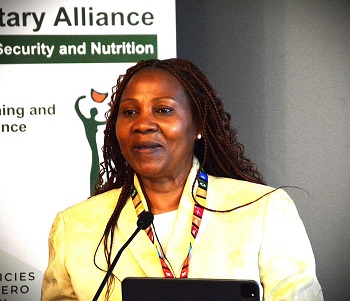
Moses Magadza and Angel Alessandri
THE inaugural meeting of the SADC Parliamentary Alliance on Agrifood Systems, Food Security and Nutrition began in Johannesburg, South Africaon July 22,2025, with the SADC Parliamentary Forum and the Food and Agriculture Organisation of the United Nations (FAO) calling for stronger parliamentary action to combat hunger, malnutrition and build resilient agrifood systems across Southern Africa.
Addressing delegates who included lawmakers from different SADC member states, development partners and technical experts, SADC PF Secretary-General Ms Boemo Sekgoma said the meeting came at a time of global food crises exacerbated by conflict, climate change and inequality.
“As we speak,” she said, “thousands of individuals, including women and children, are deprived of nutrition in the Middle East due to armed conflicts. The situation is no better in Africa, where protracted droughts and hotter summers have rendered food scarce, unavailable or simply unaffordable in certain areas.”
Hunger, she said, was not merely a biological state but a structural injustice.
“These children are not lazy. They are hungry. And hunger does not merely gnaw at the stomach — it gnaws at dreams, at potential, at futures,” Ms Sekgoma stated, referring to reports from one member state where rural teachers keep food diaries to track what their students are not eating.
She advocated for treating food not as a private matter but as a “parliamentary concern, a human right and a legal obligation”.
She called on parliaments across the region to adopt robust legislative and oversight mechanisms to advance food justice.
Citing international standards such as General Comment 12 on the Right to Adequate Food by the UN Committee on Economic, Social and Cultural Rights, Ms Sekgoma stressed that availability, accessibility and cultural appropriateness are indispensable to fulfilling this right.
She also pointed to the paradox of global food systems, where, amid widespread hunger, 2025 saw the increase of billionaires to over 3 000 billionaires, a reflection of growing inequality.
“Does capitalism always serve the cause of malnutrition and food insecurity in the world? Or would a measure of socialism be better for food security?” she asked.
Lawmakers were urged to leverage their legislative powers to promote agricultural productivity, remove tariffs on staple foods, support smallholder farmers and provide social safety nets during emergencies.
“Parliamentary activity can enhance agro-business schemes, remove value-added taxes on rice and cereals and oversee safe pest control methods,” she said.
It is believed that remunerative employment laws must be part of the solution to food insecurity.
Ms Sekgoma reaffirmed the SADC PF’s commitment to human rights as enshrined in its 2024–2028 Strategic Plan.
She urged members of the alliance to align their work with SADC’s Vision 2050 and the African Union’s Agenda 2063.
“If we are to build the coveted SADC of tomorrow … our citizens must be safe from food insecurity. Their rights to food must be implemented to their fullest extent,” she said.
Speaking at the same occasion, Dr Babagana Ahmadu, the FAO Representative in South Africa, hailed the partnership between FAO and SADC PF as “pivotal” in achieving food security and transforming food systems in the region.
He urged lawmakers to treat the right to adequate food as a fundamental human right and a political imperative.
“This gathering is particularly timely, marking a significant milestone in our collective efforts to address hunger, malnutrition and the sustainability challenges within our region,” said Dr Ahmadu.
He stressed the role of parliamentarians as agents of change and said their legislative, budgetary and oversight mandates are essential to ensuring the right to food is realised for all citizens.
The meeting comes as the region prepares to host the Global Parliamentary Summit against Hunger and Malnutrition in 2026, a landmark event that Dr Ahmadu said would benefit from the momentum and strategic direction emerging from the newly formed alliance .
“Our initiative here is instrumental in paving the way for informed legislative action and strengthened regional leadership,” he added.
Dr Ahmadu expressed confidence that the deliberations in Johannesburg would not only result in robust governance structures for the alliance, but also deliver strategic roadmaps that “enhance parliamentary capacities across SADC nations”.
“We look forward to your active engagement as we collaboratively build the capacity to effectively legislate and implement policies that uphold the right to adequate food,” he said.
The meeting, which runs until July 24, brings together members of parliament from across the SADC region, experts from the FAO and officials from the SADC PF Secretariat.
It also aims to formalise the alliance, build the legislative capacity of MPs on food rights and chart a common regional agenda towards ending hunger and malnutrition.



 Online Reporter