admin
admin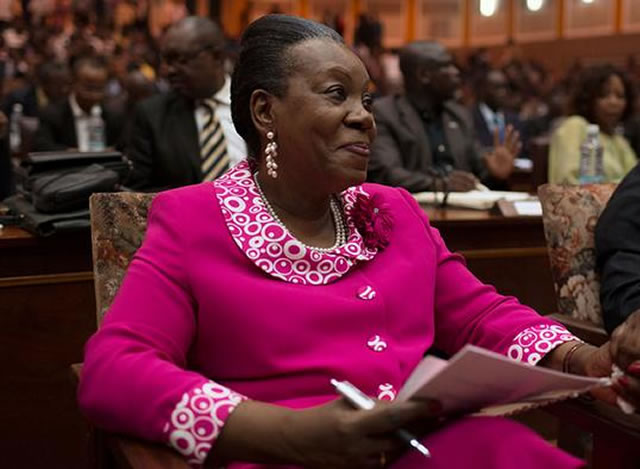
Bangui — Central African Republic’s new interim president Catherine Samba-Panza warned there were not enough international troops to restore peace in her country, as she prepared to assume office yesterday.Her comments came the day after the UN officials urged African nations to reinforce the military mission or risk a descent into genocide.
“The present number of troops is not sufficient to regain order in Bangui,” Samba-Panza said in comments published in yesterday’s Le Parisien newspaper in France.
While applauding the military involvement of former colonial power France, she said she hoped other European countries would “follow France’s example”.
Samba-Panza said her priorities after she is installed would be “a return to security” and putting people back to work. The violence pitting civilians and Christian militiamen against ex-Seleka fighters of the Muslim minority claimed 10 more lives on Wednesday in the capital Bangui, witnesses said.
The trouble broke out near a prison and a military barracks housing the former rebels, they said. Samba-Panza lives just 100 metres from the prison.
The witnesses said they saw the bodies of six former fighters and four Christian civilians near the prison building. Medics from the 1,600-strong French peacekeeping force tried in vain to save the life of one former Seleka fighter with extensive machete wounds.
The UN envoys on genocide prevention, human rights, children and sexual violence in conflict all called on the UN Security Council to order tougher action.
Adama Dieng, the UN advisor on the prevention of genocide, said the size of the African force, officially known as Misca, means it cannot cope with the chaos.
Only 4,000 troops of a promised 6,000 African force have been deployed in the country, mainly in Bangui.
“There is an urgent need for the full deployment of Misca peacekeepers as soon as possible,” Dieng told a Security Council meeting in New York.
Dieng said that on a visit to the country in December, he had been shocked by the “level of hatred” that has built up between the Muslim and Christian populations as the government has lost control.
He said there was a “high risk both of crimes against humanity and of genocide”. Leila Zerrougui, UN envoy on children in conflict, said there had been “unprecedented levels of brutality” against children and others.
On Monday EU foreign ministers agreed to send hundreds of troops to back up the French and African forces already on the ground.
The archbishop of Bangui, Dieudonne Nzapalainga, and its imam, Oumar Kobine Layama, during a trip to Paris, lamented that most of the country remains under the control of warlords.
The religious leaders urged the international community to support Samba-Panza.
“Everyone must get behind her for the transition to become a reality. We must support her, encourage her, help her,” Nzapalainga said.
Samba-Panza faces “enormous challenges” including disarming and billeting the fighters as well as reintegrating them into society, the archbishop added.
The Seleka mounted a coup in March 2013 and installed their leader Michel Djotodia as the country’s first Muslim president, triggering a descent into chaos.
The latest unrest in the capital, where 1 000 people were reportedly killed last month alone in clashes between Christian and Muslim militias, comes just 48 hours after Samba-Panza’s election as interim president.
Djotodia stood down on January 10 under intense regional pressure over his failure to stem the violence that has displaced a fifth of the country’s 4,6 million people.
He had overthrown President Francois Bozize in a country with a long history of coups, attempted coups and army mutinies.
Looking to restore a functioning state and heal religious hatred, Samba-Panza said Tuesday: “We have thousands of armed youths, both with the Seleka and the anti-balaka [Christian militias]. If we release them onto the street, we will not have solved the problem.”
Samba-Panza, whose election by parliament has been hailed by Central Africans and the international community, said the new government would have to find ways to provide new opportunities for young people in the resource-rich but desperately poor former French colony.
“It is often out of anger, in extreme poverty and with no future that these young people resort to violent behaviour,” she said.
But the new president will be totally reliant on foreign funds as the government coffers are empty. On Monday, international donors pledged $496m in aid to the country for 2014.
And Nzapalainga noted that because the unrest had forced farmers to skip two planting seasons, serious food shortages loomed. — AFP


 Online Reporter