Ivan Zhakata-Herald Correspondent
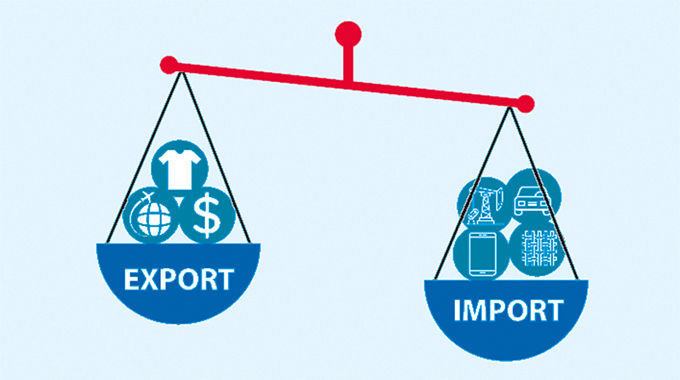
ZIMBABWE’S external trade position saw a dramatic improvement in July, with the nation’s goods trade deficit dropping by 94.5 percent to just US$8.7 million.
In a statement, the Zimbabwe National Statistics Agency (Zimstat) said the turnaround from a June deficit of US$158.6 million was attributed to a significant surge in exports.
Zimstat detailed the robust performance of Zimbabwe’s export sector.
“July 2025 exports amounted to US$877.5 million, an increase of 21.3 percent (US$154 million) from the June 2025 value of US$723.5 million,” reads the statement.
The export boom was primarily driven by a handful of key commodities.
Semi-manufactured gold, nickel mattes, and tobacco were the top three exports for the month, collectively accounting for over 75 percent of the total export value.
Semi-manufactured gold alone represented more than half of all exports at 51 percent, while nickel mattes and tobacco contributed 15.9 percent and 8.1 percent respectively.
Imports, while still significant, saw only a marginal increase, helping to narrow the trade gap.
Total imports for July stood at US$886.2 million, a modest 0.5 percent rise from June’s US$882.1 million.
The main imported products were mineral fuels, mineral oils, machinery and mechanical appliances and vehicles.
The Zimstat report also shed light on the country’s key trading partners.
The United Arab Emirates emerged as the top destination for Zimbabwean exports in July, receiving 51.6 percent of all goods, primarily due to the export of semi-manufactured gold.
South Africa and China followed as the second and third largest export markets, respectively.
On the import side, South Africa remained Zimbabwe’s largest source of goods, supplying 35 percent of the total, followed by China, Bahrain and the Bahamas.
The data also provided a detailed breakdown of trade within regional and continental blocs.
Exports to the Southern African Development Community (Sadc) were dominated by nickel mattes, while exports to the European union (EU) were led by tobacco and ferro-chromium.
Major imports from SADC included machinery and mineral fuels, while the EU primarily supplied pharmaceutical products and mechanical appliances.
While the trade deficit has not been completely eliminated, the significant reduction provides a welcome boost for Zimbabwe’s economic outlook, indicating a healthier balance in its international trade activities.
Financial Economist Mr Malone Gwadu said this was a statistical depiction of trade movements in the economy, where key commodities lead in earnings due to increased output as the country is now in the peak season of production and trade.
“Tobacco season is now in full throttle and is playing its part in increasing export earnings and by derivation narrowing trade deficit,” he said.
“Also, mineral export prices have improved, hence increased earnings that improve overall trade health. On the supply side, the relatively smaller increase in imports generally speaks to a higher marginal propensity to export than to import. This is a healthy economic phenomenon which needs to be sustained to ramp up our productive capabilities and export competitiveness.”
Dr Persistence Gwanyanya, an economist, said the trade balance was a high-impact variable on currency stability in Zimbabwe for several reasons.
“Driven by a surge in exports, the improvement in trade balance implies increased export surrender, which is key is liquifying the interbank market,” he said.
“The notable improvement in the functionality of the interbank market since the introduction of ZiG, typified by the capacity to satisfy the demand for forex and narrowing parallel market premiums, largely on account of improved trade balance bears, is telling. It is important to realise that due to exchange control regulations, which treat remittances as free funds, there is no guarantee that these inflows are captured into the mainstream economy or formal banking system to support currency stability.
“This is why we are more interested in trade balance beyond, current account balance or BoP. We get more insights on the impact of external balance from trade balance than from current account balance or BoP position.”
Dr Gwanyanya said improvement in trade balance demonstrates good prospects for the country.
Mrs Gladys Mutsopotsi-Shumbambiri, a financial analyst, said the sharp narrowing of Zimbabwe’s trade deficit in July was an encouraging development, reflecting the strong performance of mineral and tobacco exports.
“The 21.3 percent rise in exports demonstrates the country’s capacity to leverage its comparative advantage in commodities to strengthen the external sector,” she said.
“Importantly, this improvement comes despite imports remaining relatively stable, showing that the surge is export-driven rather than a result of suppressed demand. However, while this is a positive sign for foreign currency inflows and the balance of payments position, Zimbabwe still faces the challenge of export concentration in a few primary commodities.
“Commodity price volatility poses serious risk, and to sustain this momentum, the country needs to diversify its export base, add value through beneficiation, and expand non-traditional exports such as agriculture value chains and manufactured goods. If the gains are to be sustainable, it will also be crucial to channel the increased export earnings towards retooling industry, supporting infrastructure, and enhancing productivity.”
The narrowing deficit, Mrs Mutsopotsi-Shumbambiri said, becomes more than just a short-term statistic.
“This can form the foundation for sustainable trade growth and improved economic resilience,” she said.