Online Reporter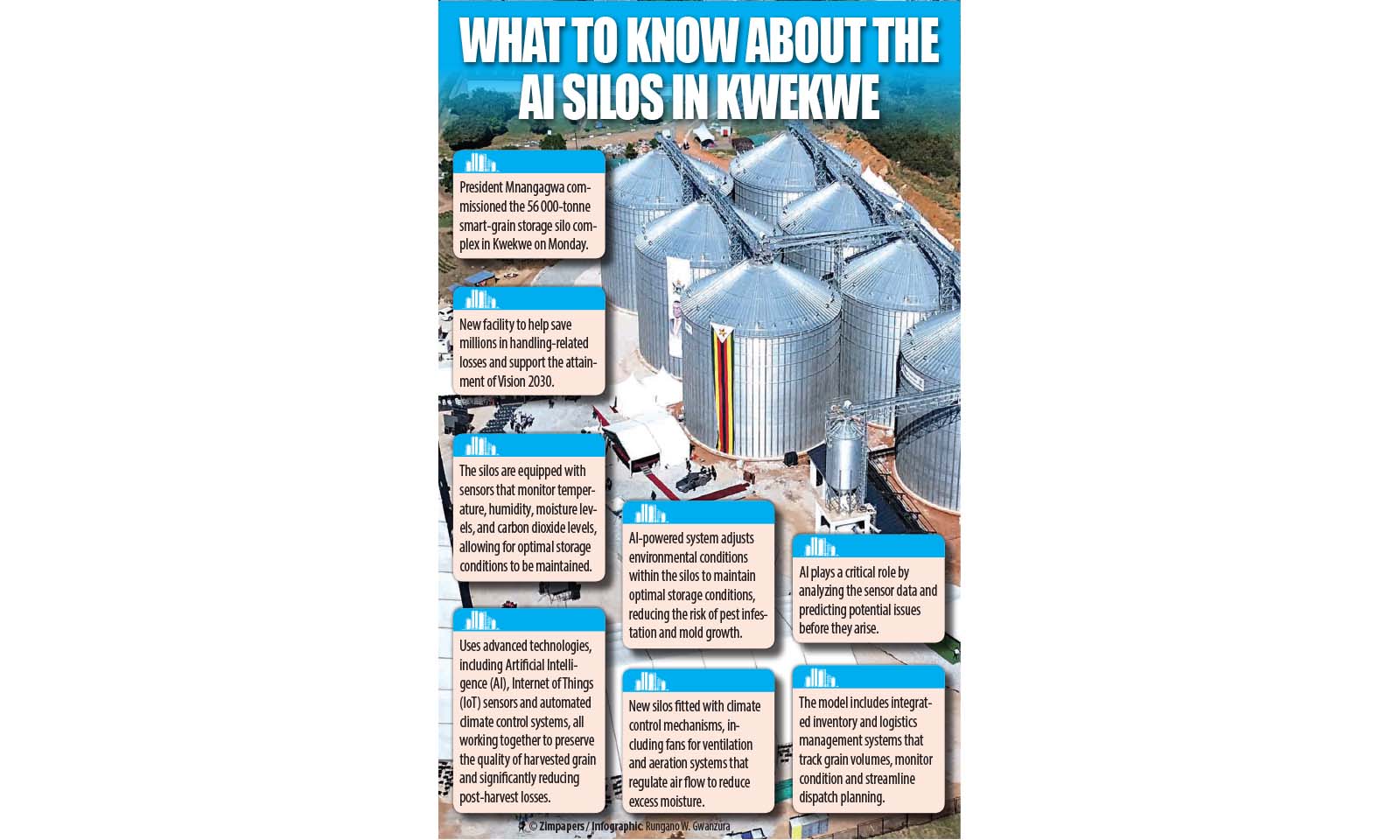
Innocent Mujeri
IN a defining moment for Zimbabwe’s agricultural future, President Mnangagwa on Monday commissioned a state-of-the-art 56 000-tonne smart grain silo complex in Kwekwe.
This milestone not only marks a leap in infrastructural development but also reflects the Second Republic’s unwavering commitment to achieving national food security, rural transformation, and economic resilience as part of Vision 2030.
The silos — powered by artificial intelligence and equipped with advanced preservation technologies — are a testament to the Government’s investment in forward-thinking, sustainable food systems.
This facility is more than concrete and steel; it’s a symbol of hope, strategy, and progress.
The smart silo complex at the Kwekwe Grain Marketing Board (GMB) depot represents a radical shift from the outdated, loss-prone infrastructure of the past.
Previously, Zimbabwe lost over US$30 million annually due to grain spoilage from pests, moisture, and poor handling systems.
With seven self-cleaning, temperature-regulating silos capable of preserving grain for up to seven years, that era is coming to a definitive end.
The new system’s ability to load or offload 100 tonnes per hour drastically reduces turnaround times, improving efficiency across the grain supply chain.
More importantly, this project is the first of 14 additional silo depots to be rolled out across all rural provinces, ensuring that every corner of Zimbabwe has access to safe and reliable food storage.
President Mnangagwa made it clear: the fight for food security must be won at both national and household levels.
In line with this, Government has committed to upgrading the country’s existing seven older silo complexes and building new ones in historically underserved, drought-prone regions such as Beitbridge, Gwanda, Lupane, and Gokwe.
This expansion is not just about storage — it’s about strategy. It enables grain to be stored near vulnerable communities and made readily available during times of crisis.
Such foresight is vital in mitigating the effects of unpredictable weather patterns, droughts, and economic shocks.
By targeting high-risk regions and integrating AI-driven monitoring systems — capable of tracking moisture, temperature, humidity, and carbon dioxide in real time — the Government is laying a durable foundation for agricultural resilience.
Food security starts with the farmer. Recognising this, the Second Republic has been proactive in introducing fair and competitive producer prices for crops.
As announced by the GMB, maize and traditional grains will be purchased at US$376,48 per tonne, soya beans at US$580, and sunflower at US$668,98.
Meanwhile, wheat producers will benefit from an incentive price of over US$4 451 per tonne.
This pricing structure not only rewards productivity but also serves as a floor for market prices, protecting farmers from exploitation.
Additionally, the Government’s continued investment in the climate-proof Pfumvudza/Intwasa programme has empowered smallholder farmers with free inputs, technical training, and guaranteed markets.
These steps are breathing new life into the agricultural sector, making farming a viable and dignified source of income for thousands of Zimbabweans.
Even in the face of the worst drought in 43 years, the Government kept its promise — no Zimbabwean died of hunger.
Through an impressive logistical effort, over 328 000 tonnes of food were distributed to vulnerable households, and nearly 4 million schoolchildren benefited from the School Feeding Programme.
This feat reflects more than efficiency; it speaks to a governance model rooted in compassion and responsiveness. The silo programme enhances this capability, ensuring that future droughts will meet a more prepared and better-equipped Zimbabwe.
Climate change poses a persistent threat to agriculture, with Zimbabwe already experiencing its harsh realities — erratic rainfall, flooding, and new pests.
The new smart silos are part of a broader climate adaptation strategy designed to increase the country’s grain reserve capacity from 750 000 tonnes to 1,5 million tonnes.
By being able to store grain for up to three years, the country will be more equipped to bridge the gap between good harvests and dry spells.
President Mnangagwa’s push for smart, tech-driven solutions reflects a long-term vision that understands the interconnectedness of food security, climate resilience, and national sovereignty.
The strategic location of new silos in both high-yield and low-rainfall provinces is a reflection of the Government’s devolution agenda.
By decentralising storage facilities, farmers reduce transport costs and gain quicker access to markets. Moreover, the smart silos foster inclusive development — where no province or community is left behind in the journey toward food security.
A fundamental shift under the Second Republic has been the commercialisation of agriculture.
With the re-modelling of agricultural extension workers into business advisors, farmers now receive better guidance on increasing productivity, reducing waste, and managing farms efficiently.
Additionally, President Mnangagwa has called on universities and industries to innovate around home-grown storage and post-harvest solutions. This collaboration between academia, government, and industry is key to building a self-reliant agricultural ecosystem.
All these developments point toward one bold goal — achieving an empowered and prosperous upper-middle-income economy by 2030.
The smart silos are not an isolated project, but part of a larger mosaic of agricultural reforms, technological advancement, and social support.
From policy to implementation, the Government is actively delivering on its promises.
The Second Republic has not only prioritised infrastructure but also woven food security into the fabric of national development.
As the sun rose over the newly commissioned silos in Kwekwe, it illuminated more than a modern structure.
It cast its light on a new era —where no child sleeps hungry, where rural farmers are empowered, and where the nation is prepared for both prosperity and hardship.
The commissioning of AI-powered silos is not just an agricultural achievement — it is a social contract, a national insurance policy, and a cornerstone of Zimbabwe’s bright future.
President Mnangagwa and his administration deserve commendation for this bold stride.
With continued investment, collaboration, and unity, Zimbabwe’s dream of food sovereignty and economic dignity is well within reach.