

 admin
admin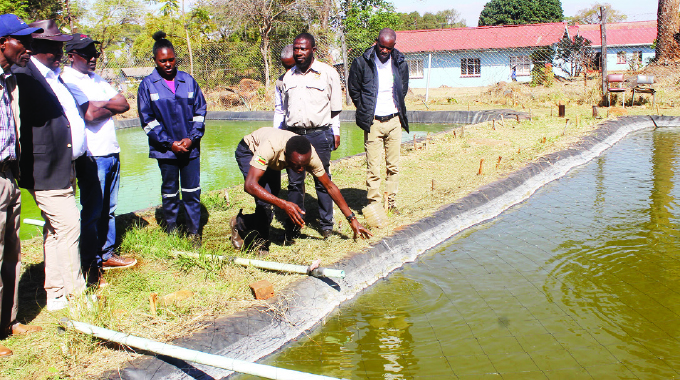
Mangaliso Lawrence Kabulika
The Government is pulling out all stops to ensure the country’s flagship fish farming programme does not lose its momentum through fingerling shortages and has moved to identify additional breeding sites to augment existing ones such as Kariba Breams to tame the growing demand for the product.
Director of Fisheries and Aquaculture Resources Department (FARD), Mr Milton Makumbe yesterday revealed that sites were identified in Chipinge, Lupane, Matopos and Toppick in Zhovhe Dam, which is already producing fingerlings that will be absorbed by the aquaculture sector later this year.
Mr Makumbe added that the breeding sites were dotted across the country at Government research institutes.
He went further to say: “We are also upgrading our breeding sites such as Henderson Research Fisheries Unit where we breed species to support either the Presidential Community Fisheries Scheme or sell to fish farmers.”
He further revealed that Zimbabwe’s annual fish consumption per individual was three kilogrammes basing on a survey they conducted four years back.
However, the Zimbabwe National Statistics Agency (ZimStats), recently presented that the rural population in Zimbabwe accounted for 68 percent of annual fish consumption in both volume and value whilst the urban community took care of 32 percent of the annual expenditure on fish consumption.
“There will, in fact, be another survey later this year in conjunction with the United Nations Food and Agriculture Organisation (FAO),” said Mr Makumbe.
Mr Makumbe further revealed that 51 dams had since been stocked with the juvenile fish.
“For this year we have managed to procure two million fingerlings from Lake Harvest to boost our breeding sites.
“They (Lake Harvest) will be assisting our provincial offices to stock dams across the country, especially those meant for agricultural use under the Zimbabwe National Water Authority (ZINWA) and farm dams,” added Mr Makumbe.
Government has also commenced training people to produce fish particularly under the Presidential Community Fisheries Scheme.
“To reduce the demand and high cost of fish feed, Government has started training people to produce home made fish feed to support their aquaculture ventures too. People in Manicaland are already producing fish feed through a programme called Fish 4 African, Caribbean and Pacific States (FISH4ACP) by FAO,” said Mr Makumbe.
Additionally, the Government is seeking to train people on how to make fish feed according to their different agro-ecological regions, further explained Mr Makumbe.
Government is targeting to stock 1 200 dams with potential to increase Zimbabwe’s consumption rate per capita to 13 kilogrammes by the year 2025.


 Online Reporter