admin
admin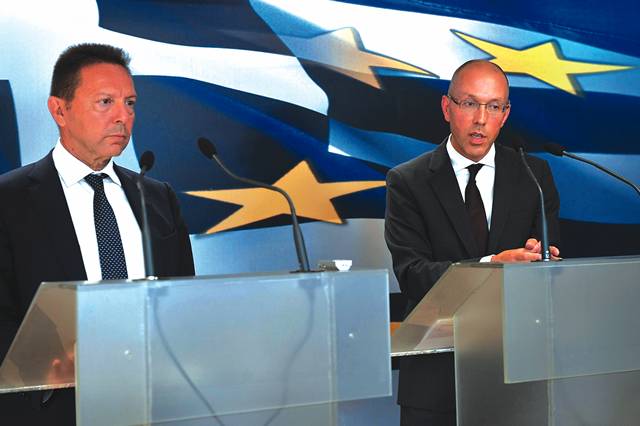
ATHENS. – ECB board member Joerg Asmussen said yesterday that Europe would consider additional aid to Greece if Athens makes progress on cutting its budget deficit and meets all the terms of its bailout deal. “Euro area member states will consider additional measures and additional assistance once Greece has reached a primary surplus on an annual basis” and provided the indebted country fulfils the terms of its bailout deal, Asmussen said after talks in Athens with Finance Minister Yannis Stournaras.
The Greek government aims to reach by the end of this year a primary budget surplus, which does not include the costs of servicing debt.
German Finance Minister Wolfgang Schaeuble rekindled debate about Greece’s outlook after its current bailout programme ends next year in comments on Tuesday that Athens will need another bailout.
The IMF had also warned in July that Greece was likely to face a financing gap in 2014 once its rescue programme ends.
Asmussen said Schaeuble’s comments were not discussed at the meeting and noted the eurozone states pledged last year to provide support to Greece beyond its current programme until it can regain access to the markets.
“It is public knowledge, it is nothing new and there is nothing to add,” Asmussen said.
He urged the Greek government to continue with reforms required under its bailout programme.
Auditors from the so-called troika of Greece’s creditors – the EU, the International Monetary Fund and the European Central Bank – are expected in Athens in September for the next review of the government’s efforts and determine whether it should receive the next instalment of its rescue loans.
EU economic affairs commissioner Olli Rehn also told Finnish daily Helsingin Sanomat yesterday that he may back an extension of Greece’s loan period.
“In this context (the troika’s evaluation of of the Greek programme) we will also evaluate the potential continuation of the plan and its financing,” he wrote in an email.
In late July, the IMF put Greece’s financing gap at nearly US$14,7 billion for 2014 and US$6,5 billion for 2015.
Greece, now in its sixth year of continuous recession, has been forced to apply a tough austerity programme in return for 240 billion euros in EU-IMF rescue funds.
The austerity measures, which include job, pay and pension cuts, have caused widespread protests.
“I recognise this is a painful process and that unemployment has reached levels which are unacceptable,” Asmussen said.
Greece’s official unemployment rate hit 27,6 percent in May, the last month for which data is available. – AFP.


 Online Reporter