Online Reporter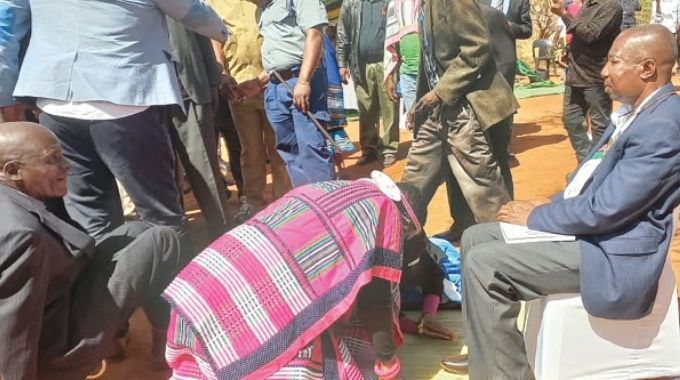
Thupeyo Muleya, [email protected]
THE installation of Mr Joseph Muleya as substantive Headman Tshinoni has brought to an end a prolonged traditional leadership vacuum that had affected governance and development coordination in parts of Beitbridge East.
Hundreds of community members, traditional leaders, Government officials and development partners gathered at Old Nuli Village on Saturday to witness the installation, which marked the continuation of a traditional leadership lineage spanning several decades.
The appointment is expected to restore order and strengthen coordination in key areas such as land allocation, dispute resolution and the implementation of community development programmes.
Chief Matibe, under whose jurisdiction the Tshinoni Headmanship falls, presided over the ceremony and described it as an important milestone in preserving the community’s cultural heritage and traditional governance systems.
“This occasion is not only about the installation of a new traditional leader; it is also a celebration of our culture, our heritage, our traditions and the continuity of traditional leadership in our communities,” said Chief Matibe.
Headman Tshinoni’s jurisdiction covers Ward 5 and parts of Wards 2, 13 and 15 in Beitbridge District.
The Tshinoni area shares boundaries with the jurisdictions of Headmen Foromela, Tsetana, Tshikwelengwe and Mabidi.
Providing a brief history of the headmanship, Chief Matibe said the leadership lineage began with Nevare Muleya, who was succeeded by his son, Tshiwandelani Muleya.
Following Tshiwandelani’s death on April 19, 1975, his son Fhurani Muleya assumed the position before his death on June 6, 1984.
The headmanship later passed to Amos Munengiwa Muleya, who was appointed on February 20, 1995, and served until his death on October 15, 2009.
“Following his death, the Tshinoni Headmanship remained vacant for some time. It was subsequently occupied by Samuel Muleya, who served until his death,” said Chief Matibe.
“Today, we are gathered here to witness the continuation of this important lineage through the installation of Mr Joseph Muleya as the substantive Headman Tshinoni.”
Chief Matibe said the prolonged absence of a substantive headman had created governance challenges in the area, with some village heads allegedly taking advantage of the leadership vacuum to allocate land and engage in other irregular activities.
He said the installation of a substantive traditional leader was therefore expected to strengthen oversight and restore accountability at community level.
Chief Matibe reminded the new headman that traditional leadership carried significant responsibilities and should be exercised in accordance with the Constitution and the Traditional Leaders Act [Chapter 29:17].
The duties of a headman include assisting the Chief, recommending village heads, presiding over Ward Assemblies, mediating disputes relating to lobola, burials and domestic matters, and helping to enforce environmental and planning regulations.
“Headman Tshinoni must find his place within the national and local development agenda and actively contribute to key areas such as education, health, agriculture, business development, communication, water provision and other community development initiatives,” said Chief Matibe.
Chief Matibe also challenged the new traditional leader to take a firm stand against social ills affecting rural communities under the “Not in My Village” concept.
The initiative targets challenges such as child pregnancies, child abuse, sexual and gender-based violence, and domestic violence.
Chief Matibe said traditional leaders would be expected to provide regular reports on progress made in addressing social challenges within their communities.
“Traditional leadership comes with significant responsibilities and must be exercised with integrity, commitment and accountability. Where there are cases of misconduct, neglect of duty or incompetence, appropriate action will be taken. This office is an honour, but it is also a great responsibility. Your subjects should respect you because of the integrity, fairness and service you demonstrate, not because they fear you,” he said.
In his acceptance speech, Headman Tshinoni pledged to work closely with fellow traditional leaders, Government departments and development agencies to restore order and promote development in his area.
“I expect to work with other traditional leaders and development agencies to restore order and end vices like child marriages, drug abuse, land parcelling and stock theft,” he said.
Headman Tshinoni said he would also ensure that village assemblies were held regularly and that village heads were properly recognised and supported in carrying out their responsibilities.
Beitbridge District Development Coordinator Miss Sikhangezile Mafu said traditional leaders remained critical partners in implementing Government programmes and advancing the devolution agenda.
“Traditional leaders are a key component in rolling out the devolution concept from the grassroots level. We look to Headman Tshinoni to help coordinate development and ensure communities benefit from Government programmes,” she said.
Beitbridge Rural District Council chairman Councillor Oscar Chiromo said the local authority was looking forward to working with the new headman in implementing development projects.