Online Reporter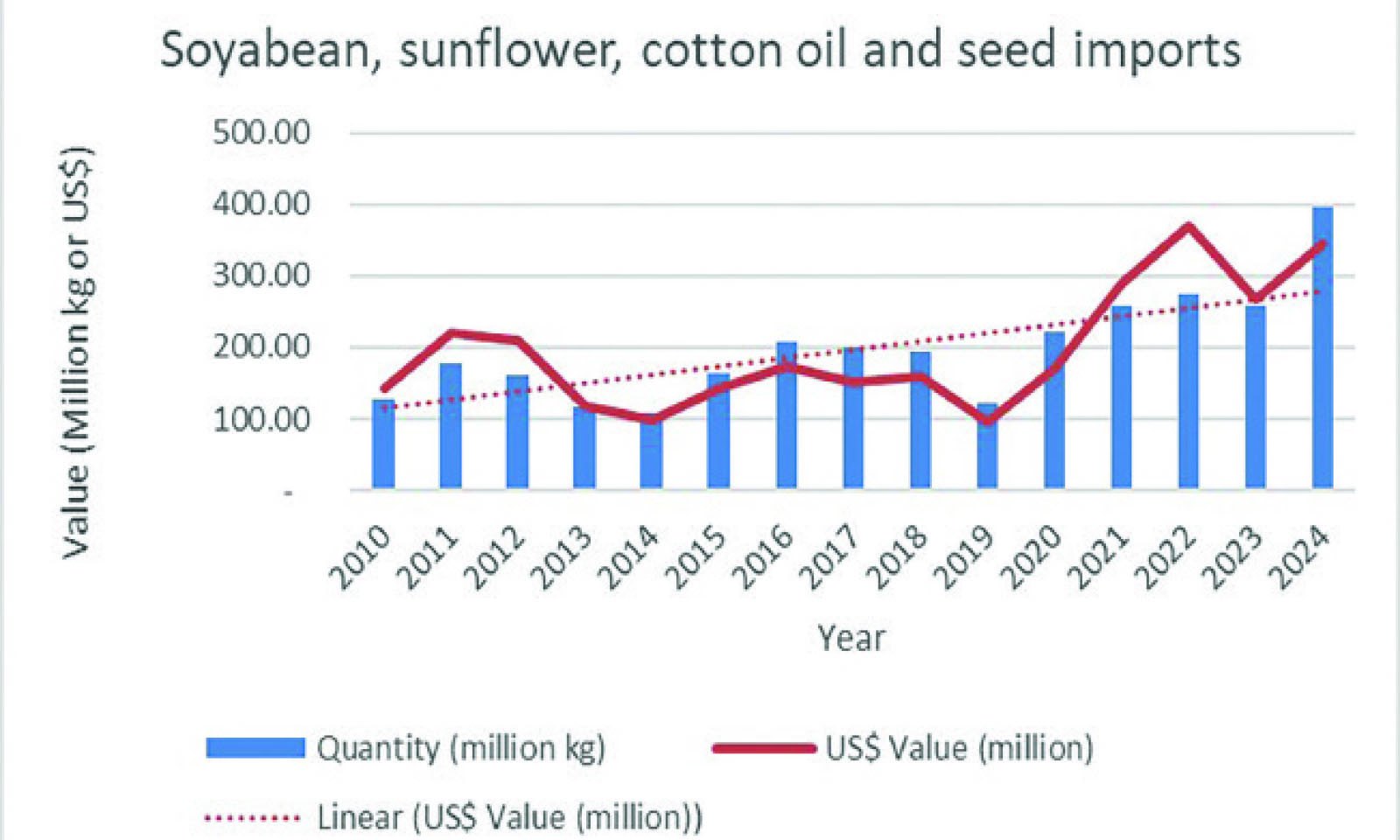
Edgar Vhera
Specialist Writer – Agribusiness
As the 2025/26 agriculture season begins, the country’s import substitution policy is poised to gain a significant boost from the enactment of Statutory Instrument 87 of 2025.
This legislation mandates that processing industries procure 40 percent of their raw materials locally, fostering domestic production and enhancing local supply chains.
According to the Zimbabwe National Statistics Agency (ZimStats), soyabean, sunflower, cotton seed, and crude oil imports have risen by 144 percent from US$142 million in 2010 to US$346 million last year, with a peak of US$370 million in 2022.
The Government crafted SI 87 of 2025 CAP. 18:24, the Agricultural Marketing Authority (Grain, Oilseed and Products) (Amendment) Regulations (No. 2), which banned the import of grain, oilseed, and products, except for contractors in instances of need.
“With effect from April 1, 2026, all processors must source at least forty percent of their annual requirements of grain, oilseed and products locally.
“With effect from April 1, 2028, one hundred percent of all annual requirements of grain, oilseed and products must be sourced locally,” read the SI.
The Grain Millers Association of Zimbabwe (GMAZ) has since entered into an agreement with the Agricultural and Rural Development Authority (ARDA) to produce and supply 200 000 tonnes of Non-Genetically Modified (Non-GMO) white maize during the 2025/26 summer cropping season.
Under the agreement, ARDA will cultivate and deliver maize to GMAZ members between April 1, 2026, and March 30, 2027, with deliveries destined for major urban centres including Harare, Bulawayo and Mutare. The maize will be supplied at a fixed price of US$355 per tonne.
An agricultural expert and Wisdom Afrika Leadership Academy (WALA) and Barefoot Education Afrika Trust (BEAT) founder and director, Professor Mandivamba Rukuni, said this was a revolutionary and transformative move from the Government.
“By legally requiring local sourcing, protecting contractor investment and opening pathways for rural manufacturing, the Statutory Instrument turns a long-running policy debate into a competitive reset — one that can stabilise prices, support farmers, and invite new investors into village and township-based agro-industries.
“It reduces import dependence and cushions consumers from volatile global food prices, guarantees market access for local farmers, encourages higher production and investment, and creates a policy environment for rural industrialisation and small miller participation,” he said.
Stockfeed Manufacturers Association of Zimbabwe (SMAZ) executive administrator, Dr Reneth Mano, said their members had been sourcing most of their requirements from the local market under the Food Crop Contractors Association (FCCA) banner.
“We also have Small and Medium Scale Enterprises (SMEs) under SMAZ. These have for a long period developed their local supply chain by integrating local farmers within their district catchment areas. They used standard, tried-and-tested third-party commercial offtake agreements involving the feed company, the farmer, and the credit provider offering crop input financing to the grower.
“These are the mutually beneficial, risk-sharing contract agreements that do not create the kind of systemic moral hazards and principal-agent problems that the SI was going to unleash by transferring disproportionate farming risk from the farmer to a stockfeed manufacturer,” he said.
FCCA chairperson, Mr Graeme Murdoch, said their members were taking heed of the Government’s directive for industry players to fund at least 40 percent of their raw material from local production.
“The FCCA has increased soyabean production from 11 609 hectares in the 2020/21 season to 30 692 in the 2023/24 season, a 164 percent increase. Output surged 78 percent from 34 827 tonnes to 62 000 over the same period,” he said.
“The FCCA, CBZ Agro-Yield, AFC, NMB, and ARDA are primarily funding commercial soyabean growers, with the Presidential Input Scheme (PIS) funding small-scale farmers.“The bulk of the soyabean produced in the country is for the stockfeed industry, and any shortage is met through imports, mainly from Zambia,” he added.
Oil Expressers Association of Zimbabwe (OEAZ) representative, Mr Roderick Musiyiwa, said the most pragmatic step was to increase soyabean production for the country to be self-sufficient in meal production.
“The country requires around 250 000 tonnes of oilseeds to be crushed to meet the annual demand of soya meal. This output can be achieved by putting around 120 000 hectares under soyabean at an average yield of two tonnes per hectare,” he said.
“To increase oil seed production, OEAZ is contracting farmers and providing a ready market for self-financing growers.Oil expressing companies have increased from three in 2010 to eight, and over US$100 million in local and foreign investments has gone into the sector since 2009.
“It still remains to be seen whether all the oil expressers will contract local farmers for their raw materials, as some only have refining plants and no oil crushers, margarine, laundry, or bath soap capabilities”.
Meanwhile, statistics from ZimStats show that oil seed product imports have been rising over the years with a peak of US$370 million in 2022.