malvernmugadzikwa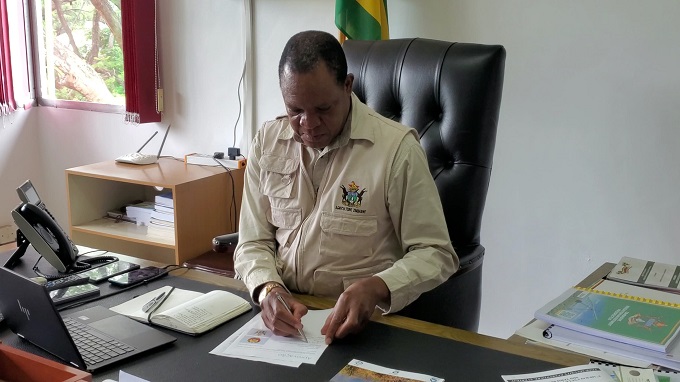
Theseus Shambare
ZIMBABWE and Mozambique have taken a significant step towards sustainable water resource management in the Buzi, Pungwe and Save river basins.
The two countries signed a 10-year strategic action plan on Friday to guide the development and management of the tri-basin.
In an interview with The Sunday Mail soon after the signing ceremony Lands, Agriculture, Fisheries, Water and Rural Development Dr Anxious Masuka said the agreement, signed under the auspices of the Buzi, Pungwe and Save Administrative Commission (BUPUSACOM), aims to address challenges posed by climate change.
“Prior to this, there was no formal management system in place,” said Dr. Anxious Masuka.
“This is important as you know, there are reducing and fluctuating water levels in rivers occasioned by climate change. And there are also weather extremes, as we have seen with La Nina and El Nino and the destructive effects of water.”
The Buzi, Pungwe, and Save River basins (BUPUSA) are exclusively shared by Mozambique and Zimbabwe.
The population in the BUPUSA Tri-basin is vulnerable to a combination of social, economic, and environmental factors that interact with climate change.
Most of these challenges have the same underlying and root causes which are largely attributed to inappropriate resource use and practices.
This saw the development of the Strategic Action Programme (SAP) for the Buzi, Pungwe and Save shared watercourses under a US$ 6 million Global Environment Facility (GEF) grant implemented by the International Union for Conservation of Nature (IUCN) in partnership with the Global Water Partnership Southern Africa (GWPSA) and the governments of Mozambique and Zimbabwe.
Dr Masuka emphasized the economic significance of water resources, particularly for agriculture.
“Water now has become an economic enabler. And for Zimbabwe, we say that agricultural development will lead to rural industrialisation. And this is anchored on the availability of water,” he said.
Mozambique Minister for Public Works, Housing and Water Resources Mr Carlos Albeto Fortes Mesquita who was speaking online from his home country said he was happy with the progress made.

“I am happy with the journey we are embarking on; I look forward to a fruitful execution of this plan.
“Our countries share a rich history and we will continue on the same trajectory as we fight against the effects of climate change through sustainable means,” said Mesquita.
BUPUSACOM interim executive secretary Elisha Madamombe said the plan resonates well with the Zimbabwe National Development Strategy 1 and the Vision 2030 as it outlines specific interventions to be implemented over the next decade, including infrastructure development, water conservation and environmental protection.
“Within the strategic action plan, something which is quite critical is infrastructure development.
“You realise that in order for the countries to develop, to improve the livelihoods of the communities and economic development, we need infrastructure in place. So in the strategic action plan, it talks about construction of dams, irrigation schemes and so forth, as a way of improving the livelihoods of the communities,” said Madamombe.
The joint management of the tri-basin, he said, will enable both countries to share water resources more equitably and efficiently.
The signing ceremony, which was attended by high-level officials from both countries physically and online, marked a significant milestone in regional cooperation and sustainable development.
Feedback:X@TheseusShambare



 Online Reporter