admin
admin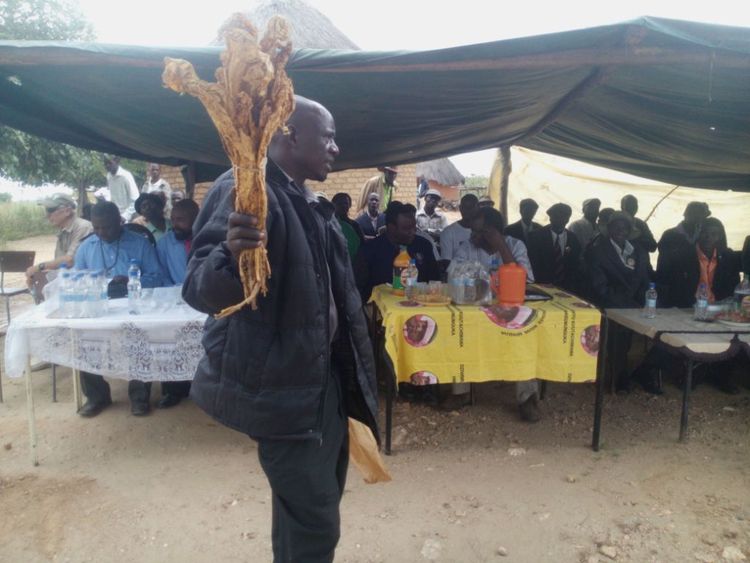
Noah Pito in Hurungwe
While Government and environmental conservationists encourage tobacco farmers to use coal rather than wood for curing their crop, the great challenge for many remains incapacity to burn the coal due to unavailability of electricity to run barn fans.
Despite being supplied with coal by tobacco contractors, farmers often abandon the fossil fuel and switch back to firewood which demands no electricity.
Now, Carbon Green Investment, a United Kingdom-based company specialising in conservation and carbon credit management in Zimbabwe, has unveiled new tobacco curing technology that is set to reduce reliance on wood.
The rocket barn solar fan was launched a fortnight ago at a tobacco field day at Mr Dzingai Kusekarombe’s homestead in Makuvisa Village in Hurungwe.
Hurungwe North legislator Cde Reuben Marumahoko (Zanu-PF) officiated at the ceremony, which was also attended by Hurungwe Rural District Council chief executive Mr Joram Moyo, councillors, Chief Kazangarare and tobacco companies.
Although the technology is still on trial, Mr Kusekarombe has used it on four harvests, saying it is efficient in how it regulates temperatures and conserves energy.
“The control of heat is better than in firewood barns. The coal will burn for more than three hours as the burning is controlled thermostatically. Compared to the use of firewood, the use of this technology is less strenuous and less costly. One can even go and attend to other duties while the thermostat controls the temperatures unlike the use of firewood which requires constant attention.
“The other disadvantage with firewood is that it burns so fast thus requiring large volumes to be replaced. Once you have the equipment installed, you will not pay any costs in terms of electricity since it is solar-powered,” says the farmer.
The solar fan equipment includes a heavy-duty battery powered by a solar panel, a light bulb, a thermostat and a copper coil, all valued at about US$450.
The pilot project is the brainchild of CGI project manager Mr Rory Muil, pursuant to a request from Hurungwe RDC for help with new technologies.
Cde Marumahoko says: “Remember, of about 77 000 tobacco farmers we have countrywide, 26 000 of them are in Hurungwe. Using these statistics, if we allow each one of us to cut down only one tree for tobacco curing every year, we will not remain with any tree in the next two years.
“It is my sincere hope that tobacco companies will embrace the new technology and assist in the conservation of our natural resources. It means from now on you must also buy your farmers such equipment so that they will be able to use coal effectively.”
Mr Moyo castigated some tobacco companies working in the area for not giving back to the community.
“You come here to make business leaving the roads and bridges damaged while you just watch and take no action to help the people making business for you. Please we need each other, let’s work harmoniously as partners to improve the welfare of these farmers you are using to make money. Remember you have a social corporate role to play, which is paying back to the community.”
CGI area manager for Hurungwe Mr Jeremiah Matiza urged local companies to start producing the solar fan kits, which are presently being imported.
In Zimbabwe CGI operates in four districts — Binga, Nyaminyami, Hurungwe and Mbire under the Kariba Redd+ Project.
Meanwhile, the Hurungwe RDC wants to sue all tobacco companies that are not signing agreements with the local authority before contracting farmers, which is a breach of council regulations.
The position was adopted at a recent full council meeting.
Mr Moyo says of the seven companies operating in Hurungwe, only BAT had complied with council regulations.
“The companies must come through council since we have records of the farmers in the area be they communal, A1 or A2 farmers. All the farmers they contract must be genuine. We don’t expect them to engage illegal settlers in game areas, wetlands or waterways.
“In the MoU there are also clauses that talk about monitoring their farmers to ensure that they (farmers) stick to the use of coal rather than what is happening now.
“Some of these merchants have engaged mostly illegal settlers in game areas. The farmers have become the main culprits in causing deforestation. There is a lot of wetland infiltration, veld fires and siltation of dams all being caused by the very illegal settlers they are contracting.
“One other thing is they have not shown commitment in encouraging tobacco farmers to concentrate on cereal crops for the farmers’ food security. Imagine that their extension workers are only trained in tobacco although they must take part in assisting the farmers in the growing of cereals, particularly maize.
“The tobacco merchants have decided not to operate under the council regulations and by-laws, the reason why council has also seen it fit to take them to court. By recognising these illegally settled farmers they are in a way formalising these settlements. This is the reason why we are also experiencing fierce land disputes in these areas,” laments Mr Moyo.



 Online Reporter