malvernmugadzikwa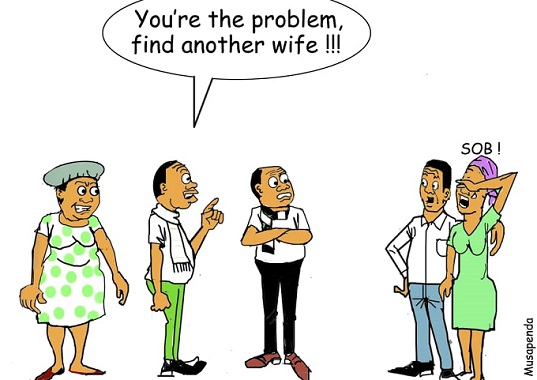
Part 4: Human voices, challenges, and inspiration through success stories.
Catherine Murombedzi
Health Correspondent
When a couple fails to have children in times ‘set’ by the extended family and society, the blame is usually placed on the woman.
In most African settings, the husband is urged to find another woman who can give him children. Usually, the mother-in-law pushes a fellow woman to the wall.
Derogatory words like ngomwa, barren, inyumba and broiler chicken fly. All these derogatory terms take away self-esteem. When faced with discrimination, one tends to withdraw.
It is common to have the mother-in-law saying, “I want to see my grandchildren before I die.”
It becomes a chorus. If the man is not strong enough, the marriage may break down.
Miriam, who preferred to use her first name only, is one of those affected.
She had this to say: “In 1998, we exchanged our vows, young and full of joy. Our dream was to buy a house before starting a family. By 2003, we achieved that milestone. As we went for our next chapter, our journey to parenthood was not as smooth as we had planned.
“Despite stopping contraception, l failed to conceive for months, and then years and frustration crept in. The blame game began with the extended family, and our loving relationship turned mechanical as we tried to conceive.”
Miriam said her husband’s family started accusing her of having carried out abortions in the past.
“It was a painful lie. I sought medical help while my husband refused, opting for faith healers instead. The finger-pointing continued, and I was asked to confess to something I did not do,” she said.
“Due to family pressure, he found a secret lover. As per his wish, the other woman fell pregnant. I was the last one to know. Fatherly roles demand one’s presence. In the dead of the night, he received a call, he had to rush over, the baby was ill, and the mother needed to get to the hospital as an emergency.
“I learned the hard way. Our dreams were shattered and our love story turned into a painful saga.” With no support from her husband’s family, the marriage fell apart.
“As our marriage crumbled, he spent more time with his new interest, eventually leaving me for her. I endured a painful divorce. However, I didn’t let the heartache define me.
“Four years later, I found love again. I explained what had led to the failure of my previous union. My partner said children are a blessing and that he would accept whatever came our way. We got married two years later.
“Today, I’m a happy mother to a vibrant four-year-old and eagerly awaiting the arrival of our second child in three months.”
Meanwhile, her ex-husband is left with nothing, but regret.
His new wife eventually revealed that she had been pregnant when they met. She had used him for financial support until her boyfriend completed his studies abroad.
“His baby mama eventually reunited with her child’s father, leaving my ex-husband with no one. It was too late. I had moved on. Had we sought medical intervention, maybe he could have gotten correctional assistance,” said Miriam.
“I am grateful for my new chapter, filled with love and happiness. My ex-husband’s refusal to seek help and his blame game only led to his downfall. I’ve moved on, and my heart is full.”
The second couple to share their story supported each other amidst family and societal pressure.
Chido, the woman, requested to speak in anonymity too.
“After six years of marriage with no child, calls to leave me grew louder by the day. Tete, my husband’s sister, even had the guts to bring prospective girls for selection in my presence,” she said.
“However, my husband turned them down, telling his family and friends that we were saving money to seek medical help. He held my hand, assuring that we would be okay one day.
“He said to me: ‘there are many ways to build a family. Let’s explore other options together. If medical assistance fails, then we shall look into adoption’.”
The woman was diagnosed with empty follicles, and they were informed that they could be helped to conceive.
“I did not undergo any procedure in theatre. I got estrogen medications to stimulate ovulation and egg release. The process is called ovulation induction. I took the medication for five months.
As I was about to lose hope, I started to vomit early in the morning. Mind you, I had irregular periods, or at times, I could experience heavy or light bleeding. So, during the time I conceived, I had no monthly period. Since I would have irregular months, it was normal for me.
“I got very ill, and we went back to see the doctor. He said I was two months pregnant. Fear and uncertainty followed as we were worried about the health of the baby and potential complications.
“There were times when l would feel guilty for needing medical assistance to fall pregnant when other women conceive naturally. At the same time, I felt joy and excitement.
“We kept our pregnancy a secret until my tummy was too big for concealment. The doctor supported our journey,” said Chido.
At three months, the gynecologists informed them after a scan that she was carrying two healthy foetuses.
The couple got their two bundles of joy when Chido was aged 40 – a bouncing boy and a girl .
The couple settled for their names, looking no further.
“Our journey to parenthood came slightly late, but God’s time is always the best. We decided that we were now complete at four, and we gave the babies our own names,” said Chido.
In an interview, Dr Mugove Madziyire said it was pleasing to note that there had been some progress in IVF, although more could still be done.
“After taking further studies with the Merck Foundation, my care for infertile patients is way better, and I now offer assisted reproductive techniques in the form of In Vitro Fertilization (IVF) and Intrauterine Insemination (IUI),” said Dr Madziyire.
He said the University of Zimbabwe constructed a specialist medical centre that will house an IVF unit, adding that all necessary equipment was being acquired.
“The main issues on infertility are limited to societal knowledge, diagnostic and treatment capacity in the public sector. The investigations and treatment remain too expensive for many couples.
“However, many more couples are now presenting for care, especially in the private sector.
“We need more awareness campaigns and we also need to improve access to treatment through acquiring enough diagnostic tools such as ultra-sound machines and fluoroscopy machines. There is also a need to set up public IVF clinics,” said Dr Madziyire, adding that tere must be a dedicated infertility clinic in each province with enough investigative capacity.
Women struggling with infertility often face societal pressure, stigma and hurtful language, which can significantly affect their self-esteem and mental well-being.
The assumption that marriage is solely for procreation is a harmful and outdated notion. Marriage is a union between two individuals, and their relationship is built on love, trust, companionship and mutual support.
The ability to bear children is only one aspect of a relationship, and it does not define a person’s worth or the value of their marriage.
Using derogatory terms to describe women struggling with infertility is unacceptable and perpetuates harmful stereotypes.
Instead, there should be support, understanding and encouragement.
Let us work together to create a more inclusive and compassionate environment for all individuals, regardless of their fertility journey.
A person’s worth and identity extend far beyond their fertility. Let’s celebrate the beauty of diverse experiences and relationships.



 Online Reporter