malvernmugadzikwa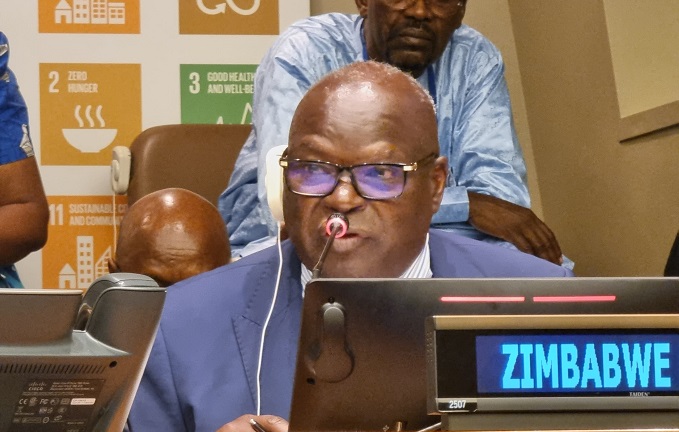
Theseus Shambare
ZIMBABWE has recorded significant progress in the attainment of the United Nations (UN) Sustainable Development Goals (SDGs) through the rolling out of various initiatives in various sectors.
Addressing the UN 2024 High-level Political Forum on Friday in New York, Public Service, Labour and Social Welfare Minister July Moyo presented a national review that noted the country’s major strides.
The 11-day forum started on July 8 and will run until July 18.
Minister Moyo said Zimbabwe made notable strides in implementing SDG-aligned initiatives, leveraging both public and private sector investments.

“The 2024 report, developed through a whole-of-Government and whole-of-society approach to sustainable development, stands as a testament to the collective effort being done to achieve the SDGs,” he told the forum.
“Zimbabwe’s GDP growth increased by 8,5 percent and 6,5 percent in 2021 and 2022 respectively, supported by direct interventions in areas such as agriculture to reduce poverty.
“The country also made notable progress in social protection, with 66 percent of the 3,8 million vulnerable population receiving support in 2023.”
Under food and nutrition security, Minister Moyo cited advancements in agricultural transformation.
“As a result, food insecurity notably decreased from 56 percent to 26 percent in rural areas and 42 percent to 29 percent in urban areas from 2020 to 2023,” he said.
Highlighting progress in health and education, Minister Moyo said the country’s life expectancy rose from 38 years in 2012 to 64,7 years in 2022, while the maternal mortality ratio decreased from 614 per 100 000 mothers in 2014 to 363 in 2022.
“In education, the primary school completion rate increased from 83,34 percent in 2021 to 90,98 percent in 2022 and the lower secondary completion rate rose from 54,3 percent in 2021 to 65,95 percent in 2022, despite the effects of the Covid-19 pandemic.
“To promote inclusion and gender equality, there is a notable female leadership participation in local councils that rose from 13 percent in 2018 to 42 percent in 2022 after the introduction of a 30 percent quota system.
“Additionally, the country has targeted a 15 percent inclusion of people with disabilities in all employment sectors, although there have been challenges in accommodating this group, pointing to the need for investments in producing assistive devices locally,” he said.
In 2022, Minister Moyo said 87,9 percent of the population had national identification registration documents, and 78,6 percent had birth registrations for resource allocation and management purposes.
The minister reported that 62 percent of the population now has access to electricity and solar and other green energy sources that now constitute 12 percent of the national installed capacity.
Government has also accelerated the empowerment of 140 independent power producers with licenses to install solar and other green energy sources.
Regarding industrialisation, Minister Moyo highlighted the establishment of innovation hubs and industrial parks across the country’s universities, colleges and polytechnics.
He mentioned the US$1,5 billion plant in Manhize near Mvuma that will produce 1,2 million tonnes of steel annually, thereby creating over 3 000 jobs.
To address the impacts of climate change, Minister Moyo stated that Zimbabwe formulated a National Adaptation Plan, developed Low Emission Development Strategies and revised its Nationally Determined Contributions.
The country has also increased awareness on carbon credits.
He acknowledged that Zimbabwe’s journey towards sustainable development faced some challenges.
“Our journey is not without challenges. Climate-induced shocks, pandemics, global conflicts and the unilateral coercive measures imposed on us by some Western powers, which impose restrictions in the global financial architecture, have seen the country recording an increase in poverty rates, hence the need for adaptive mechanisms to ensure a sustainable future,” he said.
“Zimbabwe’s 2024 VNR exemplifies our unwavering commitment to sustainable development, rooted in inclusivity, collaboration, and proactive measures to address emerging challenges.”
Minister Moyo said Zimbabwe aimed to build a resilient, equitable and prosperous future for all its citizens by leveraging partnerships and embracing innovative solutions.
Feedback: X@TheseusShambare



 Online Reporter