Chronicle Editor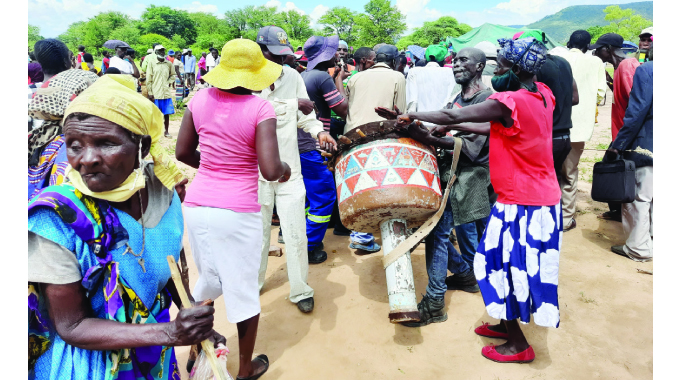
Leonard Ncube, Victoria Falls Reporter
BINGA District is a unique area in many ways.
Besides being an untapped tourism destination with a magnificent view at the foot of one of the biggest man-made lakes, Lake Kariba, boasting of a booming fishing industry, hot springs, wildlife, forests and attractive hotel infrastructure, the local culture is an unparalleled pride.
Aside with claims of underdevelopment, the Tonga people that predominantly make the greater part of Binga are united by their culture and have preserved it over the years as one of their most prized possessions.
While other tribes have allowed dilution of their practices through modernisation, the Tonga people are still glued to their culture which they depict through music, dance, dressing, art and practices such as traditional ceremonies, smoking pipe (dombola), piercing the nose, and others.
Ngoma Buntibe, a type of music act characterised by drumming, blowing horns and free dancing has become popular even at state functions where traditional groups entertain crowds with the instrumental music.
The name Ngoma Buntibe is derived from the type of big drum whose design is such that its foot is different from ordinary drums that can balance on the ground and is played with sticks with two or more people balancing it for the one beating it.
Seven drums, ranging from a very small one to mundundu which is the lead and loudest drum as well as the biggest one known as nyina, meaning the mother of all and several horns, with two or three representing each part of a normal choir are played.
Knobkerries, spears, shields and sticks are also part of the dance as those carrying them imitate warriors fighting while elderly women will be wearing traditional Tonga regalia with beads around their necks and waists.
This in short is Ngoma Buntibe, a dance that many have seen at events.
It is taboo to have sex a night before a ceremony where Ngoma Buntibe is to be played.
What is interesting about it is that whenever any traditional group is given the opportunity to play at an event, directors of ceremonies struggle to stop the music or make the group leave the stage as those playing will be heart and soul in the rhythm, while the whole gathering would have also joined.
Ngoma Buntibe is played at public events known as Lwindi, as well as cultural events such as harvest or thanksgiving (Chilimba), rainmaking ceremonies, installation of chiefs and others.
It is used to communicate something and each song played is composed for a specific reason.
People not familiar with Tonga culture and language usually think Ngoma Buntibe only involves playing of instruments and dancing without words being sung yet behind the instruments, only played by men, are female voices well choreographed to the rhythm and beat, but hardly heard by strangers.
This is what makes Ngoma Buntibe unique.
Those involved in it know what they are singing about and this can be naming and shaming a bad person, announcing or mourning the death of an elderly person or celebrating something hence all get consumed in it.
Mr Mackson Mudimba, who is coordinator of Nchalilayi Binga Culture Groups, which is a grouping of traditional dance groups drawn from across the district, said Ngoma Buntibe is the heart of Tonga culture.
“Nchalilayi literally; ‘We can’t be left behind’ and is used by the Binga folk to promote their culture.
“It is cultural, and no amount of contemporary music can replace Ngoma Buntibe. When it starts playing the whole body reacts if you are truly Tonga and everyone loves it. You feel inside that you are Tonga and start dancing. It is our pride,” said Mr Mudimba.
He said all generations love the music although youth are slowly shunning their culture.
Mr Mudimba said Binga’s prayer is for Tonga culture and traditional dances to be included in the education curriculum.
“Ngoma Buntibe was historically used whenever an elderly person died or when performing traditional rituals. With time it became even popular at ceremonies. The horns and drums follow a properly composed song. Men play instruments while women sing words and if you want to hear the lyrics go closer to women.
“It was for disciplinary purposes especially when a man engaged in extra marital love affairs or when someone was suspected to be doing witchcraft, they would compose a song telling society that this man or woman is a bad apple. So, it was a form of communication,” said Mr Mudimba.
He said each instrument plays a key role such that if it goes off tune or stops, the whole act is disturbed.
“The mundundu, mugonzo, pininga and nyina drums all play a big role. Even the horns, if one stops blowing, the whole song stops because it will be off tune. So, each type of horn has two or three people playing so that when one sneezes or coughs then the rhythm is not affected but this does not mean that one person can’t play it,” added Mr Mudimba.
He said Ngoma Buntibe is mandatory during a chief’s installation ceremony.
He said culturally, it is a taboo to have sex a night before a ceremony where Ngoma Buntibe was to be played.
Mr Mudimba said while the whole district was particular about preserving Tonga culture, Lubu (Ward 11) dominates in all cultural activities.
“Our schools try to teach Tonga culture, but our challenge is that most teachers in our schools are non-locals and don’t know our culture. This new curriculum came late and we were not even consulted with regards to local culture. If it’s taught in school and children compete in Tonga dances, we know this can help preserve our culture. My appeal to all Tonga is that we unite and preserve our culture and we also appeal to sponsors to help our traditional groups so that they can travel countrywide,” he said.
– @ncubeleon.


 Online Reporter