Tendai Gukutikwa
Post Reporter
THE ceremony had not yet begun, but a confession had already changed its course.
Before Headman Abisha Sakarombe could be unveiled to his subjects last Friday, one of his sisters was asked to step away from the reed mat on which he and his wife sat, after admitting that she was intimate with her partner the previous night.
It was a brief exchange, quietly handled, but it revealed the weight of tradition in the installation of traditional leaders among the Mutasa people, where purity, discipline and respect for ancestral customs remain central to the transfer of authority.
The installation, held at Nyamhuka Primary School in Nyanga, was not merely about recognising a new headman – but public demonstration of customs that have survived generations, including the expectation that those involved in installing a traditional leader observe abstinence before the ceremony.
For Chief Mutasa, the observance is not an optional ritual that can be discarded to accommodate modern lifestyles – but part of the responsibility that comes with traditional leadership.
As the new headman and his wife sat on a reed mat, covered in a white cloth, symbolising purity and royalty, Chief Mutasa approached them before they could be unveiled by the Sakarombe sisters, known as vazvare.
The sisters had been shielding the royal couple from the scorching sun with an umbrella.
Chief Mutasa immediately objected, saying the gesture was inconsistent with the customs of a people, whose totem is the lion.
“This is not how we do things as the Mutasa people. A lion is fierce, not soft. It is the king of the jungle and does not hide from the sun or rain. A lion goes hunting without an umbrella. Even if it were raining, we would have carried out these traditional procedures in the rain because leadership cannot be soft or run away from the sun and rain,” he said.
The chief’s intervention transformed an ordinary act of providing shade into a lesson on the expectations of traditional leadership.
To the Mutasa people, the lion represents more than a family totem – a symbol of courage, endurance and the ability to face difficult circumstances without retreating.
The message was clear, a traditional leader must be prepared to endure hardship alongside the people he leads.
But the ceremony’s most revealing moment came when Chief Mutasa turned his attention to the white cloth covering the new headman and his wife.
He instructed the sisters responsible for unveiling the couple to leave the mat if they were intimate the previous night, explaining that those participating in the ritual were expected to observe abstinence.
One of the sisters stepped away.
Chief Mutasa warned that anyone concealing a breach of the custom risked compromising the ceremony, insisting that those handling the royal cloth had a responsibility to respect the traditions governing the installation.
“A headmanship is a sacred institution, and those involved in installing its holder must observe the required customs. His sisters must be pure as they handle the white cloth. Anyone who was intimate the previous night must step away,” he said, further cautioning those participating in the ceremony against bringing charms or other objects believed to interfere with the traditional proceedings.
For the Mutasa people, such observances are understood within a cultural and spiritual framework in which traditional authority is connected to ancestry, family responsibility and the proper performance of established rituals.
The abstinence requirement does not end with the people directly involved in the unveiling.
Chief Mutasa said he also observes a period of abstinence prior to installing a headman or carrying out other traditional leadership duties.
The period ranges from seven to 15 days, depending on the traditional procedure being performed.
“Even as a chief, when I am preparing to install a headman, I observe these customs and abstain from sex with my wife for seven to 15 days. That is our tradition, and my wife understands and respects it,” he said.
The discipline required before an installation is inseparable from the respect accorded to the institution itself.
He said Mutasa traditional leaders, who died without observing the required standards of ritual cleanliness, are denied burial at Bingaguru Mountain ninga (cave), regarded as the clan’s royal resting place.
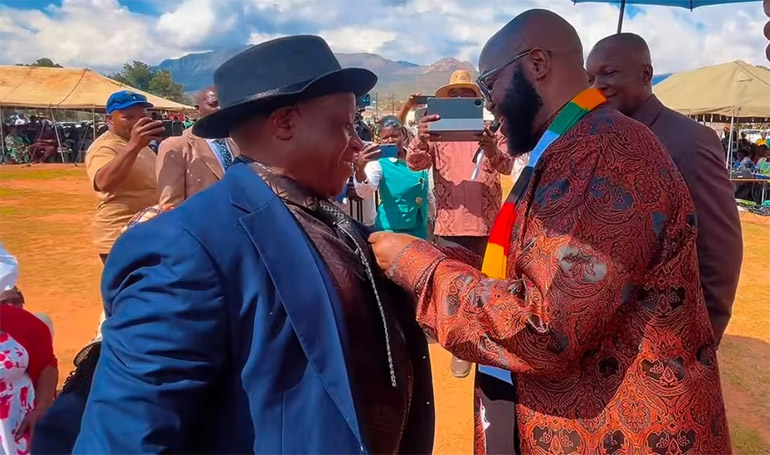
At Nyamhuka Primary School, the unveiling eventually proceeded, with the white cloth rolled away to reveal Headman Sakarombe and his wife to the gathered community.
The ceremony marked the restoration of a traditional institution suppressed during colonial rule, raising questions of ancestry, land and cultural identity into the present.
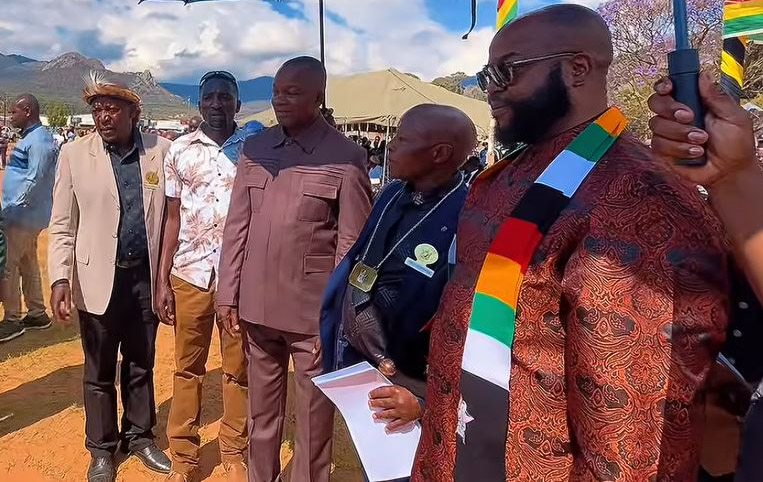
Chief Mutasa said the installation of Headman Sakarombe is part of a broader effort to restore Mutasa headmanships in Nyanga, where the clan’s traditional authority once extended to.
He said the headmanships belonged to members of his family before its abolishment. Those already installed as substantive headmen in Nyanga are Sanyatwe, Sakarombe and Saruchera.
He also intends to install Nyangani, Chovhu, Mawoko and Shawi headmenships as part of the process of reclaiming the clan’s traditional heritage – which points to the historical reach of his jurisdiction in Nyanga.
Chief Mutasa also explained the historical connections between his clan and neighbouring traditional authorities, including Chiefs Saunyama and Hata.
“The Mutasa territory in Nyanga bordered Katerere, but the establishment of the Saunyama chieftainship was linked to a marriage between the Mutasa family and Saunyama’s ancestors. Our forefather gave a daughter in marriage to Saunyama and subsequently allowed the son-in-law to establish an independent traditional authority,” he said.
He described the arrangement as a decision intended to protect his daughter from hardship rather than insist on retaining all the land under his own authority.
“Our forefather did not want his daughters to suffer. He would rather give up land to allow a son-in-law to become a chief than see his daughter living in difficult circumstances. Saunyama is a son-in-law of Mutasa,” he said, adding that Saunyama and Hata were brothers.
He said Saunyama gave some of his land to his brother, paving the way for both to become chiefs.
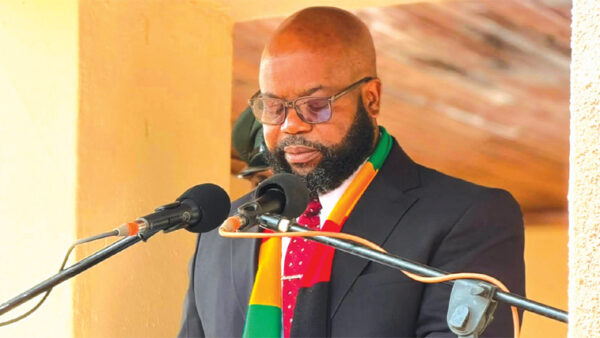
Minister of State for Manicaland Provincial Affairs and Devolution, Advocate Misheck Mugadza, said the Sakarombe family shared the lion totem with the wider Mutasa family.
He attributed the abolition of the Nyanga headmanships to the colonial authorities, arguing that it was linked to the acquisition of fertile land.
“Cecil John Rhodes is the one who abolished these headmenships in Nyanga because he wanted the good land. Nyanga National Park is said to have been his farm after our families were displaced. We are happy that today we are restoring these headmenships,” he said.
For Headman Sakarombe, the responsibility now extends beyond the symbolism of the white cloth, the reed mat and the rituals that preceded his unveiling.
Born on August 27, 1956, he attended Kambudzi Primary School, before joining Lafarge Cement Company in 1979, where he worked until 2023.
He has five children and five grandchildren.
Minister Mugadza urged the community to respect, listen to and support their new headman, emphasising the need for unity and peaceful relations.
For villagers gathered at Nyamhuka Primary School, the installation was both a return to tradition and the beginning of a new chapter in local leadership.
Nyanga resident, Mrs Rufaro Nhakairo, said they were happy that their headmanship had been restored.
“We grew up hearing about our customs and how our families were organised before these institutions were abolished. Seeing a headman installed today gives us an opportunity to teach our children where they come from and why our traditions matter,” she said.
Mr Richard Sakarombe said they were elated as a family.
“We are happy to have our own headman, but what matters now is that he brings people together. We want someone who listens to our concerns, helps resolve disputes and treats everyone fairly,” he said.