admin
admin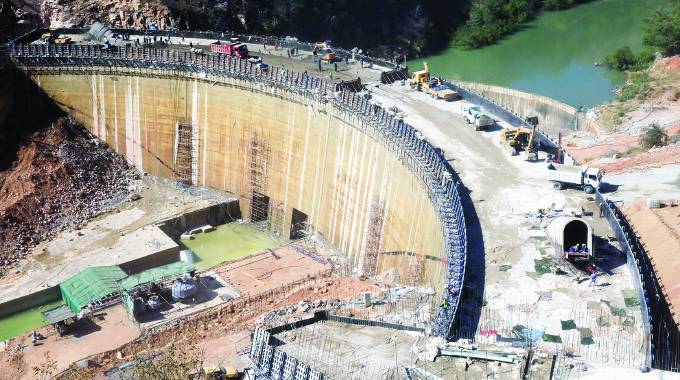
Mashudu Netsianda-Senior Reporter
A SYMPHONY of massive flood lights illuminates the sky at night at the construction site of the gigantic Lake Gwayi-Shangani in Hwange District in Matabeleland North province.
The clangour of the heavy construction equipment fills the night air. Silhouetted against the dimly-lit sky, construction workers, in their protective clothing, meticulously carry out their activities late into the night.
Their target is to meet the deadline which has been moved to early next year.
Contractors at the big dam recently introduced night shifts to ensure work is completed within the agreed timeframes.
A total of 610 workers are involved in the project and 50 of them are Zimbabwe National Water Authority (Zinwa) employees while the other 560 workers were engaged by the main contractor, China International Water and Electric Corp (Pvt) Limited.
Upon completion, Lake Gwayi-Shangani, will become the third largest inland water body after Tugwi Mukosi and Lake Mutirikwi, both in Masvingo Province.
The big dam is part of the National Matabeleland Zambezi Water Project, an idea which was conceived more than a century ago and has only been turned into reality by the Second Republic led by President Mnangagwa.
Lake Gwayi-Shangani is expected to provide a permanent water solution for Bulawayo and Matabeleland region.
Situated about 6,5km from the confluence of Gwayi and Shangani rivers, the concrete gravity arch dam was designed and engineered by the Zimbabwe National Water Authority (Zinwa) and has a gross capacity of 650 million cubic metres.
The project is a significant milestone that will transform the lives of many communities living along the pipeline from the dam to Bulawayo as irrigation schemes will be established taking advantage of the abundant water that will be pumped through the pipeline.
The dam is a roller compacted concrete gravity dam, implying that it depends on its weight for stability. It will have an ogee-shaped overflow, with a 200-metre-long spillway while the maximum depth of water would be 59 metres.
The construction of Lake Gwayi-Shangani is the First Phase of the project which also involves the laying of a 245km pipeline from the dam to Bulawayo.The delivery of pipes for the pipeline which are being imported, has started.
Our Bulawayo Bureau on Thursday night visited the site during which the news crew had an opportunity to witness the works.
Some workers were busy removing coatings from masonry surfaces where concrete is set to be laid while others were surface roughening using twist drilling machines and broaching tools.
Zinwa assistant resident engineer Lucio Chayeruka said they introduced day and night shifts, each having at least 300 people as part of efforts to speed up the process.
“At any given time, we have 300 people working at the site but in total the number of people employed is 600. We now have two shifts divided into two groups, each comprising 300 people working during the day and the other at night,” he said.
“At night, we break from 12 midnight to 1AM while during the day it is from 12 midday to 2PM.”
Eng Chayeruka said in terms of the height of the dam wall, this year alone, they did 19 metres.
At the bottom, Lake Gwayi-Shangani has a width of 24 metres but it narrows as it goes up and when it gets to a height of 72 metres, the top-most part will have a width of 12 metres.
“Ever since this project started, we have never moved at this pace and there is tremendous progress. We are placing 15 000 cubic metres of concrete every month and so far, the height of the dam wall is now at 36, 5 metres,” he said.
Eng Chayeruka said about 95 percent of the workforce is drawn from Hwange, Lupane and Binga districts.
He said out of the 50 supervisory staff that they have, eight are women.
Eng Chayeruka said to avoid disruption of works, they have 100Kva back-up generators, which are used in the event of power cuts.
At least 15 000 cubic metres of concrete, translating to about 1 500 tipper trucks, are used every day. Similarly, 150 tonnes of cement and 150 tonnes of fly ash are also used daily, illustrating the sheer size of the dam.



 Online Reporter