admin
admin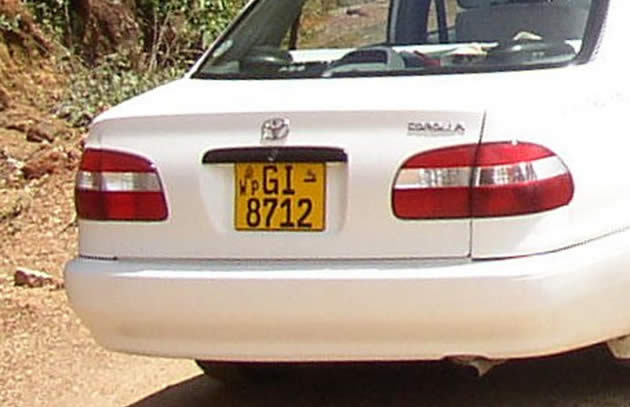

Gerald Maguranyanga Traffic Friday
Zimbabwe; how, why, do we tolerate the number plate-less car? Over the years, we have known President Mugabe’s car to exhibit the personalised “Zim 1” number plate on his official-issue limousine, always. That eminent Zim 1 number plate, for the youth particularly, is the height of cool, and is possibly the subject of much admiration and envious glances.
You could say, in Zimbabwe, it is the numero uno of personalised number plates as it is easily the most well-known number plate.
In every nation, there surely must be a Zim 1 counterpart.
In South Africa, perhaps, they have a Mzansi 1 for President Zuma, and a One Zambia-One Nation, across the Zambezi River for President Sata. Because I have not bothered to find out, I will take a wild guess that in the UK, Prime Minister Cameron has a simple No. 10 after the famed British Prime Minister’s official residence. President Obama’s super-heavyweight official Cadillac has a number plate which sometimes carries curious, politically-charged statements like the controversial, “Taxation Without Representation”.
Belgian King Philippe’s official ride is a top-of-the-range Mercedes-Benz V12-S600 with the number plate simply emblazoned “1” because he is the commander-in-chief of the army.
The sovereign Queen Elizabeth II’s official car is a claret-coloured Lincoln Town which bears a number plate showing a gold St Edward’s Crown on a red field.
Currently, the State Car of the President of Germany is a Mercedes-Benz S600 with an interesting plate; 0-1 or 0-2.
Not sure about now, but years ago, Harare City had a numberless plate that spotted, maybe appropriately so, only the Harare City emblem for the city’s mayor.
The examples that Wikipedia provides for official state number plates as above and many others are abundant but it seems the standard, worldwide, is to license each and every vehicle in a country.
The above citings are the colourful bits about the automobile number plate.
It could therefore be reasonably concluded that a number plate is so important that even the head of state or the mayor of city is not exempt from clearly identifying their official wheels.
The simple question Traffic Friday would like to pose is, if a whole head of state could have their wheels clearly marked with an official number plate, then why, how, have we come to see, at any time, on any stretch of Zimbabwean road, so many number plate-less vehicles, predominantly in the private car category?
Before we even look at the logic and official reason why a number plate is deemed necessary, many of us would agree that even for reasons aesthetic, the humble number plate plays a part in adding form, colour and looks to a vehicle. A number plate-less car, to me, looks a bit like a pretty face with a tooth or two missing in front.
Of course, missing a couple of incisors does not change who you are, but it surely knocks off a point or two in the beauty stakes.
A vehicle registration plate is a metal or plastic plate attached to a motor vehicle or trailer for official identification purposes. The registration identifier is a numeric or alphanumeric code that uniquely identifies the vehicle within the issuing region’s database. In some countries, the identifier is unique within the entire country, while in others it is unique within a state or province. Whether the identifier is associated with a vehicle or a person also varies by issuing agency.
Depending on the country, the vehicle registration plate may be called a licence plate or tag (United States), licence plate (Canada), or number plate (United Kingdom).
Let me add, a motor vehicle number plate is ordinarily produced by a state agency or state-monitored entity under usually tight security systems and conditions. It would obviously cause huge nationwide problems if car registration plates were to be easily reproduced. In Zimbabwe, number plates can only be purchased for affixing to a motor vehicle on satisfying onerous security requirements.
Strangely in South Africa, a lackadaisical failure to observe these tight security requirements means number plate-making facilities are so commonplace, a new set of plates can be made out for you while you wait, even in a backyard shop for a mere US$20.
A special investigation by The Star newspaper and reported just this week reveals that there probably were thousands of illegally-cloned number plates all over Gauteng.
South Africa’s implementation of a seemingly unpopular but probably necessary e-tolling system has catapulted the devious number plate cloning.
It now poses a serious headache for authorities, from a fund gathering and a security point of view.
Most governments require a registration plate to be attached to both the front and rear of a vehicle, although certain vehicle types, such as motorcycles, require only one plate, which is usually attached to the rear of the vehicle.
In Zimbabwe a Central Vehicle Registry national database relates this number to other information describing the vehicle, such as the make, model, colour, year of manufacture, engine size, type of fuel used, chassis number and the name and address of the vehicle’s registered owner.
A few days ago, Zimra, Government’s official tax collector, was relentlessly pushing for a change of the current vehicle registration system, particularly as relating to the current number plate which the taxman decried as allowing massive tax evasion. Zimra had a point, though they had now acquiesced to the existing system.
In Zimbabwe, like other jurisdictions worldwide, we have our own plate style, which was hugely criticised upon its introduction for allegedly copying the Zambian one, save for the colours.
The pair of plates for a vehicle comes with a decal (a small tamperproof tag for permanently affixing to inside front windscreen to enhance security.) Locally, a number plate-less car is not ideal as you may get penalised for it as generally the police may stop you for not displaying a plate but it’s not a biggie.
If you are quite unlucky, your vehicle may be impounded. It is reasonable to assume that one may drive around, number plate-less, fingers crossed, and actually not get molested in any way by officialdom. Surely, it is logical that if it was hot to drive a number plate-less vehicle, then there would not be any out there. If the system truly did not tolerate plate-less vehicles, then the existing challenge would probably be cars with fake plates and not this plate-lessness that is widespread in Zimbabwe.
The sanctions for a number plate-less or fake ones should be severe. In fact, Traffic Friday recommends that there should be only one sanction for a plate-less vehicle -impounding!
Ordinarily, there should never be a good reason, any reason at all why a vehicle should traverse the road unidentified.
Any plate-less car should immediately raise a big red flag, particularly on the part of the police.
If President Mugabe’s car has consistently carried a number plate, why then do we allow ordinary Tom and Dick; Farai and Chipo to escape serious sanctions for a number plate-less car?
An unidentifiable vehicle is a potential hit-and-run weapon.
Of course, bad guys would so prefer not to have any number plates at all for obvious reasons. The laxity in our current systems allows bad guys to take advantage.
Traffic Friday encourages the relevant authorities, particularly the police and the Transport Ministry, to provide a watertight registration and punitive system that allows no room for the many cars we see on the roads with unattractive “gaps in the teeth”.
It’s a Friday – keep the driving, happy, happy!
Gerald Maguranyanga moderates Road Safety Africa, on www.facebook.com/RoadSafetyAfrica , an interactive community page that solicits ideas to curb road traffic accidents in Zimbabwe and Africa. Contacts: WhatsApp only – +263 772 205 300; e-mail: [email protected]


 Online Reporter