

 admin
admin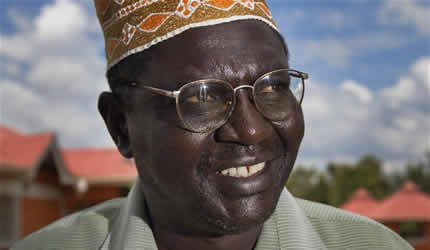
Malik Obama as he failed miserably to win a county gubernatorial seat in Kenya’s recently concluded polls.
Malik Obama (54) who shares a father with United States president Barack Obama and who ran as an independent, won just 2 792 votes — some 140 000 behind the final winner — in his bid to claim the seat for his home area in western Kenya.
“He was not the winner but at least he competed,” said Benson Mughatsia, returning officer for Siaya county, where Obama’s ancestral home is located.
“He was not last, but he was still a long way off.”
Standing well over six feet, Obama, who describes himself as an economist and a financial analyst, told AFP on the campaign trail that he would use his contacts with Washington to bring development to the rural backwater he hoped to govern.
“Why would my people settle for a local connection when they have a direct line to the White House?” he asked.
Campaigning under the slogan “Obama here, Obama there”, Malik said he dreamed of bringing food chains like McDonalds to the area and launching a bid for the presidency.
Malik Obama, who was refusing to take calls from journalists on Sunday, might have been undone by his much-vaunted refusal to give handouts, a common feature of Kenyan election campaigns where voters collect small sums of money to attend rallies.
Meanwhile, Barack Obama is facing a possible diplomatic headache in how to deal with Kenya’s new president elect Uhuru Kenyatta, who faces trial at the International Criminal Court in The Hague.
In Zimbabwe, the defeat of Kenyan opposition leader Raila Odinga by Uhuru Kenyatta at the weekend leaves MDC-T leader Mr Morgan Tsvangirai in a quandary.
Odinga and his Coalition for Reforms and Democracy’s defeat in the crucial presidential election, local political observers say, has sent shocking waves in the spine of MDC-T as their parties were modelled along the same fashion by their western financiers.
US Assistant Secretary for African Affairs Mr John Carson, had prior to the polls, threatened Kenyans with some “consequences” if they voted for Kenyatta.
In Zimbabwe, the West has threatened to extend the illegal sanctions if MDC-T loses the harmonised election.
Political observers said Africans were aware of the Western machinations to cause illegal regime change in countries such as Zimbabwe and would stand by principled leaders.
The so-called democratic and western-backed parties, the observers say, were known for standing for Western values and their politics was driven by money.
The Kenyan result, they argued, meant that the puppet parties’ days in Africa’s body politic were numbered.
The wind of political revival and stabilisation of liberation parties was blowing across the continent and the Kenyan scenario was likely to repeat itself come general elections in Zimbabwe sometime this year.
Political and social commentator Mrs Margaret Dongo said Kenyan elections results were “health for Africa”.
She said they came as a surprise to America, Britain and their puppets.
Mrs Dongo said the history of the two countries was the same given that all were former British colonies and got their independence after undergoing protracted liberation struggles.
“The people in Kenya and similarly in Zimbabwe have realised that the liberation parties are principled parties and will never abandon them. These other parties come and go,” said Mrs Dongo.
“The leaders of liberation parties are not after money, they are not mercenaries. These leaders of today are after money…people who prosecuted the struggle never asked for payment. You could see them in buses travelling long distances and never demanded allowances.”
She said Mr Odinga lost the battle because the people realised that he always vacillated and stood for Western interests, just like his Zimbabwean counterparts.
Political analyst Mr Gabriel Chaibva said the Kenyan election and the ultimate results exposed the West’s hypocrisy and their love for parties they can manipulate.
“Fairness and freeness of an election in Africa is premised when puppets win, but in this case Kenyans were wiser. The idea of taking Kenyatta to the ICC, which is after all, seriously discredited, is an attack on all parties that have links to the liberation of Africa from colonial rule.
“This will, however, not work because the winds of change are now blowing from the east coast across Africa and in a few months it will be in Zimbabwe and the British and their puppets will be counting their loses. All the puppets in the region are in panic mood right now,” he said.
He said there was no return to the colonial era adding the puppets were likely to suffer heavy loses.
Another observer Ambassador Chris Mutsvangwa said the Kenyans punished the British and their puppets, sending the message that Africans had come of age.
“This time the West ate a humble pie. Their ICC judges are not better than the Kenyans, the Africans are saying what you think about us is not what we think about ourselves. What happened in Kenya means if you are endorsed by the West you are heading for the doldrums,” he said.
Ambassador Mutsvangwa said the carrot and stick approach no longer works for countries such as Zimbabwe and Kenya.— AFP-The Herald.



 Online Reporter