admin
admin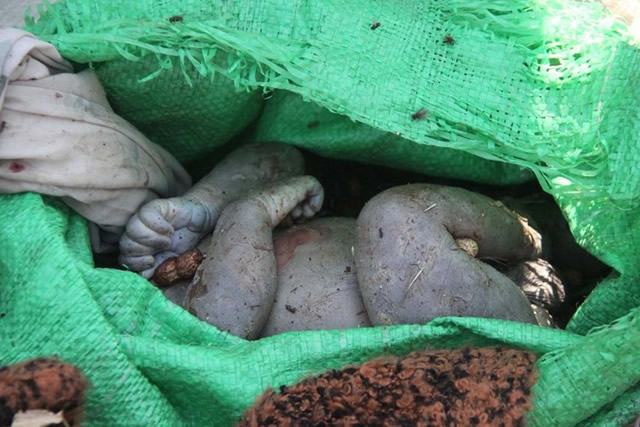
Lloyd Gumbo Features Writer
A picture of a 1,5-tonne hippopotamus which had its plump and bulky body flipped into the air like a feather by a bull elephant for trying to protect its calf made world headlines. Media houses all over the world buzzed with this story, which depicted the hippo’s love for its calf.Wildlife photographer Rian van Schalkwyk (40), who captured the astonishing scene of the hippopotamus at the Erindi Private Game Reserve in Windhoek, Namibia, said the calf got enough time to run to safety.
“She landed on her back and rolled 360 degrees down the embankment towards the water,” Van Schalkwyk was quoted as saying.
“Afterwards, the elephant just stood there and shook his head. The hippo retreated into the water, the calf ran away towards the other hippos and the mother stayed in the water for about five minutes before eventually coming out.
“I felt very sorry for the mother trying to protect her young. It was quite emotional to see her go to those lengths, to stand her ground against a much bigger animal,” he said
The captivating story of the hippo bruises the pride of the so-called superior human race, which has been found wanting as some have failed to protect their children instead, killing newly born babies.
This just goes to show that the humans who view themselves as a superior race, for all intents and purposes seemingly appear to be lower than of this caring and protective hippo, which captured global news headlines.
Even though statistics of infanticide cases are difficult to collate, health experts estimate that millions of infants are dumped globally every year. Between January and October last year, 87 cases of infanticide were recorded by the police nationwide in Zimbabwe.
The figure increased to 89 in 2013 also between January and October. While the police have recorded such figures that may appear moderate to some people, anecdotal information suggests the statistics could be awful considering that a number of them may go unaccounted for.
The situation has been compounded by our laws which are strict on abortion resulting in dangerous ones carried out in backyards.
Abortion is allowed only in cases where a woman has been raped, became pregnant in an incestuous relationship or if the pregnancy puts the mother’s health at risk.
This should be done within the first three months. National police spokesperson Chief Superintendent Paul Nyathi in an interview with The Herald urged women to seek counselling when they encounter problems.
“If they are mature people and they have problems about the baby after birth, we encourage them to engage the police, local communities or professional councillors to help them than resorting to infanticide,” said Chief Supt Nyathi.
“We also encourage schoolchildren to focus on school work than doing other things that may force them to end up committing these crimes.”
The Infanticide Act (Chapter 9:12), explicitly states that women who commit infanticide will not be precluded, from being charged at a court of law regardless of the circumstances.
The law, however, gives them a benefit of doubt unless proven otherwise. According to the Infanticide Act of 1990 that was amended in 2001, a woman who, within six months of the birth of her child, unlawfully and intentionally causes the child’s death at a time when the balance of her mind is disturbed as a result of giving birth to the child, shall be guilty of the offence of infanticide and liable to a fine not exceeding level 10 or to imprisonment for a period not exceeding five years or to both such fine and such imprisonment.
The Act goes further to assert that where a woman is charged with the offence of infanticide and it is proved that, within six months of the birth of her child, she unlawfully and intentionally caused the child’s death, it shall be presumed unless the contrary is proved that she did so at a time when the balance of her mind was disturbed as a result of giving birth to the child.
“For the purposes of this Act, in determining whether or not the balance of a woman’s mind was disturbed as a result of giving birth to a child, regard shall be had to any pressure or stress from which she suffered arising out of any one or more of the following circumstances or considerations;
“(a) the effects which the birth had, or which she believed it would have, on her social, financial or marital situation,
“(b) the difficulties which were created, or which she believed would be created, in caring for the child in the social, financial or marital situation in which it was born.
“(c) the difficulties which she had, or which she believed she would have, in caring for the child due to her inexperience or inability,
“(d) any other relevant circumstance or consideration, whether based on the psychological effects on the woman’s mind arising from the birth itself, or otherwise,” reads the Act on Chapter 9:12 (4).
However, some people would feel there is no justification whatsoever to commit such a “heinous crime’”.
Zimbabwe Catholic Bishops Conference secretary-general Father Frederick Chiromba said while people could try to use circumstances to justify committing infanticide, the Church condemned it.
“On the side of the Church, we condemn such practice because we promote the dignity of human life that begins with conception and ends with natural death,” he said.
“Any acts of abortion or infanticide are outlawed in the scriptures as well as in our traditional customs. There is no reason to justify taking away of an innocent human life.”
Father Chiromba added that as the Church, they urged mothers to take “unwanted” babies to a safe place where they can receive proper care and protection.
“We have opened institutions where those who don’t want their babies can take them there. There are various orphanages that are run by the Church and we even have some babies that were surrendered by their mothers.
“Several babies that were dumped and taken care of by the Church have gone to become successful in life. They have become professionals with others being doctors, priests and sisters among others.
“Occasionally, we get surprised when the dumped baby grows and becomes successful. That is when some mothers re-appear to claim lobola when the woman gets married,” said Father Chiromba.
Some countries like the United States enacted a “safe haven” law to encourage mothers to take their unwanted babies to a safe place. The first such law was passed in Texas in 1999 after 13 babies were left in public places in the city in one year. Four were found dead and by 2008, all the 50 states in the US had enacted something similar.
According to Dianne Hubbard (Baby Dumping and Infanticide Research of 2008), Zimbabwe’s Infanticide Act was preceded by the 1987 case of a 38-year-old widow with seven children.
The widow wrapped her baby in a fertiliser bag and placed a rock on top of her until she died, fearing her late husband’s relatives would chase her from the village since he (late husband) was not responsible for the pregnancy.
“She was initially sentenced to nine years’ imprisonment with hard labour, but the case was appealed,” wrote Hubbard.
“The Zimbabwean Supreme Court reduced the sentence to four years imprisonment with hard labour. The judge (JA McNally) stated that it was time for the court to reassess its attitude towards sentencing in cases of infanticide. The judge pointed to this mother’s desperate situation and lack of family support.,” he said.
Danai Children’s Home founder Mrs Francisca Saungweme, who is taking care of 25 children including orphans and dumped children said most of the dumped babies she adopted were doing very well.
“We need people who are committed like me to take care of children who would have been dumped,” she said. She added: “I have realised that if dumped children are taken care of they can succeed in life. For instance I have some of them who are doing very well at school with others now doing their Advanced Level studies while others are still in primary school.
“I am taking care of some children who were premature but have grown now and they have so much potential.
“I have no doubt that these children will succeed in life because they are intelligent, judging by the way they are performing at school now,” she said.
Mrs Saungweme explained: “It is better for mothers who don’t want their babies to take them to a safe place or to the Department of Social Services than killing them.
“There is no justification for killing or dumping children. It is also important for parents to accept their daughters if they are impregnated when they are still at school. Sending them away will not help the situation. Instead, they should take care of their grandchild and send their daughters back to school so that they can pursue their education.”
The general feeling among people is that there are intrinsic circumstances that lead to infanticide, chief among them neglect by men responsible for the pregnancy. For school-going children or under-aged girls, the reasons are usually because they know their parents would not accept their situation.
This results in those children concealing their pregnancy or opting for dangerous backyard abortions to avoid a backlash from their parents. Poverty has also pushed mothers to commit infanticide as they may feel they would not be able to cater for the babies.
For these reasons some infanticide lobbyists argue that the crime is committed in self-defence than an insensitive gratuitous cruelty.
It is apparent from some of the above reasons that lack of self-determination by women is the driving force behind infanticide.
There is certainly need to empower women as well to give them authority over decisions that they make. It is important for women to seek counselling when they face problems than resort to infanticide or baby dumping.
- Feedback [email protected]
Raising awareness about the need to preserve life can play a big part in reducing or averting infanticide. Even more importantly, it is worth considering for Government to support, through legislation, the establishment of safe havens where ‘unwanted’ babies can be taken to without prosecuting their mothers.



 Online Reporter