

 Chronicle Editor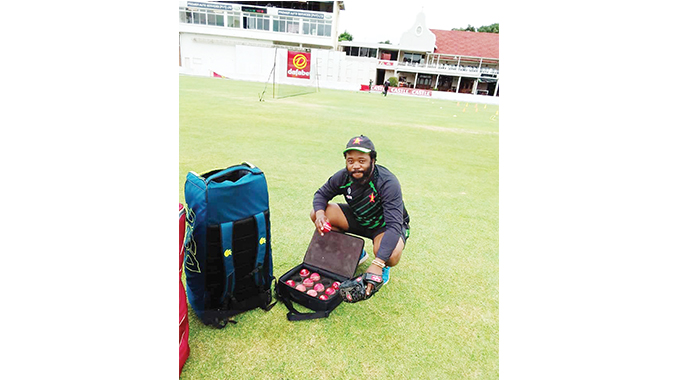
Ricky Zililo, Senior Sports Reporter
AT the age of 30, he should be in the prime of his game, competing for a place in the national team, but alas, Njabulo Ncube has decided to change roles and can now be found barking instructions as a cricket coach.
Nicknamed Papa, the former national team pace bowler, who has a single cap in one-day internationals and Test cricket in the 2011 home series against New Zealand, surprised all and sundry in 2014 when he turned down a contract with Matabeleland Tuskers Cricket Franchise to take up a coaching job in South Africa.
He coached St John’s school in Johannesburg and on his return to Zimbabwe, he doubled up as a player-coach for Rising Stars Academy.
He was 24 then and at the peak of his career, having played a pivotal role in ensuring that the Bulawayo franchise successfully defended the Logan Cup.
Very few cricketers would have turned down an offer to play for Tuskers and enhance their chances of playing First Class cricket as well as being considered for the national team but Ncube did and has never looked back since then.
As it is, he is now a provincial coach in Bulawayo and has been honoured with the responsibility of training national team players based in the City of Kings in preparation for the incoming tour of Afghanistan.
Due to the Covid-19 lockdown restrictions, the ZC training pool was split into small sub-groups that are practising in their provinces.
The players focused on strength and conditioning sessions for the first three weeks before switching to skills training.
Those that have been training under Ncube include 35-year-old lanky pace bowler Christopher Mpofu, all-rounder Sean Williams (34), opening batsman Brian Chari (29) and 26-year-old bowler Ainsley Ndlovu, who all have more national team caps than Papa.
Mpofu has 15 Tests and 84 ODI caps, while Williams has 12 Test appearances and an incredible 133 ODIs for Zimbabwe. Chari is on seven Tests and 15 ODIs and Ndlovu has two Tests and ODI caps.
Ncube is not intimidated by coaching high-profile cricketers and neither does he have regrets for changing roles to take up full-time coaching responsibilities.

“I don’t have any regrets switching to coaching at a young age. I’m happy and grateful for everything I have achieved,” said Ncube.
“When I moved to South Africa in 2014, during the week I would be coaching St John’s and then weekends I would play club cricket. Somehow, my passion shifted to coaching, as I enjoyed it more compared to playing. I worked with Justine Summons, who is now a batting coach for Highvield Lions. I also worked with Stuart Matsikinyeri, the current batting coach for the Zimbabwe national team. I learnt a lot from these two guys. The hard work and dedication they have is priceless, so I can say they really had a big influence in me taking up coaching seriously.”
As a player-coach for Rising Stars Academy in 2017/18, Ncube led them to the 50-over championship victory.
He returned to Tuskers for the 2018/19 season before getting a surprise call-up to the national team as a bowling coach at the beginning of this year.
Ncube was amazed by the response he got from national team cricketers.
“The guys’ response has been brilliant. Early this year I got called up to be the bowling coach for Zimbabwe against Sri Lanka. I was nervous at first and somehow the guys’ response was good. As you are aware, I have been working with the Bulawayo-based national team players and so far it’s been brilliant and I’m looking forward to working with them for a long time,” Ncube said.
Described as a small man with a big heart during his playing days, Ncube, who considered former South African bowling speedster Makhaya Ntini as his role model for his aggression and commitment, holds his ODI debut for the national team as the most memorable highlight of his career.
In that match, he picked up the three wickets of Rob Nicol, Brendon McCullum and Ross Taylor.
Zimbabwe went on to win that high scoring match by a wicket.
“My most memorable moment was my debut game, which we won against New Zealand at Queens Sports Club in Bulawayo. The feeling of playing in my home town was just irreplaceable,” he said.
He also said legendary former player and coach Dave Houghton had encouraged him to “go out and express” himself and that calmed Ncube’s nerves as he headed onto the pitch against New Zealand.
He said his worst cricket moment came as a youngster when he lost to Mtshingwe School of Emakhandeni while turning out for Fusi in a primary schools final.
Ncube, described as a short, nippy fast bowler, first played cricket on the streets of Bulawayo’s Gwabalanda township and later represented Milton High School before finding his way into the Westerns Under-19s and B teams.
He represented Zimbabwe Under-19 in the 2008 World Cup in Malaysia.
Just how did Ncube start playing cricket.
“I was introduced to cricket when I was in Grade 5 at Fusi Primary in Gwabalanda when we played against other primary schools from the neighbourhood. My brothers are the ones that influenced me to take up cricket because I wasn’t gifted in football, which was popular ekasi, ngangilixaba.
“As I grew older and moved to Milton High School, I was fortunate enough to represent Zimbabwe Under-19 at the World Cup in 2008. That was the year I made my First Class debut (domestic) for Matabeleland Tuskers, but it was at Mountaineers where I moved to in 2010 and made an impact before being selected for Zimbabwe A, then the national team in 2011,” Ncube said.
Besides his mother and brothers, Ncube also gives credit to experienced players Keith Dabengwa, Mpofu and Tawanda Mupariwa for supporting him in First Class cricket.
“As a youngster my dream was to play at the highest level. It’s tough to get the cricket kit because it’s expensive and I just want to thank my mother who supported me throughout this journey. Back then, it was hard for players from the Western areas to be recognised and break into First Class cricket, but people like Dabengwa, Mpofu, Ainsley Ndlovu, Charlton Magaiva Tshuma and Brian Chari came through the grassroots and are having positive influence on cricketers from the western suburbs.”
He said up-and-coming players should believe in their dreams and work towards them because they could achieve anything in life if they develop self belief.
Veteran cricket administrator Nicholas Singo, now Tuskers boss, who co-ordinated the game in Bulawayo’s high density suburbs in the 1990s, spoke highly of Ncube.
Singo recalls how he gave Ncube a contract to train school going cricketers during his time as Matabeleland North general manager in 2007.
“The first time I met Njabulo was while he was at Fusi Primary School when I used to go around picking up the best talent from the Western suburbs to BAC for specialised coaching. Njabulo was a stocky shy boy and rarely looked into your eyes when you engaged him. However, what amazed me was the pace he generated with the ball and from there on I never doubted his ability. As he grew older he became more engaging and I liked his dedication and discipline.
“When I moved to Matabeleland North as GM, I offered four contracts to the Bulawayo up-and-coming players and Njabulo was one of them. In Matabeleland North he developed in two areas, as a player and a coach. They would practice in the morning and coach schoolchildren in the afternoon. Maybe that’s where he developed the love for coaching. After two years of development he moved back to Bulawayo and the rest is history,” said Singo.
The other three up-and-coming cricketers who were identified by Singo are Dumisani Mankunzini, Mike Mhlanga and Vincent Dururu.
Dururu also became a top development coach for Bulawayo and at some point was assigned to the national Under-14 team, which toured South Africa.
Mhlanga still plays local club cricket for BAC and is a fringe player for Tuskers. — @ZililoR


 Online Reporter
 Bongani Moyo