admin
admin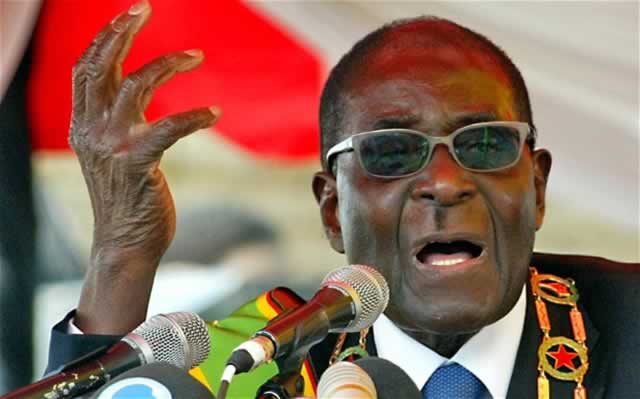
Harare Bureau
President Mugabe yesterday said it was Zimbabwe’s God-given right to determine its destiny without foreign interference.
The President said this at the burial of veteran nationalist and Zanu-PF founder member Cde Enos Nkala at the National Heroes Acre yesterday.
Cde Nkala (81) died at the Avenues Clinic on Tuesday last week from organ failure induced by high blood pressure.
In his address to the thousands of mourners that thronged the national shrine, President Mugabe said Cde Nkala was a fearless fighter who had sacrificed his life for the country’s independence.
“As he gave his physical and intellectual life to the nation, he sacrificed it so that our nation could regain its lost sovereign right to determine its own future after all one life leads to another, a father begets a son or daughter and so the life goes on and on.
“That is also how we regard this life, to be long and perpetual, until perhaps the good Lord or some Armageddon occurs and the world vanishes and life on it extinguished. But for as long as it is there, we have a right to determine our own destiny, the right to say to foreigners you can’t rule us so go and if you are not gone, then we will kick you out that is what Enos did and we want to thank him today and say you were unafraid, unyielding. You sacrificed your entire life except for the few years when you were now old, you gave direction to others, you showed your love.
“God says love your neighbour and to us in the struggle there is no greater love you could show to your people than that to sacrifice for their freedom, that is what Enos did,” President Mugabe said.
The President said even when they were in prison or detention they never wavered from their belief in God and Zimbabweans’ right to fight for their freedom.
“We never divorced our actions from the actions of those who are dedicated to the good Lord. We knew that part of each person is spiritual, another part physical, still yet another part intellectual but the fight had to be fought and fought morally. It was a moral fight, we believed as we still believe that the people of Zimbabwe have a God-given right to defend themselves, a God-given right to defend that right, a God-given right to fight any intruders or persons or organisations which interfere with their right of ownership and the right to determine their own future that we believe is a sacred right the people have and even in the scriptures we see it,” he said.
He said the late Cde Nkala had a short temper but was also a friendly person.
“Yes, Enos was abrupt, short tempered but friendly, one moment he would be quarrelling the next moment he would be very friendly, very calm that was his nature,” he said.
President Mugabe added that Cde Nkala would also participate actively at the meetings they had and did not tolerate the notion that whites were superior to blacks.
“A meeting we had with Enos Nkala we knew it was going to be an active meeting, he did not want to see a white man next to him . . . he had that bravado, that I-dare-you spirit but we liked that. Why? At that time there was so much subjugation, so much acceptance that the white man was next to God, we wanted the minds of the people to be cleansed — in psychology they say to uncondition them.
“They were conditioned to worshipping the white man, you must uncondition them and the way to uncondition them was to show them that the white man was no better than any of us. He could be insulted, he could even be beaten up and this worked, worked in so far as our youths were concerned they became more and more fearless,” he said.
President Mugabe narrated how he met Cde Nkala in June 1960 when he had returned from Ghana and the National Democratic Party had just been formed in January of the same year.
He said some of the founders included George Silundika, Morton Malianga, Michael Mawema, Leopold Takawira and the late Cde Nkala.
The NDP, President Mugabe said, had been formed to replace the banned Southern Rhodesia African National Congress.
President Mugabe said when he returned, a number of nationalists had been in detention as a result of the Preventive Detention Act and these included the likes of national heroes Maurice Nyagumbo, Jason Ziyapapa Moyo, the late Vice-President Joseph Msika, among others. President Mugabe said he had to terminate his teaching contract in Ghana after he was asked to be the NDP’s secretary for publicity after its congress in 1960.
President Mugabe also narrated events that led to the formation of Zapu after the banning of the NDP and then later Zanu.
He said differences among the nationalists on strategies led to the formation of Zanu on 8 August 1963. Zanu was formed at Cde Nkala’s house in Highfield and he was elected its treasurer.
Cde Nkala was born August 23, 1932 in Filabusi (Matabeleland South) and did his primary education at Mzinyati Mission where he learnt up to Standard Six.
He then did the National Junior Certificate through correspondence. In 1950 he was employed by Rhodesia Cement in Bulawayo and then took up another job at a clothing factory in the same city.
He moved to Harare in 1953 where he was employed as a newspaper vendor before he joined Old Mutual as an insurance broker.
He joined the Southern Rhodesia African National Congress in 1957 until it was banned in 1959.
At the formation of the NDP in 1960 he became the deputy secretary general. In 1964 after the Zanu congress held in Gweru, Cde Nkala was arrested and was detained at Sikombela Detention Camp and also at Salisbury, Connemara, Hwahwa and Gonakudzingwa and stayed in detention for 12 years.
He was released towards the Lancaster House talks and after the attainment of independence became Minister of Finance until 1983 when he moved to Minister of National Supplies.
He briefly moved to the Ministry of Home Affairs in 1985 and then became Minister of Defence before he resigned from Government in 1989.
He is survived by his wife, Thandiwe, eight children, six grandchildren and two great grandchildren.


 Online Reporter