Online Reporter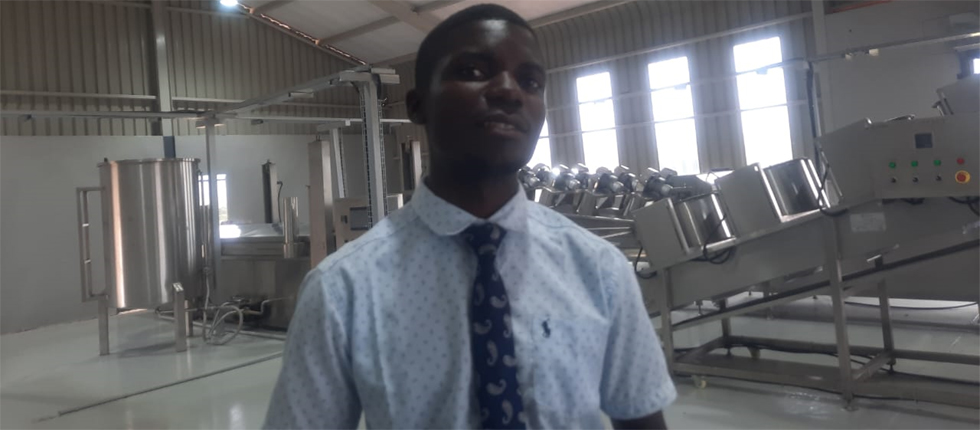
Tendai Gukutikwa
Post Reporter
NOAH Simango did not build an ark, but is building something that saves lives in Honde Valley – starting off with his own family.
At just 24, he supports five adults through banana farming, a responsibility he never planned and trained for.
With no father in the picture, and schooling cut short at Form Two because his mother could not afford the fees, his future once looked like a flood of dead ends.
But when the US$450 000 Hauna Fruit and Vegetable Processing Plant began rising from the ground, the young farmer, whose name evokes the Biblical figure who prepared for survival against all odds, planted hope.
He expanded his field from 200 banana plants to 800, believing that for the first time, the market was no longer far away, controlled by middlemen, or dangerous to reach.
“This facility gave me courage. I knew the market had finally come to us,” he said in an interview on Wednesday.
To him, the development represents, not just better income, it is the difference between poverty and survival for an entire household.
At just 24, he carries responsibilities that would overwhelm many adults twice his age.
He is the provider for his mother (49), grandfather (87), uncle (54) and elder brother (30). He supports five people, all through banana farming.
“I started banana farming in 2022, and back then I only had 200 plants. The construction of this processing plant is the reason why I extended my plants to 800 plants. It gave me hope because I knew the market was now close,” he said.
Mr Simango is part of Gadziriro Agricultural Cooperative Society, one of several cooperatives under the Valley Sharks Agricultural Cooperative Union. These cooperative form the backbone of banana production in Honde Valley. For years, their labour enriched middlemen and transporters, not the farmers themselves.
“We had to rely on middlemen who offered us very low prices. They would only select large bananas and leave behind smaller ones, which led to significant losses,” he recalled.
Before the new plant was constructed, farmers transported bananas to Mutare and sometimes Harare. It was, not just expensive, it was dangerous.
Rural roads are winding and steep, and accidents involving banana trucks have been frequent over the years.
Some farmers never returned home.
“We often heard of farmers dying in road accidents while transporting their bananas, and many families were left in pain and poverty. A friend of mine actually perished in one of the accidents while transporting his produce to Harare,” Mr Simango said, his tone, though it carried a bit of hurt from talking of his friend, also sounded relieved that such suffering could soon be behind them. With a processing plant now a few kilometres from his homestead, the one-tonne harvests that used to earn him only US$300 can finally command a fairer price.
“Now that the processing plant is closer, I believe I will get more money,” he said.
Before producing for himself and his family, Mr Simango worked for other farmers. With no father and no safety net, he entered adulthood early.
“I grew up in a poverty-stricken family. I do not know my father; he left my mother while she was carrying me. I worked on someone’s banana farm to save money for school, but the wages were too little. I focused on supporting my family instead,” he said.
What began as survival turned into ambition, his future and pathway out of poverty.
“The farming got so good that I ended up doing farming myself and enjoying it. I had gained experience that farming can get you up there because in Zimbabwe farming is money,” he said.
The Hauna Fruit and Vegetable Processing Plant represents more than infrastructure. It embodies a promise that people like Mr Simango will not be left behind, he said.
“This project has brought market growth to the farmers, reduced post-harvest losses, and opened doors to income generation for many families, especially among youths and women,” he said, repeating the sentiment with pride.
Farmers across Honde Valley share that optimism.
When the plant starts operating, bananas will be processed into chips, flour, cooking oil and other by-products. Nothing will go to waste. Smaller bananas, the ones middlemen rejected, will finally bring income.
Valley Sharks union vice-chairperson, Mr Noah Maroro, confirmed the plant’s capacity and its potential impact.
“The plant can process 500kg per hour, which is four tonnes per day. This will cushion us from the usual post-harvest losses. We will start with chips and later venture into powder, cooking oil and other by-products,” Mr Maroro said.
Farmers in Honde Valley said the plant will change the economics of their households.
Mrs Mercy Matahwa, another banana farmer, said she is already preparing to increase her production and follow in Mr Simango’s footsteps.
“We used to sell only what was big enough to be accepted. Now everything will be used, and this means every bunch will give us income. I wish I had followed Mr Simango’s footsteps earlier, but there is still time for me to plant new banana plants because this plant gives women dignity,” she said.
Government sees the project in the same light of empowerment, not charity.
In an interview on the sidelines of a recent site tour, Presidential Advisor and former Minister, Dr Joram Gumbo underlined this shift in thinking.
“The establishment of the Hauna Fruit and Vegetable Processing Plant marks a transformative moment, not just for this valley and young farmers like Mr Simango, but for Zimbabwe’s entire rural industrialisation agenda,” he said.
Dr Gumbo said the facility is, not simply a structure of steel and machinery, but a tangible symbol of empowerment, economic resilience, and inclusive national growth.
He said the plant addresses the longstanding injustice that farmers faced.
“For too long, the dedication of our banana growers and smallholder farmers has been undermined by immense post-harvest losses and the exploitation of unscrupulous middlemen. Today, we confront that vulnerability head-on,” he said.
More than 600 farmers are expected to benefit directly, and another 2 000, mostly women and youths, indirectly. The goal is that no rural community should remain trapped in a cycle of producing raw commodities without value addition.
Back at his field, Mr Noah Simango adjusted a banana bunch tied to a support pole as he spoke softly and fluently with the conviction of someone who has seen both struggle and possibility.
“I am the sole breadwinner. I take care of my mother, grandfather, uncle, and older brother. The proceeds from my fields keep us going,” he said.
For him, the processing plant is not just a facility. It is validation, and proof that young farmers like him are not wasting their time on land.
It is a future he can finally count on.