

 Chronicle Editor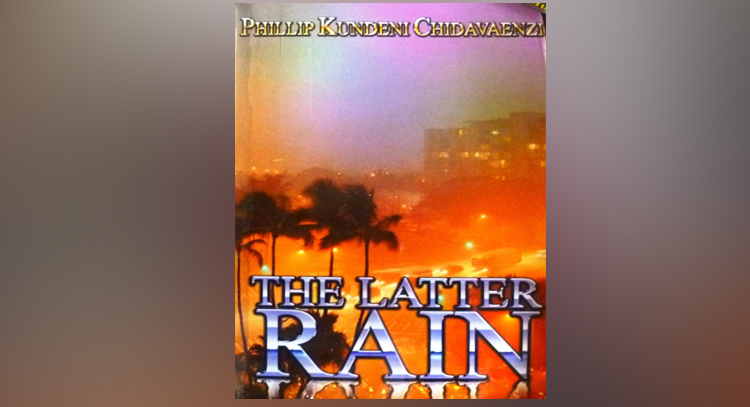
Beaven Tapureta Bookshelf —
The unbridled patriarchal tendencies of men has contributed to turning the city into an unfriendly place for desperate young women or girls searching for economic empowerment as portrayed in novelist Philip Kundeni Chidavaenzi’s third novel “The Latter Rain” (2016, New Heritage Press).
The novel is divided into three sections, which are, in their order, The Broken Places (six chapters), Years of Desolation (23 chapters) and Finding the Light (16 chapters).
The first two sections of the novel are sad when one looks at how the female characters play to the gallery of many male characters who worship sensuality and monetary power. The men pretend to be sensitive to women’s craving for self-realisation yet they have ulterior motives.
It looks like without the men, the female characters are helpless in a city in which deceit and money rules. Rape, incest, infatuation and many other sins committed against women are brushed aside as if it’s the normal way of city life.
What Chidavaenzi has achieved with this novel is the display of a vivid, moving narration and a real exploration of what exactly happens in the dark corners of the city, the hunger for spiritual, mental and bodily liberation. Even those men who are looked up to as men of God such as the characters Pastor Lisbon Mathe and Madzibaba Josiah are falling victim to the whims of the body!
Isabel, who escapes from her rural home in Mt. Darwin after her widowed father marries the insensitive or overbearing MaDube, comes to Harare but soon is forced by circumstances to become an expert “prostitute”. Her friend Dorothy, also escaping from an arranged marriage to Madzibaba Josiah, a leader of an apostolic sect in Mt Darwin, comes to stay in Harare but also soon she discovers that all that glitters is not gold.
These two young women are the centre around which the story in “The Latter Rain” revolves. They are the protagonists whose lives are broken by men whom they wish could understand what a woman needs. How Chidavaenzi plots this story is outstandingly experimental.
It is like an objective story that shows what we might experience through our senses if we were in the same room with the characters. It is like a movie, just as all stories at the objective end of the spectrum resemble those movies which hardly have any voice-overs.
The story takes off with Dorothy being disowned by her mother at the funeral of her father Jethro. She is disowned for refusing the polygamous Madzibaba Josiah as husband and she comes back to the city.
The story moves on but a little later in the fifth chapter it flashes back to Mt. Darwin to show what exactly happened back home when Dorothy escaped – the humiliation her parents suffered at the hands of Madzibaba Josiah! There is forward and backward movement of the story which excites a reader’s curiosity.
In the city, men in power, who include a pastor and some businessmen, proudly flaunt their wallets and use cash to take advantage of desperate women looking for real love or a better life. Isabel, soon as she arrives in Harare, is forced into an incestuous relationship with her uncle whom she looks up to. And next she falls in haphazard affairs which result in some unwanted pregnancies which she terminates.
Dorothy’s friends like Isabel, Natasha, Lorna and others, discovering they would never win the ‘money’ game in Harare without paying with their bodies, begin nightclubbing and engaging in very risky careers which involves nudity and prostitution.
Chidavaenzi mixes first and third person points of view and further tries to run away from chronological narration.
It is a mixed bag of action, close-knit events in which a number of secondary characters are introduced. There is something amazing about how the story was plotted – as if it is being told from the end towards its beginning and yet in between there are other circular plots as well.
The flashbacks or cutbacks are simply occasionally implanted anywhere in the novel as it progresses. For instance, how Dorothy and Josh came to be lovers and have a son together is shown in latter chapters 23 and 24, way after we have learnt that the two lovers are no longer together in the opening chapters!
In the last section “Finding the Light” Dorothy and Josh re-unite. In fact, many of the conflicts in the story are resolved in the chapters under this section. Dorothy’s victory over her challenges consoles the reader after Isabel dies.
By virtue of its cinematic narration, “The Latter Rain” has a certain momentum which Chidavaenzi’s previous works have not achieved.



 Online Reporter