admin
admin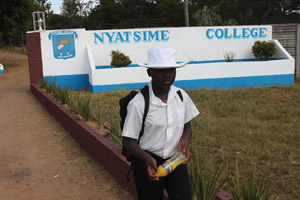
independence.
From being one of the most-sought-after schools in the country, the first private school to be established and administered by black people, it is now a pale shadow of its former self failing to refurbish its infrastructure to meet students’ demands.
The changeover from an institution offering academic and vocational subjects to a school offering purely academic subjects after independence has left Nyatsime College facing a myriad of challenges.
Chief among them is the shortage of adequate water, deteriorating infrastructure and increasing demand for its services, a clear indication of years gone by.
This has seen some parents withdrawing their children from the school alleging the quality of education had plummeted.
As such, the institution has been in the news for failing to give children quality service that reflects the name that it has managed to build over the years.
The situation has been worsened by reduced funding into the education sector due to effects of the ruinous economic sanctions that are eating into the country’s education system.
Despite the school having produced lots of influential people, some who went on to become top civil servants and successful businesspeople, the school which started in 1962 has failed to attract alumni to boost its coffers.
Among the school’s former students are former Minister of Health and Child Welfare Dr David Parirenyatwa, Minister of Science and Technology Heneri Dzinotyiwei, Dr Andreas Rukobo, a principal director with Parliament of Zimbabwe, secretary in the Ministry of Labour and Social Services Lancaster Museka and accountants Mr Harrison Mbewe and Mr William Mafi among others.
Some of these former students acknowledged that they have not been doing much for the school despite having benefited from the institution.
With the school expected to celebrate its golden jubilee next year, it is unforgivable that it still has only single storey buildings, a small library and dining hall. It is surely crying for help – given historical importance.
The school became synonymous with the struggle for black emancipation in a system that did not allow for the complete development of black people.
A modest dining hall that has to cater for the more than 400 students in batches during meals still characterises what was the sweat and idea of the late educationist Dr Stanlake Samkange.
The school is thus crying out for help.
Its decaying infrastructure is failing to compete with the more modern institutions of education.
Chairperson of the Nyatsime College board of directors Dr Tommie Anne Samkange acknowledged that the school was going through tough times just like most schools in the country.
“We have problems of water provision as it relates to the municipality and of learning equipment that befits the school of our magnitude.
“The water problem is, however, being addressed as we have contracted the District Development Fund to drill another borehole.
“The Parents Teachers Association has donated a borehole to augment the water situation,” she said.
Dr Samkange said the school has a number of small boreholes but power outages were retarding efforts to improve water supplies at the institution.
“We are pleased that a member of the school community has secured a generator through the state lotteries.
“We however, have an oversupply of the chairs and desks that we don’t know where complaints are coming from,” she said.
Currently the school caters for roughly 600 students, all boarders.
A parent with a child at the school a Mrs Makoni recently wrote a letter to The Herald bemoaning lack of basic services at the institution.
She wrote: “Can the Board of Governors at Nyatsime College do something to improve hygiene at the school.
“There is hardly any water. Toilets are cleaned once a week.
“Boys have to take their showers in the same toilets with unbearable stench.
“Surely an established school like Nyatsime College should have sunk boreholes or made other arrangements to have a consistent supply of water even by water bowsers?”
A pupil at the school said students were not happy with the infrastructure, which they said was lagging behind that of other schools in the country.
“It is always difficult when you try to compare us with other schools in the area and country.
“The school desperately needs new buildings, a proper water supply and better accommodation for us,” said a form three student who can not be named for fear of victimisation.
Mrs Samkange said the school is in the process of constructing a double storey hostel to house female students at the college but the process has been slow due to limited funding.
One such way to correct shortage of resources is engaging former students by creating an old students association or alumni.
Board member and former student Mr Mbewe said the association of old students has not been active and efforts were underway to revive it.
“We have not been active but we are moving to come up with a register of former students before convening a meeting before the year end,” said Mr Mbewe.
He said once the college manages to bring former students into the development of the school it would be easy to get ideas as well as raise funding for school re-development and expansion programmes.
Opened in 1962, the school became a symbol of African pride in the region, as it showed that blacks could also set up and run a successful school.
To date thousands of individuals have passed through the school’s gates but the institution is failing to tap into its large resource base.
It has even created a website to help to link with former students who would in turn help to source funding to renovate and spruce up the school but with little success.
Dr Samkange said: “It is something that we will keep on trying to establish but currently it has not given us much joy. We know we can do more with alumni as we have graduated prominent Zimbabweans.
“There is, however, a group that is working on that and it has managed to attract only a few people to alumni.”
Alumni would enable the college to attract students and continuously improve the welfare of students at the institution.
This allows an institution to raise funds to further develop the school and equip it for the benefit current and future students.
She said Nyatsime College had to streamline its operations after the Government increased funding in the technical education sector.
The institution is now offering only computer science, agriculture and building, as vocational subjects but was facing competition from other Government educational institutions.
She said despite the many challenges the college was facing, Nyatsime remained popular and was receiving hundreds of applications from prospective students.
Dr Samkange appealed to former students who have made it in society to plough back in the school, a local initiative that was established to serve the need of the national community.
[email protected]


 Online Reporter