dyton mupawaenda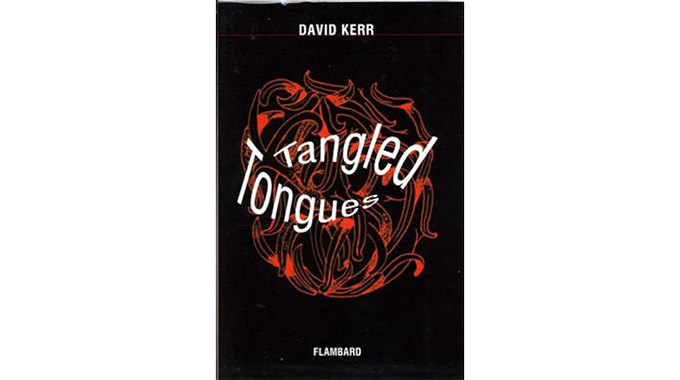
Elliot Ziwira-At the Bookstore
In “Tangles Tongues”, DAVID Kerr visits the all too sensitive, yet familiar landscape of intercultural existence as individuals are thrown off board in their quest to co-exist in a global village.
Cultural integration, whose root may be traced back to slavery, another thorny issue, and colonisation, has its own fair share of casualties, especially in recipient communities.
The poet, who is British by birth, has travelled extensively through Africa as a scholar and filmmaker.
His experiences in Malawi, Zambia and Botswana, among other countries, have shaped his resolve to side with the voiceless and displaced Africans.
Kerr shares their experiences as they continue to be weighed down by hegemonic machinations of the erstwhile coloniser, years after independence.
The imperialist’s presence is still felt in the administrative apparatus of some new governments across Africa that struggle to wean themselves from the imperial power, because of neo-colonialism.
The education system, economic impetus, and social cohesion are still under the tutelage of alien powers.
It is worth noting that when different cultures converge, language; the major informant of cultural values, suffers. In the African experience, European languages seem to take precedence over indigenous ones, which are pushed to the brink of extinction.
When language suffers, then naturally culture becomes the biggest loser.
It is on record that a language dies every fortnight and takes with it a whole cultural and intellectual heritage. There are some languages and cultures that may never be redeemed, as they collapse under the guise of industrialisation and progress.
Many languages have suffered due to technological advancements and an increasingly globalised village, with at least 43 percent of the 6 000 tongues spoken across the world facing extermination.
Owing to colonialism and hegemony, education systems the world over rely mainly on a few hundred languages, which disadvantage 40 percent of the global population that neither speak nor understand them.
The advent of the Information Revolution has further jeopardised thousands of languages as the digital world only makes use of less than a hundred.
The subtle nature of colonialism and its attendant efforts to destroy cultural ethos through destruction of shrines, and all that made colonised people tick, created individuals who hated themselves more than they did their colonisers. They lost their languages, which they were made to believe to be the source of their backwardness.
Language carries a people’s culture, and culture is the backbone of societal aspirations. Loss of language equates to loss of culture, and ultimately loss of confidence, because everything that the colonised should be cherishing is reduced to “a quintessence of evil”, as Frantz Fanon writes in “The Wretched of the Earth” (1967). He argues that the best way to destroy a people is to rob them of their confidence.
It is normal for the formerly colonised, particularly Africans, to boast of eloquence in alien languages, like English, French, Spanish, German and Portuguese, without realising how much they have lost in terms of tangibles and intangibles of heritage.
They want their children to speak through the nose, as they say, and invest a lot of resources towards acquisition of the said languages, and the cultures that come along with it. With the death of language, indigenous knowledge systems also suffer the same fate. As more and more people migrate from their countries of birth to the Diaspora, the rout is complete.
For global citizens to live in harmony, there is greater need for linguistic diversity and more emphasis on multicultural education through promotion of mother tongues.
As Kerr depicts in “Tangled Tongues”, when languages are twisted words to express human phenomena like betrayal, despondence, hope and disillusionment, lose the intensity of meaning. As a result, the feeble are exposed to toil and oppression. There is no better way of expression than that which comes with the debonair of semantics. The poet fractures sense boundaries through his use of a combination of aural, visual, olfactory, gustatory and tactile imagery, which is aided by symbolic elements prevalent in African communities.
Varying form also heightens the deciphering of thematic concerns raised, since inhibitions usually associated with traditional forms, which make the reading of poetry cumbersome, are mitigated.
The different forms used also tap heavily into folkloric traditions as the reader is drawn into the narrative. The poems can be read from different angles and are open to a plethora of interpretations, for the themes raised capture the blistering experiences of the African social, economic and political landscapes. Afflictions, civil wars, hypocrisy, deceit and oppression are fleshy for the poet’s surgical knife.
Using the autobiographical mode, Kerr, through the nomadic persona in his poetry, contrasts reality with what is hoped for, and juxtaposes affluence with squalor. The persona feels let down by stereotypical malfeasances born of cultural invasion. Transcultural communication becomes skewed against the host culture, as it is aided by the need to belong and the quest to satisfy carnal desires.
Kerr is contemptuous of the cultural erosion that is brought about through industrialisation and or technology. In the poems “Prayer Rock” and “Uprooted”, the poet chronicles the bane of technology and war on cultural and religious norms, as traditional shrines are destroyed.
“Prayer Rock” highlights the soothing nature of religion as it follows the story of a Zionist apostle, who goes to her traditional rock to upload her woes to the almighty God in the Christian way. Her problems are both social and economic.
At the social level, she bemoans her 17-year-old daughter’s immorality and insatiable carnal desires, which have elevated her to a grandmother.
Imprisoned by womanhood and motherhood, she fends for her plump grandson, Thabo, who “squeals and stuffs insects into his mouth”.
Also, the Zionist persona is aware that Lebogang, her unrepentant daughter, is newly pregnant. She pleads with God to save her daughter, grandson and her unknown sons-in-law. At the economic level, which has a bearing on the social platform, she prays for her customers as they find it difficult to honour their dues to her.
Clear in her prayer are the social burdens that are imposed on her by those whom she feels are not to blame, but simply need deliverance. Her suffering is profound, and her eyes “squint and water”. She feels powerless to change her situation; what she can only do is pray.
She is aware of the socio-economic burdens that implode on her community.
The apostle pleads with God to help Thabo who will soon scamper to the road where cars scream, and drunks hurl empty cans.
However, her haven to unload her baggage falls quarry to the technological predators that “guillotines the earth, which puffs back with clanking dread,” as they clear the way for a road.
The poem “Uprooted”, also explores how African religion offers respite to societal woes. The persona escapes from her suffering and seeks hope from her husband and grandfather’s graves. Each month, she goes to her husband’s grave to “pour beer and seek/blessings”. When civil strife breaks out, and insurgents demand goats, she would go to her grandfather’s grave and scatter flour.
But as the war intensifies, the villagers are forced to leave their loved ones’ graves and head to “the border in the gloomy highlands”.
Like all the other residents, she feels let down because she could not find “time to pour (her) last flour and beer on the graves” in their home thickets. The priests “who claim to know say Satan/is uprooting the whole world, and spirits/are howling around neglected graves. . .”
In the poems “Return of the Linguist”, “Tongues” and “Other Languages”, Kerr laments the death of languages, especially minority ones, and lambasts the rise of cryptic tongues, which will not articulately express the majority’s feelings.
The poet reveals the African tragedy of remaining clinging on to colonial power, not only through language, but capital; both human and monetary. This rationale obtains in “Afro-canned”, “Gaborone”, “Furnace” and “IMF Consultant”.
The juxtaposition of lack with affluence in the poems “Lifestyles” and “Children at Play (Leeds/Harare)” also lays bare the baneful nature of hypocritical tendencies of the West. The piecemeal solutions prescribed to African challenges, in most cases, aggravate, instead of mitigate them. The continent remains on its knees, notwithstanding its vast mineral resources.
It is this that has prompted the disillusioned persona in “The continuing search” to quip “with guileless truth, (that) she was looking for ‘Uhuru’”, which courts trouble with the bemused cop.
Such is the nature of “tangled tongues” that David Kerr takes a swipe at in his poetry. The individual continues to search for freedom of worship and social cohesion, but unfortunately for him or her, the means to such expression remains jumbled, thus blurring the meaning of a shared vision.



 Online Reporter