admin
admin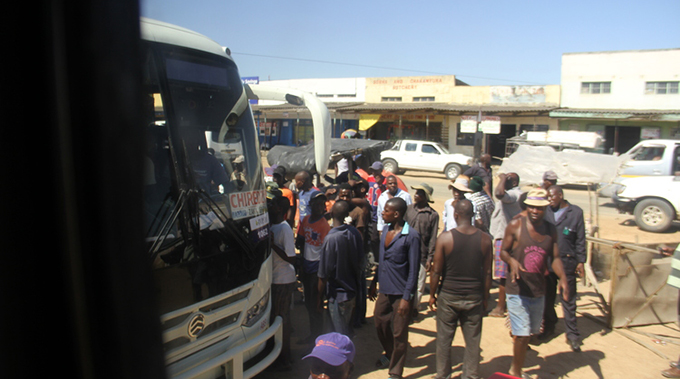
Leroy Dzenga ,Features Writer
Mbare carries a near ethereal mist in the morning.
The mild scent of moist cardboard and wilting farm produce dominates the air.
The palpable scent of bustle is what hard work smells like.
Despite it being what some would call “wee hours,” the atmosphere in Mbare is at its electric best when dawn breaks.
Life moves at a pulsating pace.
Being a morning person is a luxury those who operate from the Mbare bus rank cannot afford.
Pickpockets, police officers, drivers, conductors, touts and heavily-built men of no defined vocation, all seek to cure the itch in their palms.
Legend has it that the tingling sensations signify rich pickings to come. In this case, the burden to satisfy the expectation lies on those who operate long-distance buses.
Their pockets are shred as they abide by the laws of the land and those of the streets.
Seeking to understand tariff expenses met by long-distance operators, The Herald on Saturday travelled from Harare to Chiredzi on one of the leading buses plying the route.
The excursion revealed the weight carried by operators daily to fulfil their trips.
Upon entry into the bus rank, the first cost met by any bus is a compulsory $150 rank fee charged by City of Harare.
In principle, this money is meant to finance facilities of reasonable comfort as passengers wait to board.
However, the rank is conducive to those who are either desperate to travel or are guaranteed of earnings through their presence.
The sheds are in a sorry state, ablution facilities break almost every acceptable standard of sanitation.
Besides the rank fee being put to questionable use by the city fathers, that is if it happens to get to the city coffers, its recent hike from $25 to $150 has opened doors for connivance between bus crews and council workers.
“It is not every bus that pays this rank fee,” an employee at a bus company who identified himself as Machingura explained.
“Sometimes we split the $150 with the guard at the boom gate. We give them $50 and they open the gate without any receipting.”
As soon as a bus finds a loading spot, its door is swamped, not with passengers though.
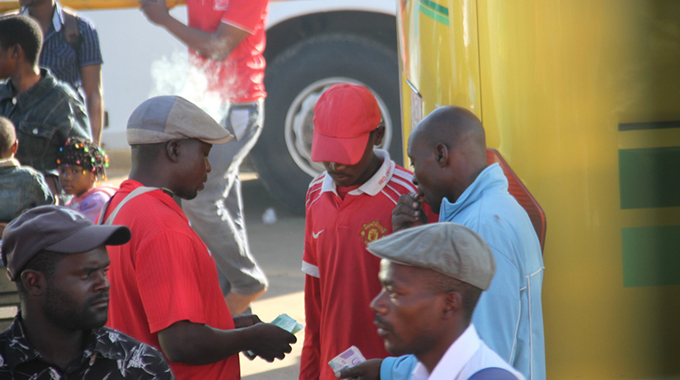
There is a gang of touts which solicits to root for passengers. No wonder they grab passengers’ luggage sometimes; they earn rich pickings.
“The money they get when a bus fills up obviously varies, but at this point, it is around $200 per bus,” said Machingura. “This money is always in cash, these touts are the ones who supply those who sell cash.
“Touts who work on long-distance buses are a different breed from those who work on local vehicles.
Most of them have cars and are building houses. On long-distance buses, three groups make money — drivers, conductors and touts.”
There was no reason to doubt, a simple calculation gives credence to Machingura’s claim.
If a tout can fill 10 buses (which is a conservative figure) a day, it translates to $1 600 in cash a day. The money is however, shared among group members.
Touts mostly work in groups of three or four, earning more than what a large percentage of white collar workers are presently netting on a month.
They have insulation from a smaller, but more powerful group, this is how they can force themselves on any bus that is not part of the ZUPCO fleet.
If touts force themselves on a bus and get arrested, the bus has to pay the fine, which in essence is pocket money for the roving police officers.
On top of the food chain at the rank, there is a group of seemingly vicious men who collect a tax of sorts from everyone.
They are of a convincing built, going against their requests is not an act ordinary men and women would dare attempt.
Besides the muscles, they appear connected to well feared characters who appear immune.
Attempts to glean information only left us with the word “Chairman.” The chairman gets 10 percent of what every bus tickets.
“The money goes to the chairman who says he conveys the money elsewhere, but that is not our business,” said a source at the busy rank.
“Promise me you will not put my picture in your paper. I will be dead meat.”
Further attempts to squeeze out names made those we spoke to restive.
A single bus can ticket around $8 000 per trip and these “bosses” pocket about $800 of that amount.
Once a bus leaves the rank, the terrain gets unpredictable, literally.
Police stops, the Vehicle Inspectorate Department (VID) and more touts await them.
Along our way to Chiredzi, there were three roadblocks and none of those stopped the bus.
There were whispers that the proprietors pay in advance for safe passage, with roadblocks being a preserve of those who run fewer buses.
An incident at the Chivhu Food Court gave a perspective into the corruption which happens on the roads.
One of the passengers on the bus was arrested for public drinking.
Sensing their passenger could be detained, the conductor and the other hanger-on usually called an inspector, facilitated his release.
The police officers had demanded $30, but the lad with a drink ended up paying $20 and pouring his beverage onto the ground.
All this happened behind the police cabin at the Food Court post.
When the bus got to Jerera Growth Point in Zaka, touts again besieged the entrance.
All of them were jostling to get the nod from the bus crew, Chiredzi-bound passengers were squeezing in and most vacant seats were taken up before the negotiations were done.
The touts did not play any part, but demanded their dues before the bus could leave.
From there, there were no other obstacles for the bus crew until we reached Chiredzi.
Operators we spoke to said what we witnessed on the trip to Chiredzi was just but a snippet of what really goes on.
Mr Isiah Mukure of Mukure Tours, which operates 15 buses and kombis on the Harare-Nyamapanda route, said there was more to the clandestine tax than most understand.
In an interview with The Herald, Mr Mukure decried predatory tendencies by police officers who operate at the Simon Vengai Muzenda Street (formerly Fourth Street) rank.
“Our problem begins with Mangongongo (police details who usually wear black), they sometimes make questionable arrests,” he said. “Recently, one of my drivers was arrested when they were buying sadza.
“They were accused of touting. We had to pay because we had passengers who needed to be driven, but up to now I believe he was wrongly arrested.”
Just like in Mbare, at Simon Vengai Muzenda where Mr Mukure’s buses rank, they have their own fair share of extortionist chaos.
“Seeing that there are many who seek to earn a living through helping load buses, we decided to have a dedicated person,” he said.
“The problem is that the arrangement is difficult to sustain because many touts impose themselves.
“They close the door if you tell them not to load your vehicles. At one point I had to take a tout to the police after they had vowed to obstruct passengers until I paid them.”
Touts are said to have police connections.
“I already have a rank disk which I bought for $75 per vehicle per quarter, but I pay an extra $125 a day to the touts,” said Mr Mukure.
“They make it difficult for us. With 15 vehicles, you can imagine how much I pay. In Murehwa when the vehicles rank, they pay another $100.”
After leaving the rank, there is still more money to be paid.
“Then there are police roadblocks dotted along the way who nit-pick for traffic offences, even when the vehicle has all papers,” he said.
“Right now I have a $340 ticket which I am yet to pay that was issued by Murehwa Police Station. They alleged that my vehicle did not have enough papers, when it actually did.”
On a single day, each of his vehicles pay around $600 to the touts. This has in turn thinned his profits.
“Touts are making more money than us who own vehicles,” said Mr Mukure.
“Last week my vehicles (kombis) cashed $300 each after gross earnings of about $1 394, $900 or so goes to these numerous payments.
“This is before wear and tear, staff salaries, and administration costs. Sometimes you are left wondering if it is worth continuing in this business with the current state of affairs.”
Mr Mukure is one of the many hard-pressed operators who are bleeding more than they are gaining by remaining on the country`s highways.
Would it be a long distance trip without a Blessing Shumba soundtrack?
As the buses stealthily tread the bends on our roads, there is a guarantee one of his compositions will be played, especially one ironically titled “Hama”, which has lyrics that talk about “shamwari dzerwendo” (journey companions).
Whether it is poetic coincidence or a case of art failing to imitate life, the lyrics speak of journey mates who are loving and caring.
But bus operators have had it rough with their version of journey companions who bleed them with each rave.
Travellers bear the heavier brunt as the cost is passed on to them.
Both buses we boarded to and from Chiredzi were not full, a sign that numbers of those moving across the country may be subdued as a result of costs; some of which are not supposed to be there in the first place.
Feedback: [email protected]



 Online Reporter