admin
admin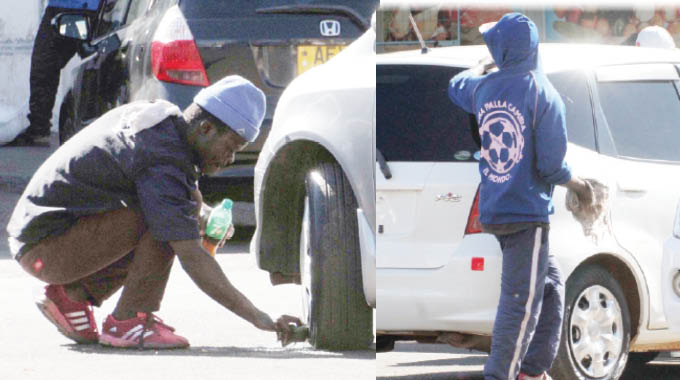
Raymond Jaravaza, Showbiz Correspondent
WITH so much ease and the craftsmanship of a seasoned car wash worker, a 15-year-old polishes an 18-seater omnibus and occasionally steps away a few metres from the vehicle as if to admire and compliment himself for his handiwork.
It’s a busy Thursday afternoon along George Silundika Street and 11th Avenue, an area that has been taken over by illegal money changers (osiphatheleni) and their clients.
Cash — in both local and foreign currency — exchanges hands as if its normal business to sell and buy foreign currency on the black market.
For the youngster whom Saturday Leisure will call Prince to protect his identity since he is a minor, all the money exchanging hands in front of his eyes does not excite him. His young eyes are fixated on the job at hand — spotlessly cleaning an 18-seater omnibus.
After all, his payday and the possibility of extra cash for a job well done is dependent on how good a job he does on the vehicle which belongs to one of the osiphatheleni who conducts his business in the vehicle, away from the prying eyes of law enforcement officers.
“If I do a good job, he will give me 20 bond (RTGS$) for cleaning the kombi inside and outside including polishing the tyres and wiping all the windows. He (owner of the vehicle) trusts me only to clean his car because the other boys steal whatever they find inside and he doesn’t like that,” says Prince.
It’s a school day and judging by his age, Prince should be at school like his peers, not washing cars.
One would assume that the youngster is just a delinquent that ran away from home to live off the streets and do odd jobs or even engage in criminal activity like pick-pocketing and snatching bags on the tough streets of Bulawayo.
“I live with my grandmother and sister in Mzilikazi and I’ve been washing cars here for two years. At first, I used to come here to wash cars before or after school depending on what time our classes started at Sobukhazi High, but now, I work the whole day because I no longer go to school,” he says.
But how did such a youngster with a home to go back to after school and a family that loves him, end up washing cars and dropping out of school?
“I hate school; I was never good at it so what’s the point of dragging myself to class everyday when I don’t even understand what the teachers are saying. It’s better that I come here, make some money and give some of it to my grandmother,” he adds.
There are hordes of children like Prince that roam the streets of Bulawayo asking for permission from vehicle owners to wash their cars for a few dollars. From the area that the teenager operates from to the parking area near Haddon and Sly Supermarket, the parking bays at the Bulawayo Centre and the vicinity around the Bulawayo Market, boys as young as 12 can be seen soliciting to clean vehicles.
It’s easy to dismiss them as street kids, but from the numerous interviews conducted by Saturday Leisure during the course of a week, not all the youngsters live on the pavements of Bulawayo.
The United Nations Children’s Fund (Unicef) categorises street kids in two — home-based and street-based children. Home-based street children are defined as the kids that live at home and generally come to the streets during the day in order to make money. Street-based children are the kids that have left their homes completely for various reasons like domestic violence, poverty or the general breakdown of family life to live permanently on pavements and street corners.
Prince belongs to the first category of street kids — the home-based who forage the streets and avenues of the Bulawayo Central Business District to make money and help take care of his family in Mzilikazi suburb.
What started as a “part time job” cleaning cars now and then has grown into a full time occupation for the teenager.
According to another youngster, it is important to learn the tricks of the trade to survive in the “competitive” business of cleaning cars.
*Mlungisi, a 16-year-old has been cleaning cars along Fife Street and 4th Avenue for over three years and considers himself a “veteran” of the business.
“We all have our regular clients, from cab drivers to some business people who come to buy bulk groceries and beer at Liquor Hub Wholesalers for resale at their shops in the rural areas. They leave their vehicles with us for cleaning while they do their shopping,” the boy narrates.
Because it is illegal to wash vehicles in undesignated places such as parking areas, municipal police officers are always on the lookout for offenders and issue out fines to those caught on the wrong side of the law.
“We don’t use too much water in order not to attract the attention of BCC (Bulawayo City Council) officers and it’s always safe to look for a partner when cleaning a bigger vehicle so that it’s ready when the owner is done shopping,” he says.
He says he makes around RTGS$80 on a good day. Weekends and public holidays are always the most lucrative.
“I have to buy shoe polish for the tyres and cleaning detergents to do a good job so I don’t always spend all the money that I make. Some of the customers pay well while others always complain that we didn’t do a good job, just as an excuse to pay less, but we are used to it,” he adds.
According to Lorraine Mlilo, the programmes manager of Youths in Action — a Bulawayo-based organisation that deals with troubled adolescents, children that start work at an early age are at the risk of social development effects.
“Teenagers who spend more than 20 hours per week working are at a higher risk of developing problematic social behaviours like drug abuse and aggression. Working can also impact a child’s social development because the child spends time working instead of being with peers in social play, at school and learning how to interact properly,” she said.
Mlilo added that spending long hours at work, even part-time, prevents children from developing proper or sound relationships leading to insecure adults who are also at risk of other emotional problems. – @RaymondJaravaza


 Online Reporter