

 admin
admin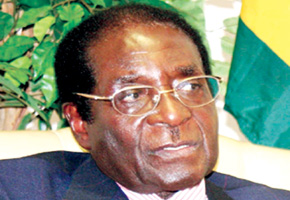
Some of those leaders have defended the Government and instead blamed the indigenous people of the concerned regions such as Matabeleland for their area’s socio-economic deterioration or stagnation.
Speaking at Hwange Colliery recently, President Mugabe said it was not only Matabeleland that was facing socio-economic challenges but other provinces as well.
It is certainly not the wish of the author of this opinion article to enter into a detailed discussion about the causes of the socio-economic deterioration or stagnation of some of the provinces of Zimbabwe.
The thrust of this article is to explain how those who are in the socio-economic leadership in various provinces should pull up their socks and offer “leadership with a responsible socio-economic purpose.”
It is a futile exercise to indulge in debates about whether or not Matabeleland has a better communication infrastructure than, say Mashonaland West or Mashonaland Central, or whichever other province.
The most important thing is to look into ways and means by which to pull the provinces, indeed the whole country, out of the socio-economic backwardness into which it is drifting.
This is characterised by, inter alia, the high level of actual (as opposed to potential) unemployment most noticeable and painfully felt in rural areas. Social development in rural areas is based on primarily three requisites, manpower, management and money.
Whatever the project, those three are basic, with motivation and materials completing the list of necessary factors for the successful prosecution of virtually any project, social, economic, cultural as well as political.
While development in the rural areas (and even in peri-urban and urban centres) is people-driven and people-centred, leadership and guidance come from the usual sources. These are the political and the traditional organisations and centres, that is to say MPs and those representing councils on one side, and village heads (bosebhuku), headmen and chiefs being the traditional voice on the other.
Non-governmental organisations also play a very important role but not at the decision making but at the implementation/ prosecution stage when finance and technical expertise are inevitably required.
It is most important to point out that social development ideas are necessarily initiated by a ward’s or constituency’s or region’s or province’s political leadership working in close liaison with the relevant traditional circles which in some cases, may involve cultural leaders.
It is the duty of a ward’s political leadership to initiate and pilot development as a way to fulfill promises made during campaigning by the electorally successful politicians. Starting with councillors and ending up with MPs, we see and hear everyone of them promising one development project or another while still campaigning.
It is the right of the people to demand the fulfillment of those promises after the politicians have been elected. Many a time we find that the politicians do not seem to know where or how to begin; they appear to be utterly overwhelmed by either their electoral victory, or by the enormity of their promised development projects, or by both.
The best way to handle such development ideas is to delegate responsibility to elected committees. Persons chairing such committees should be given just enough authority that they can convene meetings effectively, it being remembered all the time that responsibility without authority leads to frustration and failure.
Thus, working through various committees, the councillors or MPs can monitor the progress or otherwise of every project. Headmen and chiefs should be given an ex-officio position in each committee, but should not have a vote.
We are dealing with how to organise communities for project prosecution in either a ward or a constituency. Districts and provinces are too large for this structural administrative (committee) approach. We could look at the matter at that level in another article.
At the moment, we are looking at development projects at ward and constituency level, with the area of each headman or chief being treated as one whole administrative territory for development fund-raising purposes. Many reasons are given by various communities for lack of social development in their respective areas. The major reason appears to be lack of finance in virtually every instance.
“This area has no school because it has no money. It has no clinic because it has no money. There is no road from point A to point Z because the community has no money. There are no teachers’ cottages because the community has no money,” and so on.
Meanwhile, there is always a hope or a dream that some donor from abroad will one day descent from the clouds and build a bridge across the Manjori or the Gwembe or the N’homola or the Tjensusu Stream!
Donors were many and eager to assist with funds and expertise for a few years after independence to enable the young nation of Zimbabwe to stand on its own feet.
But now, a whole generation after the attainment of independence, the world expects us to stand up and walk or crawl on our own. Here is how we can and should do it, particularly in the rural areas.
First, social development projects should be identified, sited and costed.
Fund-raising should be based on the traditional leadership structures; village heads (bosebhuku)), headmen and chiefs. If it is a college that the ward or wards, constituency or constituencies have decided to construct, traditional leaders may then be roped in for fund-raising, and be the custodians of the funds.
If chiefs demand as little as R2 from each person per month, a chiefdom or chiefdoms with a population of about 5 000 will raise R10 000 every month, and some R120 000 per year. If the monthly subscription is pegged at R5 per person, the community could be having some R300 000 annually.
If the project is on a short term basis because of its meagre cost, it can be implemented after a year or two. If it is a medium term one, it can be done after five years. Long term projects could be successfully retired after 10 years. It is undoubtedly of great interest to the reader to learn that BaMangwato (now Botswana) was built by the people using the above fund-raising formula in the late 1940s.
If every Zimbabwean rural constituency adopted this self-reliant approach, the country’s face could change in the next 20 years. Projects could include communally owned residential housing schemes.
That is, however, jumping the gun as the choice of projects is a prerogative of the people concerned under the enlightened guidance of the local leadership.
In handling projects, professional management is usually, (if not always) required. That can be hired but with, first and foremost, the aim of training local people to run their own undertakings.
To motivate people in a socio-economic environment such as the current one in Zimbabwe, it is necessary to acquaint them with the prevailing global economic situation, especially the western world’s financial crisis.
They must understand that being independent (as Zimbabwe has been since 18 April 1980) means relying virtually on one’s own resources not only politically but economically, socially and culturally. They must understand that self-reliance is a source of pride whereas external aid demands some form of reciprocity in an open or some other way that directly or indirectly impinges upon one’s sovereignty.
Finally, we look at whether development projects in Zimbabwe would require imported materials. That would depend, of course, on the type of inputs required, but self-reliance as a policy and practice is based on absolute self-sufficiency in all respects, that is to say in human, financial and material resources.
In the construction industry, Zimbabwe is more or less self-sufficient, from foundation to roofing materials. Zimbabwe is without any doubt quite self-sufficient in this regard. We ought to bear in mind that the fact that social economic, cultural and political development projects in the rural areas are meant to create employment primarily for the people residing where the projects are located.
Their initial aim is to create employment for the people who can be referred to as the “owners of the projects.” If some inputs are to be sourced by someone other than the project implementers, the supplier must be local, and so must be the providers of transport services and storage facilities.
This should not, however, be done without due regard to competitive charges, but should be guided by “preference” in order to generate employment as much as possible for the ward or constituency.
If for example, a transport operator from outside the relevant area offers to deliver river or pit sand and or gravel at a much lower cost than a local one, he or she should be given the job. Reasons for such a decision would be quite obvious.
Similarly, the reasons for making headmen and chiefs custodians of development funds are clear: their traditional positions are permanent whereas those of councilors and MPs change according to what we may term “the unpredictable whims of the electorate.”
Another sound reason for entrusting traditional leaders with such funds in Zimbabwe has been created by relatively recent happenings, the unaccountable way some MPs handled their $50 000 respective Constituency Development Fund allocations.
Yet another good reason for keeping political leaders’ hands away from such development funds such as those proposed here are their repeated calls for increases in their allowances, a strange mercenary tendency in people whose duty should be to give and not to sell leadership and service to the people.
Councilors, MPs and Senators have an inalienable responsibility to develop their respective areas by using local resources, human, financial and otherwise. They can and should use traditional leaders as facilitators in the development of their wards and/or constituencies.
*Saul Gwakuba Ndlovu is a Bulawayo-based retired journalist. He can be contacted on either cell 0734328136 or through email [email protected]
Ends.mavhu



 derick.khumalo
 Online Reporter