Online Reporter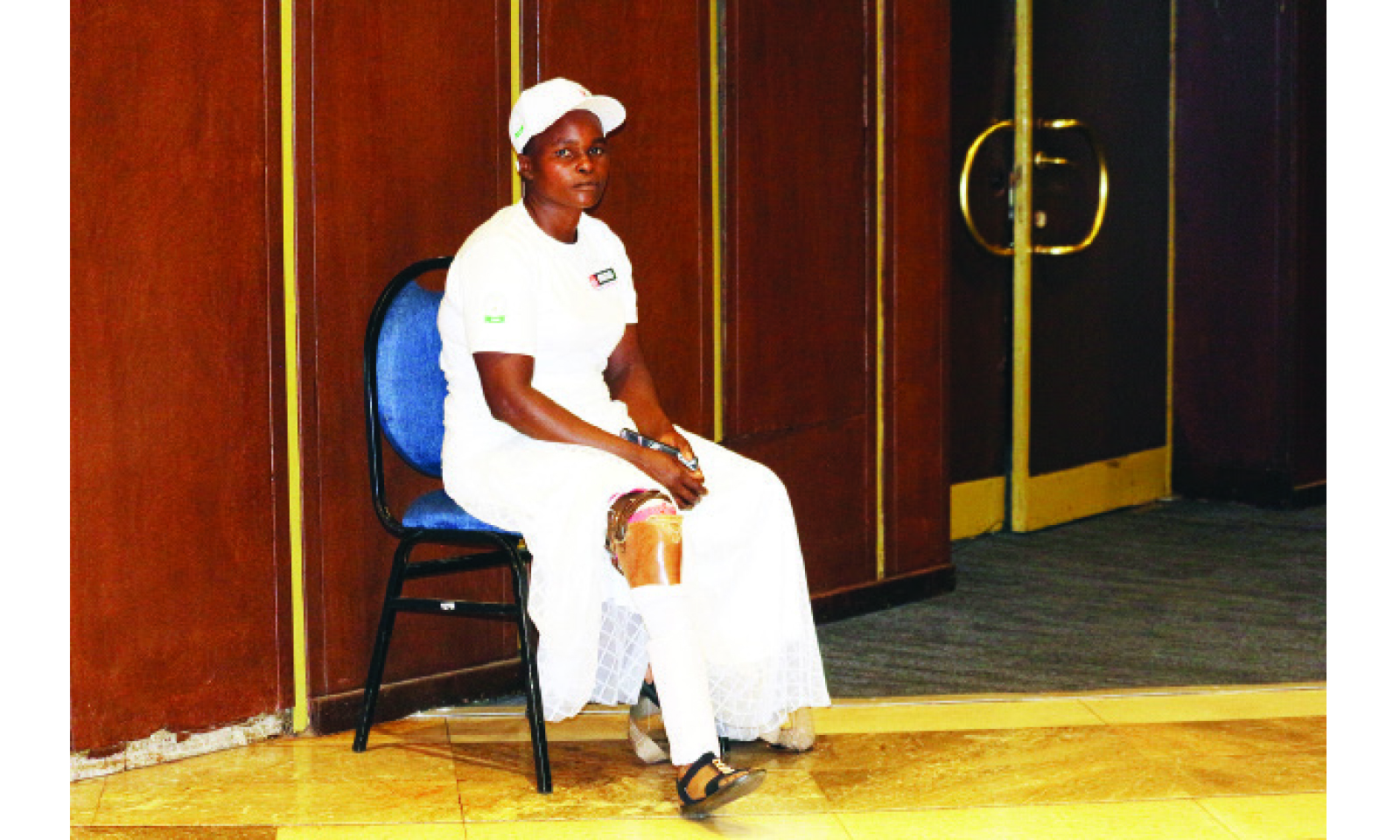
Trust Freddy-Herald Correspondent
While others celebrate Valentine’s Day with flowers, chocolates, and romantic getaways, for Ms Patience Musambidzi (39) of Mutesva Village, Mudzi District, a landmine survivor, it always brings back tears.
Her thoughts are consumed by the devastating event that altered her life forever.
Betrayed by love, forced to abandon breastfeeding her five-month-old, and clinging to life in a hospital bed for five months, Ms Musambidzi’s 17th year became an unforgettable nightmare.
It was February 17, 2003, just three days after Valentine’s Day, when Ms Musambidzi’s life took a drastic turn.
A tragic accident left her with a permanent scar, one that would affect her physically and emotionally for the rest of her life.
The Herald recently met with Ms Musambidzi while attending a three-day dialogue on landmine clearing in Zimbabwe at a Harare hotel.
This reporter met her as she was heading to grab a cup of tea, and she agreed to revisit the painful memories.
“Twenty-two years have passed, but the wounds of that fateful day remain etched in my heart,” she said.
Ms Musambidzi’s enduring wish is for former colonial powers to provide reparations for the harm caused by Rhodesian forces’ landmines.
“Independence was won, but we are not yet free,’ she said. “I believe it’s time for those responsible to acknowledge and compensate us for our suffering.”
The memory of that fateful day remains etched in her mind like a scar.
Her eyes cloud over as she recounted the events of that day.
“And then I realised . . . I had lost my leg,” these were her chilling words, recounting how the landmine left her with a trauma that still lingers 22 years later.
“Yes, I only found out after one straight week that I had lost my leg,” she added, her eyes welling up with tears.
As she regained consciousness in the hospital, Ms Musambidzi’s thoughts were consumed by fear and uncertainty.
“But where am I? How did I come here?” she recalled thinking.
“And where is my five-month-old daughter?” The thought of her child’s safety added to her distress.
At that point, the 39-year-old woman was at Harare Central Hospital (now Sally Mugabe Central Hospital), and she was quickly briefed by the nurses about how she had stepped on a landmine, was rushed to Kotwa District Hospital, and then immediately transferred to Harare.
What made her situation even more dire was the distance she had travelled from Mudzi to Harare Hospital, miles away from her home.
As Ms Musambidzi shared her story, she took a deep breath and buried her face in her palms.
“I am slowly healing, but I am still in pain,” she said, sniffing back tears.
According to the Mudzi-born woman, on that fateful day, she was following her husband to the maize field when the incident occurred.
“One moment I was walking, the next I was flying,” she recounted.
Her daily routine to the maize field had turned into a nightmare
“That’s the only thing I still remember; I don’t know how I landed.”
Her husband, who had been working ahead of her, rushed to her side after hearing the explosion and found her lying lifeless.
The landmine survivor was told that she had already lost her leg by the time her husband reached her.
He rushed her to Kotwa District Hospital, a local hospital and from there, she was referred to Harare Hospital.
She remained unconscious throughout the ordeal and only regained consciousness in Harare after a week.
After regaining consciousness, she spent five months in bed, recovering from her injuries.
When she finally began to heal, Ms Musambidzi was forced to confront the harsh reality of her new circumstances.
“But I kept asking myself, why me? The pain was unbearable,” she added.
The pain and trauma of the incident were compounded by the fact that she had to stop breastfeeding her five-month-old daughter due to her prolonged hospital stay.
After five months, Musambidzi returned to her village, relying on clutches to walk.
However, she soon realised that she could no longer work as she had before.
The fear of losing her husband due to her disability haunted her.
Her worst fears were confirmed when her husband eventually left her, due to pressure from relatives.
“I was left alone,” she said, her voice cracking with emotion.
“At first, he seemed to have understood my new condition, but he later succumbed to pressure from his relatives, who kept saying ‘you cannot live with a disabled wife’, and disappeared for a whole year.”
She said her husband would send messages, but it was clear he was no longer interested.
The pain of losing both her leg and her husband was too much to bear.
However, in 2004, Ms Musambidzi’s life took a turn for the better.
While walking with crutches in Kotwa town, she met an official from the Social Welfare Department, who informed her about the possibility of obtaining a prosthetic leg.
“It happened that I was walking near the Government complex in Kotwa when a lady, who identified herself as Sister Faith, approached me and said, ‘You are still young, you can get a prosthetic leg.”
This marked the beginning of her assistance and underwent the necessary procedures and eventually received an artificial limb.
“I think that was divine intervention, as Sister Faith worked in the Department of Social Welfare.
She took all my records and referred me to Harare, where additional documents were submitted to Jairosi Jiri and other offices, until I eventually received a cheque. I used this cheque to obtain a prosthetic leg at Parirenyatwa Hospital.”
The same team from the social welfare department also helped counsel her husband, and eventually, he returned to her.
“I am very grateful that, out of love, my husband agreed to come back, and we are now happily living together.”
Today, Ms Musambidzi and her husband have six children, and they are at peace.
The Mudzi born child, who has had three prosthetic legs since 2004, is grateful for the assistance she has received from the Government.
“I am forever grateful to the Government for assisting me in obtaining a prosthetic leg, and with the officials’ assistance, I have been able to replace it three times.”
However, she is optimistic as all landmine victims will soon be entitled to receive compensation, regardless of when the incident occurred, as the Government fast-tracks the amendment to the War Victims Compensation Act.
Previously, the Act only catered for victims who were injured before March 1, 1980, excluding those who suffered injuries after the cut-off date.
“I am glad that the Government has invited us, as victims, to participate in this dialogue, and I hope that very soon I will start receiving the compensation I am due.”
Despite the current condition, her greatest wish is to have well-wishers visit her village to drill a borehole for her, as she hopes to venture into full-time farming.
“I still have the ability to undertake various income-generating projects, and I strongly feel that if anyone could assist me by drilling a borehole, I could devote myself to farming full-time.”
Though she is slowly healing, 22 years later, the trauma of the incident still lingers.
“I don’t want to hear any sound,” she said, her eyes wide with fear.
“Even if a fork or spoon falls and makes a sound, I shiver,” she added.
The country has so far made some notable strides in clearing landmines planted during the liberation war, with over 96 percent of contaminated land now safe for communities.
However, a funding shortfall of US$23,79 million threatens to delay the country’s goal of becoming mine-free by 2028.
According to latest report, only 12 square kilometres of land remain contaminated with landmines, down from approximately 310 000 square kilometres at independence.
The minefields, planted by the Rhodesian Colonial Forces in the 1970s, transcended six provinces, including Matabeleland North, Mashonaland West, Mashonaland Central, Mashonaland East, Manicaland, and Masvingo.